Polyphron and Cellino Publish Cross-Donor Tissue Engineering Results, Demonstrating Reproducible Manufacturing Across Genetically Diverse Patient Lines
Polyphron, a company building an autonomous tissue foundry for engineering functional human tissues, today published results from its collaboration with Cellino showing that Polyphron's platform can manufacture structured human tissue across genetically diverse, patient-derived iPSC lines without re-optimizing from scratch for each new donor. Full results are available at polyphron.com/research.
This press release features multimedia. View the full release here: https://www.businesswire.com/news/home/20260407344874/en/
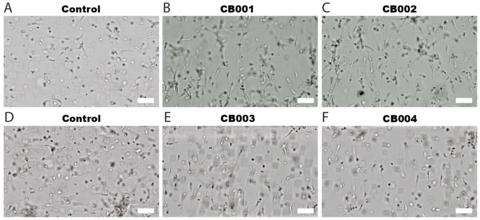
Reproducible neuronal alignment across donor iPSC lines. Bright-field images of neuronal constructs. (A, D) Control conditions (no perturbations). (B, C, E, F) Aligned conditions. Scale bar 50µM. Image credit: Polyphron
The study addresses the donor variability problem, a central bottleneck to autologous tissue manufacturing. Patient-derived stem cells behave differently depending on the donor's genetic background, meaning a fixed manufacturing protocol that works for one patient can fail for the next. Polyphron's results show this variability is structured and computationally navigable, not a fundamental barrier to scale.
Cellino manufactured four clonal iPSC lines from demographically diverse donors using its FDA AMT-designated automated optical bioprocess. Polyphron differentiated all four lines into 3D neural tissue and used its closed-loop optimization platform to engineer a key structural feature to defined tolerances across every genetic background. Gene expression profiling confirmed over 2,000 differentially expressed genes between lines at baseline, yet the platform converged on high-performing tissue in all cases.
Rather than running exhaustive screens for each new patient line, Polyphron's platform transferred what it learned from well-characterized reference donors to predict optimal manufacturing conditions for newly onboarded lines from a fraction of the data. Two lines were mapped densely. Two were given deliberately sparse coverage. Predictions were confirmed prospectively across all four. One donor exceeded Polyphron's optimized reference standard. Another matched it. The platform identified optimal conditions for a third donor, including conditions that line had never previously encountered in the lab.
To Polyphron's knowledge, this is the first prospective demonstration of computational cross-donor optimization for 3D tissue structure from sparse data.
These results extend a prior demonstration that the platform generalizes across tissue types. The same computational infrastructure now transfers across both tissue contexts and patient genotypes with no architectural changes.
"These results reframe donor variability from an unsolvable manufacturing obstacle into a structured, computational problem," said Matthew Osman, CEO and Co-Founder of Polyphron. "We reduced the optimization burden from hundreds of conditions to tens and delivered tissue that met or exceeded our reference standard across every donor we tested. The unit economics of autologous tissue manufacturing just changed."
"Cellino produces patient-derived cells with industrial consistency, and Polyphron engineers them into reproducible functional tissue. We started this collaboration less than 90 days ago, I have never known a team work so quickly as Polyphron. Together, we are proving that genetic diversity is a programmable variable, not a barrier to scale," said Nabiha Saklayen, Ph.D., CEO and Co-Founder of Cellino.
The two companies plan to expand the collaboration across the coming months.
About Polyphron
Polyphron is building an autonomous tissue foundry to make human tissue reproducible, scalable, and manufacturable. Its platform uses closed-loop optimization and non-destructive phenotyping to reliably converge on native-like tissue structure across contexts, replacing bespoke laboratory protocols with quality-controlled manufacturing. Learn more at www.polyphron.com.
About Cellino
Cellino builds manufacturing infrastructure for personalized regenerative medicine, from iPSC production through tissue and organ replacement. The company's platform enables the production of patient-derived cells with industrial-scale precision and reliability. Cellino has received an FDA Advanced Manufacturing Technology designation. Cellino’s Nebula™ platform is designed specifically to overcome key bottlenecks in personalized cell manufacturing. Nebula™ is an autonomous, AI-driven biomanufacturing technology that automates the iPSC generation process within a compact, patient-specific cassette. Learn more at www.cellinobio.com.
View source version on businesswire.com: https://www.businesswire.com/news/home/20260407344874/en/
Contacts
Media Contact
Kimberly Ha
KKH Advisors
917-291-5744
kimberly.ha@kkhadvisors.com