Open standards and edge-driven automation accelerate seamless industrial communication worldwide
NEWARK, DE / ACCESS Newswire / March 23, 2026 / The global Controller to Device Interoperability Market is witnessing sustained expansion as industrial ecosystems transition from isolated machine architectures to fully connected, data-driven environments. According to Future Market Insights (FMI), the market, valued at USD 22.8 billion in 2026, is projected to reach USD 40.5 billion by 2036, registering a CAGR of 5.9%.
This growth is primarily fueled by the urgent need to eliminate inefficiencies caused by fragmented factory networks. Manufacturers are increasingly adopting standardized communication protocols and interoperable frameworks to ensure seamless data exchange between programmable logic controllers (PLCs) and diverse field-level devices.
Get Access of Report Sample: https://www.futuremarketinsights.com/reports/sample/rep-gb-32175
Industrial Transformation: Breaking Down Data Silos
Modern manufacturing facilities are rapidly moving away from proprietary systems toward vendor-agnostic, interoperable architectures. Traditional point-to-point connections limit scalability and data visibility, prompting organizations to deploy intelligent field networks capable of real-time communication.
Key drivers accelerating adoption include:
Rising complexity of multi-vendor production environments
Demand for real-time operational intelligence
Increasing deployment of Industrial IoT (IIoT) devices
Need for predictive maintenance and downtime reduction
Industry experts emphasize that integrating standardized middleware directly into controllers is eliminating costly custom engineering processes while enhancing system efficiency.
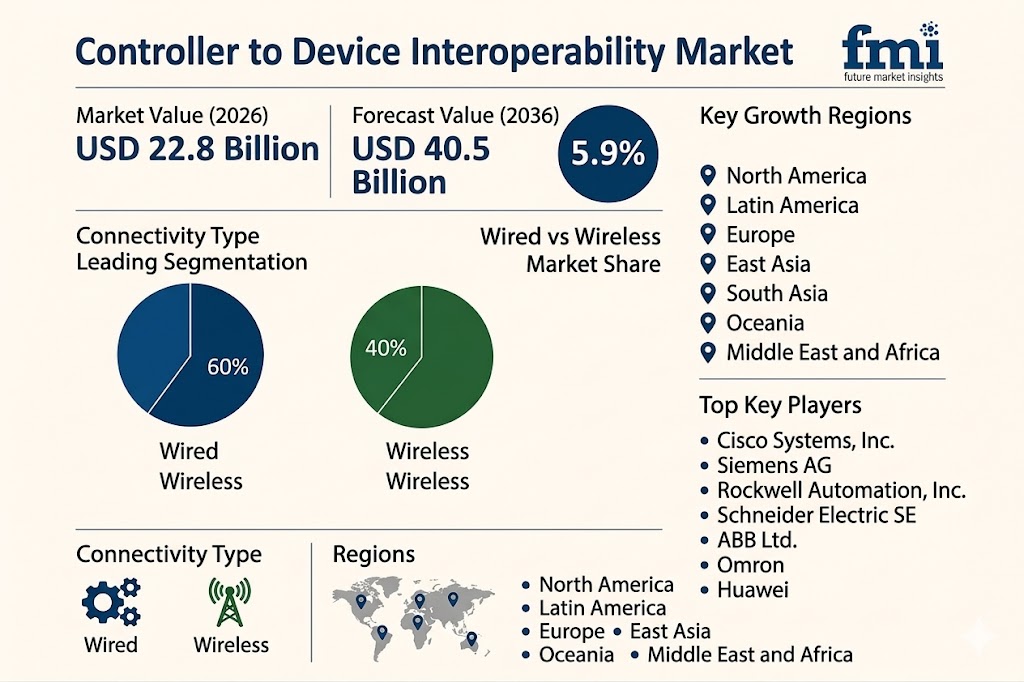
Market Metrics Snapshot (2026-2036)
Metric |
Details |
|---|---|
Industry Size (2026) |
USD 22.8 Billion |
Forecast Value (2036) |
USD 40.5 Billion |
Projected CAGR |
5.9% |
Leading Segment |
Hardware (60% Share) |
Top Connectivity Type |
Wired (71% Share) |
Edge Computing and Open Standards Reshaping the Market
The convergence of edge computing and open industrial protocols is redefining interoperability across manufacturing ecosystems. Frameworks such as OPC UA are enabling semantic data exchange, allowing machines to communicate with minimal latency and maximum reliability.
Recent advancements include:
Firmware-level interoperability embedded in controllers
AI-ready architectures supporting real-time analytics
Standardized data models improving IT/OT convergence
Cloud connectivity enabling enterprise-wide visibility
These innovations are driving a paradigm shift where controllers act not just as automation tools but as intelligent data hubs within connected factories.
Segment Insights: Hardware and Ethernet Protocols Dominate
The market structure reflects strong demand for high-performance infrastructure:
Hardware segment leads with 60% share, driven by large-scale replacement of legacy gateways and network modules
Industrial Ethernet protocols account for 47% share, as high-bandwidth applications surpass traditional serial communication systems
Wired connectivity dominates with 71% share, ensuring deterministic performance in safety-critical operations
These segments highlight the critical role of robust, secure, and high-speed communication systems in modern industrial automation.
Regional Outlook: Asia Pacific Leads Growth Momentum
Regional analysis indicates strong global demand, with Asia Pacific emerging as the fastest-growing hub:
China (7.2% CAGR): Driven by state-backed smart manufacturing initiatives and large-scale industrial modernization
India (6.9% CAGR): Growth supported by greenfield manufacturing projects and infrastructure investments
Brazil (6.0% CAGR): Increasing adoption in legacy system upgrades
United States (5.2% CAGR): Strong demand from energy and automotive sectors
Germany (4.8% CAGR) & UK (4.3% CAGR): Focus on Industry 4.0 compliance and secure automation
This regional expansion underscores the global push toward unified industrial communication frameworks.
Challenges: Cybersecurity and Legacy System Integration
Despite robust growth, the market faces several challenges:
Cybersecurity risks: Increasing exposure of operational technology (OT) systems to cyber threats
Legacy infrastructure: High cost and complexity of upgrading outdated systems
Standardization gaps: Variability in protocol adoption across regions
Integration complexity: Difficulty in harmonizing multi-vendor ecosystems
Organizations are addressing these challenges through secure network architectures, strict compliance standards, and phased modernization strategies.
Competitive Landscape: Strategic Innovation at the Core
Leading players are focusing on interoperability-driven innovation and strategic partnerships to strengthen market position. Key companies include:
Cisco Systems
Siemens AG
Rockwell Automation
Schneider Electric
ABB Ltd.
Omron
Huawei
These organizations are investing in AI-enabled automation, edge computing, and standardized communication platforms to meet evolving industrial demands.
Future Outlook: Interoperability as a Foundation for Smart Manufacturing
By 2036, controller to device interoperability will become a core pillar of smart manufacturing ecosystems. As factories scale digital transformation initiatives, seamless communication between devices will be essential for achieving operational efficiency, agility, and resilience.
The integration of AI, digital twins, and cloud-based analytics will further amplify the importance of interoperable systems, positioning this market at the heart of the next industrial revolution.
For an in-depth analysis of evolving formulation trends and to access the complete strategic outlook for the Controller to Device Interoperability Market through 2036, Full Report Request: https://www.futuremarketinsights.com/reports/controller-to-device-interoperability-market
Related Reports:
DC Motor Control Devices Market- https://www.futuremarketinsights.com/reports/dc-motor-control-devices-market
Industrial AGV Swarm-Management Software Market- https://www.futuremarketinsights.com/reports/industrial-agv-swarm-management-software-market
Industrial DataOps Market- https://www.futuremarketinsights.com/reports/industrial-dataops-market
About Future Market Insights (FMI)
Future Market Insights (FMI) is a leading provider of market intelligence and consulting services, serving clients in over 150 countries. Headquartered in Delaware, USA, with a global delivery center in India and offices in the UK and UAE, FMI delivers actionable insights to businesses across industries including automotive, technology, consumer products, manufacturing, energy, and chemicals.
An ESOMAR-certified research organization, FMI provides custom and syndicated market reports and consulting services, supporting both Fortune 1,000 companies and SMEs. Its team of 300+ experienced analysts ensures credible, data-driven insights to help clients navigate global markets and identify growth opportunities.
For Press & Corporate Inquiries
Rahul Singh
AVP - Marketing and Growth Strategy
Future Market Insights, Inc.
+91 8600020075
For Sales - sales@futuremarketinsights.com
For Media - Rahul.singh@futuremarketinsights.com
For web - https://www.futuremarketinsights.com/
SOURCE: Future Market Insights, Inc.
View the original press release on ACCESS Newswire