Rapid growth driven by demand for modular cabin designs, high asset utilization, and seamless transition between passenger and cargo operations in urban air mobility
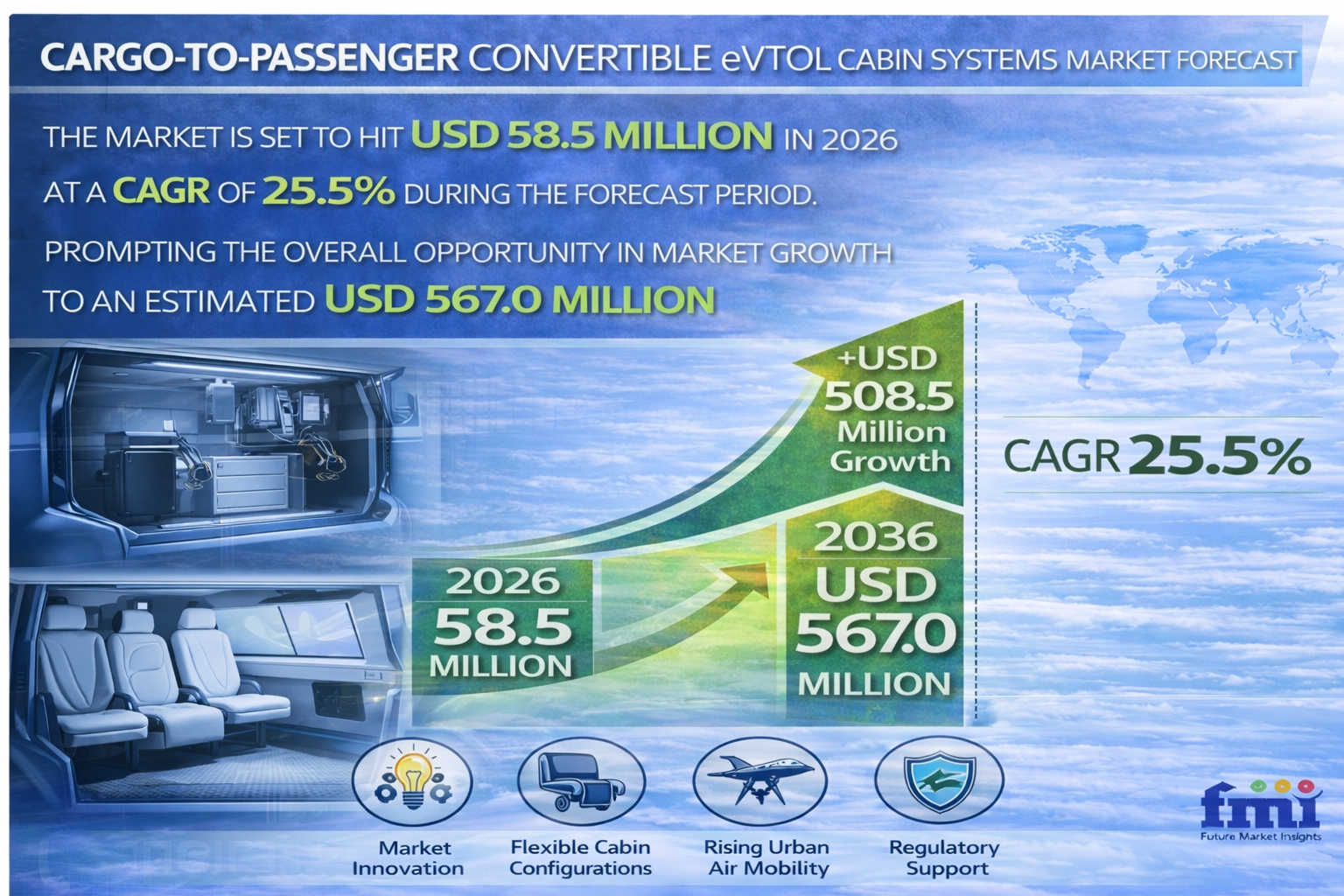
NEWARK, DE / ACCESS Newswire / March 31, 2026 / The global cargo-to-passenger convertible eVTOL cabin systems market is entering a high-growth phase as urban air mobility (UAM) operators prioritize asset utilization and dual-revenue generation. Valued at USD 46.6 million in 2025, the market is projected to reach USD 58.5 million in 2026 and surge to USD 567.0 million by 2036, registering a remarkable CAGR of 25.5% during the forecast period.
This rapid expansion reflects a fundamental shift in next-generation aviation economics, where single-mission aircraft models are no longer viable. As operators face high upfront capital costs and battery lifecycle constraints, modular cabin systems that enable seamless conversion between passenger and cargo operations are becoming mission-critical to achieving profitability.
Get Access of Report Sample:
https://www.futuremarketinsights.com/reports/sample/rep-gb-32481
Market Value Analysis: Dual-Use Economics Driving Cabin Innovation
Between 2026 and 2030, the cargo-to-passenger convertible eVTOL cabin systems market is expected to witness accelerated adoption as fleet operators demand maximum daily utilization of aircraft assets. Traditional single-purpose configurations are being replaced by flexible interior systems that allow rapid reconfiguration based on real-time demand.
Operators are increasingly prioritizing:
Quick-swap modular cabin systems enabling rapid mission transitions
Lightweight seating and cargo modules optimized for dual certification
Tool-less attachment mechanisms to minimize turnaround time
Integrated cabin layouts supporting both logistics and passenger comfort
Failure to implement efficient conversion systems forces operators to maintain larger fleets, significantly increasing capital expenditure and reducing operational efficiency.
From 2030 to 2036, growth will be driven by regulatory standardization of modular cabin certification and the scaling of commercial eVTOL operations across urban and regional networks.
Technology Evolution: Modular Design and Smart Integration Transform Cabin Systems
The evolution of convertible eVTOL cabin systems is being shaped by advancements in lightweight materials, mechanical engineering, and smart cabin technologies. As aircraft utilization targets exceed 12-14 flight hours per day, conversion speed and durability become critical performance metrics.
Key innovations include:
Quick-release seat rail and cargo floor systems for rapid reconfiguration
Fold-flat and removable seating modules with crash-certified designs
Smart sensor-enabled floor panels for real-time weight distribution analysis
Acoustic shielding systems for cargo operations in urban environments
AI-enabled cabin monitoring systems for cleanliness and safety compliance
A major challenge lies in balancing durability with weight efficiency. Cabin components must withstand frequent handling and reinstallation while maintaining strict payload limitations.
An industry analyst notes:
"In urban air mobility, profitability is not defined by passenger load factors alone, but by how efficiently an aircraft transitions between missions. Conversion speed is emerging as the single most important operational variable."
Cabin Modularity Becomes Core to eVTOL Fleet Profitability
As the eVTOL ecosystem matures, convertible cabin systems are emerging as essential enablers of commercial viability. These systems allow operators to dynamically respond to fluctuating demand patterns across passenger and cargo segments.
Key capabilities include:
Rapid conversion between passenger and cargo configurations
Optimization of aircraft utilization across peak and off-peak hours
Reduction in idle time during low passenger demand periods
Enhanced revenue streams through logistics integration
Improved operational flexibility across diverse mission profiles
This shift is redefining competitive dynamics, where cabin system performance directly impacts fleet economics, operational efficiency, and return on investment.
Segment Spotlight
Quick-Swap Cabin Systems Lead Configuration (34.0%)
Fast turnaround capabilities drive adoption of modular seat-rail and cargo-floor systems.
Seats and Restraint Systems Lead Components (27.0%)
High certification complexity and safety requirements dominate demand.
Lift-Plus-Cruise Platforms Lead Architecture (46.0%)
Optimal balance between payload capacity and cabin flexibility supports modular designs.
Dual-Use Fleets Lead End Use (39.0%)
Operators prioritize combined passenger and logistics applications.
OEM Line-Fit Integration Leads Sales Channel (72.0%)
Structural integration during manufacturing ensures certification compliance and cost efficiency.
Regional Insights: Emerging Markets and Regulatory Agility Drive Adoption
The cargo-to-passenger convertible eVTOL cabin systems market is expanding rapidly across regions with progressive regulatory frameworks and strong urban mobility initiatives.
Country |
CAGR (2026-2036) |
Key Growth Drivers |
|---|---|---|
China |
29.4% |
Early cargo flight approvals and rapid commercialization |
Brazil |
28.3% |
Transition from helicopter networks to electric fleets |
United Arab Emirates |
27.8% |
Smart-city initiatives and autonomous transit integration |
United States |
27.1% |
Defense-backed R&D and urban air mobility investments |
Japan |
24.7% |
Specialized logistics and regional connectivity needs |
United Kingdom |
23.9% |
Regional mobility and medical logistics demand |
Germany |
23.4% |
Advanced manufacturing and modular engineering expertise |
Regional growth is strongly influenced by regulatory timelines, infrastructure readiness, and early adoption of cargo-first operational models.
Opportunities: Smart Cabin Systems and Automation Unlock Future Growth
Key opportunities shaping the market include:
Development of autonomous cargo loading interfaces
Integration of smart sensor grids for real-time weight and balance monitoring
Advanced acoustic and environmental control systems for mixed-use operations
Expansion of AI-driven cabin diagnostics and predictive maintenance
Standardization of modular cabin interfaces across OEM platforms
These innovations are enabling scalable, efficient, and highly adaptable cabin systems tailored for next-generation urban air mobility networks.
Competitive Landscape: Certification and Modularity Define Market Leadership
The cargo-to-passenger convertible eVTOL cabin systems market is characterized by a competitive landscape where certification readiness and engineering precision outweigh traditional manufacturing scale.
Leading companies include:
BETA Technologies
Eve Air Mobility
Diehl Aviation
RECARO Aircraft Seating
Astronics
Supernal
EHang
Competitive differentiation is driven by:
Certification-compliant modular cabin designs
Advanced quick-release and lightweight engineering solutions
Integration with OEM airframe architectures
Durability and lifecycle cost optimization
Ability to support high-frequency operational cycles
Future Outlook: Convertible Cabin Systems Become Essential to UAM Scaling
Looking ahead to 2036, cargo-to-passenger convertible cabin systems will become a foundational component of urban air mobility operations.
Key trends include:
Standardization of modular cabin certification frameworks
Increased adoption of dual-use fleet strategies
Integration of smart and autonomous cabin technologies
Expansion of logistics-driven revenue models
Alignment of cabin system performance with fleet profitability metrics
As the industry scales toward widespread commercial deployment, convertible eVTOL cabin systems will evolve from optional features to essential infrastructure-defining the operational and economic success of next-generation aerial mobility.
For an in-depth analysis of evolving formulation trends and to access the complete strategic outlook for the Cargo-to-Passenger Convertible eVTOL Cabin Systems Market through 2036, visit the official report page at: https://www.futuremarketinsights.com/reports/cargo-to-passenger-convertible-evtol-cabin-system-market
Browse More Automotive Industry Reports:
Aircraft Gearbox Market - https://www.futuremarketinsights.com/reports/aircraft-gearbox-market
Two-Wheeler Aftermarket Components & Consumables Market - https://www.futuremarketinsights.com/reports/two-wheeler-aftermarket-components-market
One-Pedal Brake Control Modules Market - https://www.futuremarketinsights.com/reports/one-pedal-brake-control-modules-market
Low-Noise Low-Dust EV Brake Components Market - https://www.futuremarketinsights.com/reports/low-noise-low-dust-ev-brake-components-market
Regenerative Brake Calibration Services Market - https://www.futuremarketinsights.com/reports/regenerative-brake-calibration-services-market
About Future Market Insights (FMI)
Future Market Insights (FMI) is a leading provider of market intelligence and consulting services, serving clients in over 150 countries. Headquartered in Delaware, USA, with a global delivery center in India and offices in the UK and UAE, FMI delivers actionable insights to businesses across industries including automotive, technology, consumer products, manufacturing, energy, and chemicals.
An ESOMAR-certified research organization, FMI provides custom and syndicated market reports and consulting services, supporting both Fortune 1,000 companies and SMEs. Its team of 300+ experienced analysts ensures credible, data-driven insights to help clients navigate global markets and identify growth opportunities.
For Press & Corporate Inquiries
Rahul Singh
AVP - Marketing and Growth Strategy
Future Market Insights, Inc.
+91 8600020075
For Sales - sales@futuremarketinsights.com
For Media - Rahul.singh@futuremarketinsights.com
For web - https://www.futuremarketinsights.com/
SOURCE: Future Market Insights, Inc.
View the original press release on ACCESS Newswire