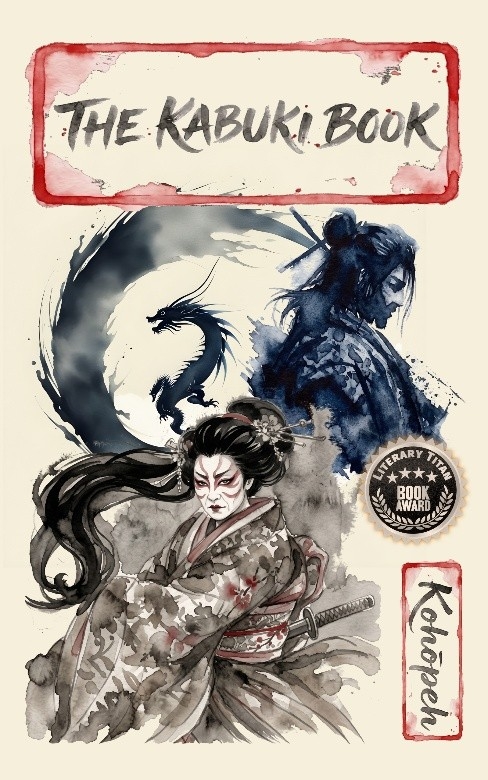
United States - August 22nd, 2026 - Kohōpeh’s historical fantasy novel The Kabuki Book has received the Literary Titan Book Award, recognizing a daring and ambitious work that explores the origins of kabuki through the lives of artists, outcasts, warriors, and mythic beings struggling against systems determined to silence them.
Set in Kyōto at the dawn of the Tokugawa Shogunate, The Kabuki Book follows Okuni, an exiled shrine maiden who arrives on the dry Kamo riverbed with little more than a tambourine and a refusal to disappear. Gathering hookers, marginalized artists, and social outcasts around her, she creates a new form of performance filled with exuberance, satire, and resistance. Her art gives voice to people pushed outside accepted society while drawing the attention of an increasingly restrictive regime.
Beside her is Niten, a scarred swordsman destined to become the legendary Miyamoto Musashi. Haunted by violence and searching for the philosophical “Void,” Niten discovers in Okuni’s art a reflection of his own transformation from killer to architect, artist, teacher, and thinker. Their relationship develops through arguments and conversations about art, faith, violence, desire, social rank, and personal freedom.
The novel expands beyond historical fiction into Shintō-inspired fantasy. Okuni’s creativity is powered by a divine life force, placing her artistic rebellion within a larger conflict involving gods, spirits, political institutions, and centuries of contested memory. Kohōpeh uses this mythic framework to examine how official histories are shaped, whose stories survive, and how marginalized creators can leave cultural legacies that authority cannot fully erase.
Literary Titan praised the novel as “an ambitious blend of historical fiction, Japanese folklore, philosophical adventure, and speculative fantasy,” highlighting Okuni as its most compelling presence and recognizing the book’s wide-ranging engagement with gender, class, theology, memory, and historical interpretation. The review also commended the novel for transforming kabuki into more than entertainment, presenting performance as a way of claiming space, gathering community, and resisting erasure.
For Kohōpeh, the novel began with the contrast between two extraordinary historical figures: the disciplined swordsman Miyamoto Musashi and Izumo no Okuni, the wandering shrine maiden associated with the birth of kabuki. That juxtaposition became a way to explore “the friction between the official history written by the rulers and the fragile, lived history of people on the margins,” while connecting the origins of kabuki to enduring questions of autonomy and resistance.
Blending visceral historical detail with folklore, spirituality, and speculative storytelling, The Kabuki Book offers readers an expansive meditation on creativity, survival, cultural memory, and the people who refuse to be erased.
Readers can discover the award-winning The Kabuki Book and experience Kohōpeh’s sweeping vision of art, mythology, resistance, and historical memory by purchasing the novel through Amazon and Barnes & Noble. Readers of immersive historical fantasy, Japanese folklore, philosophical fiction, and stories about marginalized creators challenging entrenched systems will find a bold and unconventional journey through the origins and legacy of one of Japan’s most influential art forms.
About the Author
Kohōpeh is an award-winning author based in Southeast Asia. Their historical and speculative fiction explores the intersections of linguistics, systemic power, and human autonomy. Currently, Kohōpeh splits their time between publishing several books, with attendant marketing, adapting Thai oral tales, and researching times and locales for several new books at once.
Media Contact
Company Name: Literary Titan
Contact Person: Kohopeh
Email: Send Email
Country: United States
Website: https://kohopeh.com