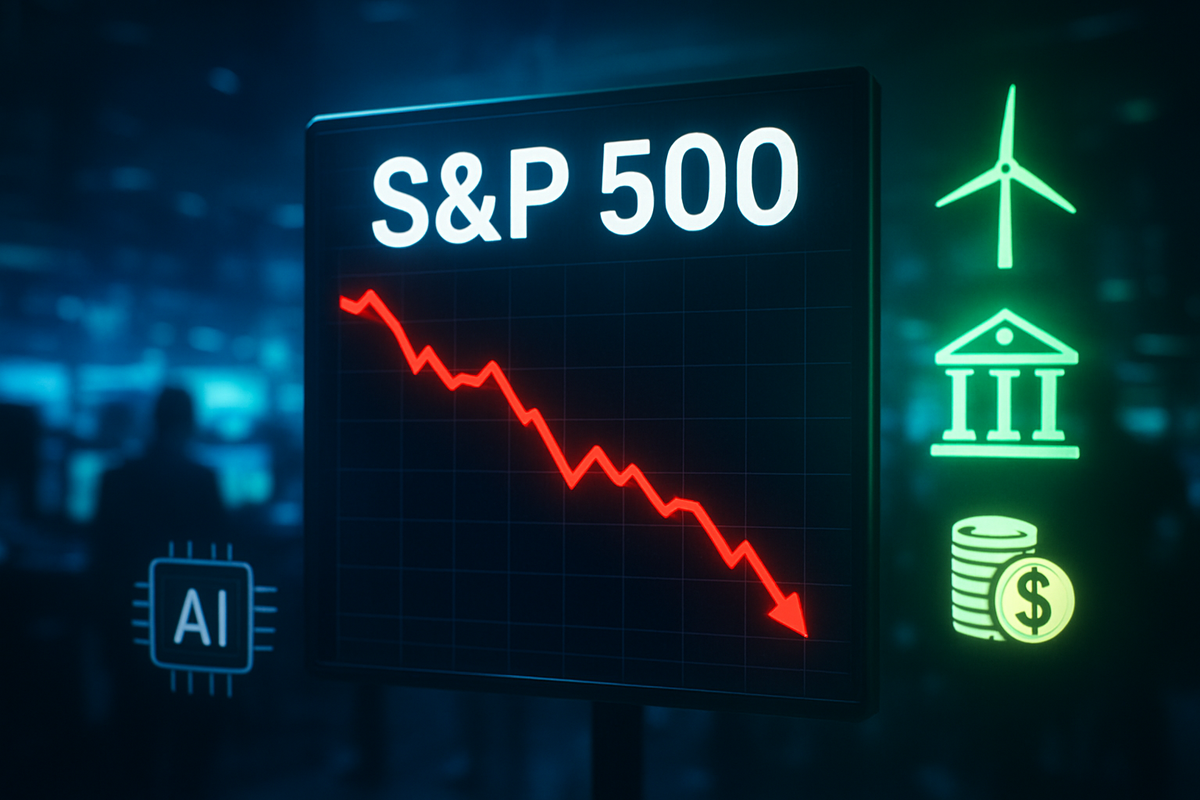
The final trading week of 2025 has opened with a decisive shift in market sentiment, as the S&P 500 index saw a sharp pullback on Monday, December 29. After a year defined by relentless growth and several historic milestones, investors are aggressively selling off high-flying technology names to lock in profits, leading to a broader market retreat that signals a cautious transition into the new year.
This late-December sell-off saw the S&P 500 fall approximately 1.4% in a single session, primarily weighed down by a 2.5% slide in the technology sector. The movement represents a significant cooling period following the index's all-time intraday high of 6,921.44 reached just days ago on December 24. As the "AI gold rush" of 2024 and 2025 matures into a more discerning market environment, the sudden exodus from tech suggests that even the most dominant players are not immune to valuation exhaustion.
The Peak and the Pivot: A Timeline of the Year-End Retrenchment
The market's current volatility follows a period of extraordinary momentum. Entering 2025, the S&P 500 was already riding high after closing 2024 above the 6,000 mark. Throughout the past twelve months, the index has delivered a total return of nearly 19%, marking its third consecutive year of double-digit gains—a feat not seen since the late 1990s. However, the air grew thin at these heights; by late December, the S&P 500’s price-to-earnings (P/E) multiple exceeded 22x, a level that many institutional analysts warned was "priced for perfection."
The catalyst for Monday's sell-off appears to be a combination of tax-loss harvesting and a strategic "Great Rotation" out of growth stocks and into value-oriented sectors. While the week leading up to Christmas saw a "Santa Claus rally" that pushed the index to its 6,921 peak, the reopening of markets on December 29 brought a wave of institutional selling. Large-scale fund managers, looking to preserve their 2025 performance metrics, began offloading overextended positions in the "Big Three" and other AI-adjacent firms.
Key players in this shift include major institutional desks at firms like Goldman Sachs and J.P. Morgan, who have spent the fourth quarter advising clients to rebalance toward "cash-flow" sectors. The initial reaction from the floor of the New York Stock Exchange was one of orderly but persistent selling, as the tech-heavy Nasdaq Composite also saw a decline of over 2%, trailing the broader S&P 500 as the market’s appetite for high-beta growth finally hit a wall.
Winners and Losers in the Year-End Shuffle
The primary casualties of this pullback are the titans that carried the market for much of the year. NVIDIA Corporation (NASDAQ: NVDA), which briefly touched a staggering $5 trillion market capitalization in October, saw its shares slide 3.8% on Monday. Despite the drop, the company remains a juggernaut with record fiscal year revenue of $187.1 billion, but the recent sell-off highlights investor anxiety over whether future growth can continue to justify such massive valuations. Similarly, Microsoft Corp. (NASDAQ: MSFT), which hit the $4 trillion milestone in July, faced pressure as concerns over high capital expenditure for AI infrastructure began to outweigh the immediate gains from its Azure cloud business.
Apple Inc. (NASDAQ: AAPL) also felt the sting of the rotation, retreating from its all-time highs of $262.24 reached earlier in the quarter. While the "iPhone 17 super-cycle" and the full integration of "Apple Intelligence" provided a strong floor for the stock throughout the year, the year-end profit-taking has seen shares dip as investors question the pace of consumer hardware upgrades in 2026.
Conversely, the "Great Rotation" has created clear winners in defensive and value-oriented sectors. JPMorgan Chase & Co. (NYSE: JPM) has emerged as a "fortress" for investors, trading near all-time highs with a year-to-date total return of nearly 40%. In the energy sector, Exxon Mobil Corp. (NYSE: XOM) has provided a safe harbor, delivering a 19% total return in 2025 supported by aggressive share buybacks and low-cost production in the Permian Basin. Perhaps the most surprising winners have been in the utilities sector, where NRG Energy, Inc. (NYSE: NRG) and Constellation Energy Corp. (NASDAQ: CEG) have surged 60.5% and 42% respectively, as investors bet on the massive electricity demand required to power the very AI data centers that the tech giants are building.
Broader Significance and Market Maturity
This pullback is more than just a seasonal dip; it represents a fundamental shift in the AI narrative. In 2024 and early 2025, the market rewarded any company with an "AI-adjacent" story. By late 2025, the market has transitioned into a "show me the money" phase. Investors are now demanding proof of tangible productivity gains and revenue generation from AI investments. This maturity is reflected in the widening breadth of the market, as the dominance of the "Magnificent Seven" has given way to a more balanced participation across the 11 sectors of the S&P 500.
The event also fits into a broader macroeconomic context where the Federal Reserve has maintained interest rates in the 4.5% to 4.6% range. While the "soft landing" appears to have been achieved, the "higher for longer" reality has finally begun to weigh on the valuations of growth stocks that are sensitive to discount rates. Historically, this mirrors the post-dot-com era or the 2021-2022 correction, where extreme concentration in a few tech names eventually led to a healthy, albeit painful, rebalancing toward the rest of the market.
Furthermore, the ripple effects are being felt by international partners and competitors. As U.S. tech giants pull back, global supply chains are bracing for a potential slowdown in capital expenditure. However, the strength in the financial and energy sectors suggests that the underlying economy remains robust, even if the "glamour stocks" of Silicon Valley are taking a well-deserved breather.
Looking Ahead: The 2026 Outlook
As we move into 2026, the market is expected to shift its focus toward "Agentic AI"—autonomous software systems that move beyond simple chatbots to perform complex tasks. This "Third Wave of AI" is projected to be the next major growth driver, potentially revitalizing the tech sector after this current period of consolidation. Short-term, the market may face continued volatility as it digests the gains of 2025, but the long-term outlook remains bullish, with many Wall Street firms setting S&P 500 targets between 7,500 and 8,000 for the coming year.
Strategic pivots will be required for both companies and investors. Tech firms will likely focus on "AI efficiency" and cost management to appease a more skeptical shareholder base. Meanwhile, investors may find opportunities in "mid-cap" AI beneficiaries—companies that are implementing AI to disrupt traditional industries rather than just providing the hardware. The challenge will be navigating a market where the "easy money" from the initial AI build-out has already been made.
Closing Thoughts on a Historic Year
The December 29 pullback serves as a poignant reminder that even the strongest bull markets require periods of digestion. The S&P 500's retreat from its record highs is not necessarily a sign of a looming bear market, but rather a healthy recalibration of expectations. The key takeaway for 2025 is the resilience of the broader economy and the successful "Great Rotation" that has prevented a total market collapse despite the cooling of tech euphoria.
As we look toward the first quarter of 2026, investors should keep a close eye on the upcoming earnings season. The ability of tech giants to meet their elevated guidance will determine if this pullback is a brief pause or the start of a deeper correction. For now, the market's move toward value and defensive sectors like NextEra Energy, Inc. (NYSE: NEE) and Bank of America Corp. (NYSE: BAC) suggests a more cautious, disciplined approach to wealth preservation as a historic year for equities comes to a close.
This content is intended for informational purposes only and is not financial advice.