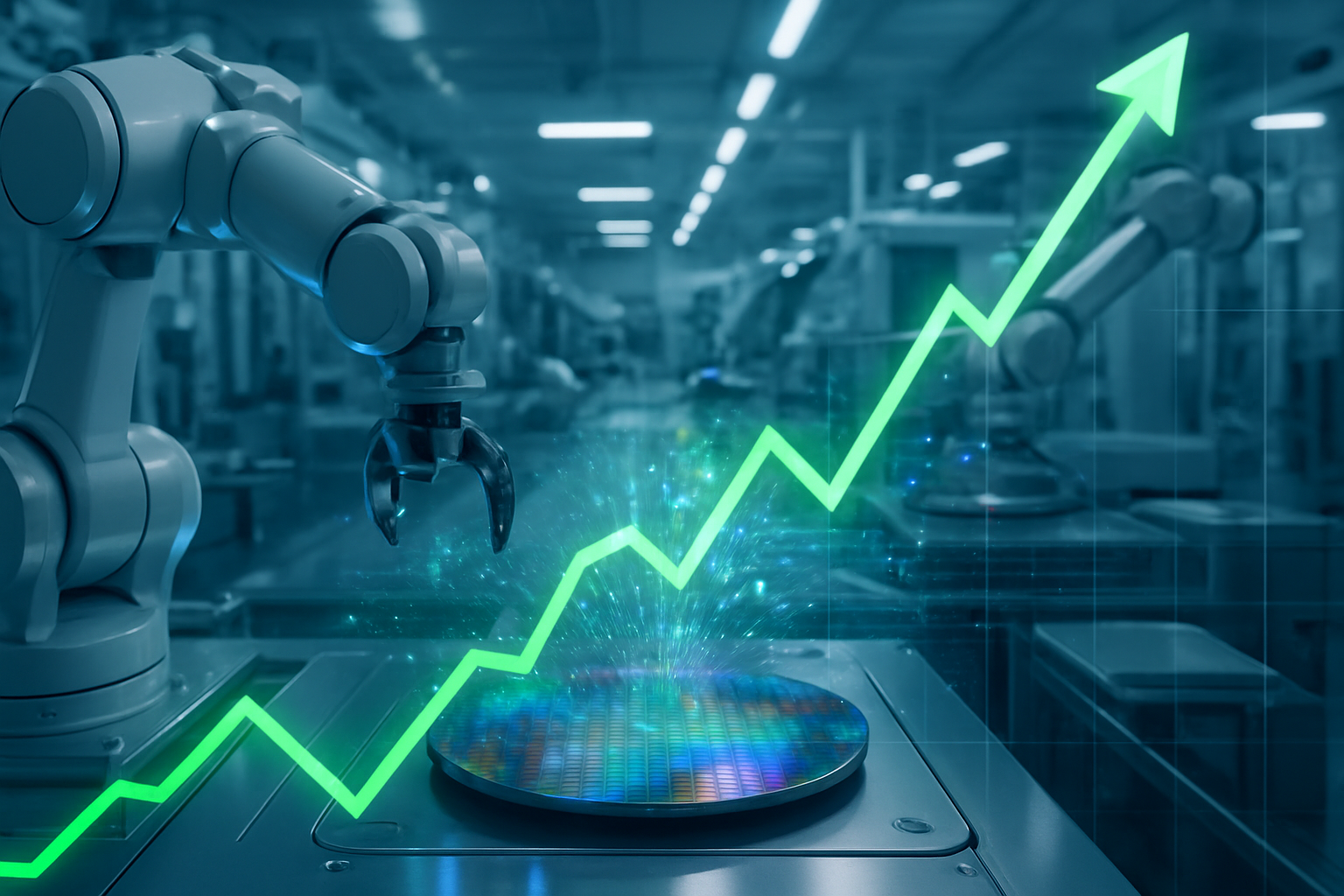
Shares of Intel Corp. (NASDAQ: INTC) skyrocketed nearly 12% on Wednesday, January 21, 2026, marking the veteran chipmaker’s most significant single-day gain in years. The rally, which propelled the stock to a four-year high of over $54, comes as the market aggressively reprices the company’s manufacturing prospects. Investors are pivoting from skepticism to optimism as Intel’s ambitious "IDM 2.0" strategy—once viewed as a high-stakes gamble—shows definitive signs of paying off through a series of high-profile customer wins and technological milestones.
The surge precedes Intel’s highly anticipated Q4 2025 earnings report, scheduled for release on January 22. Market analysts point to a "perfect storm" of positive catalysts: the successful transition of the 18A process node into high-volume manufacturing, a landmark foundry agreement with Apple Inc. (NASDAQ: AAPL), and a fundamental shift in the artificial intelligence (AI) narrative that has placed Intel’s general-purpose processors back in the spotlight. For a company that spent much of the early 2020s in the shadow of its rivals, this week’s price action signals a potential return to the throne of American semiconductor leadership.
The 18A Breakthrough: A Timeline of the Comeback
The primary engine of Intel’s recent stock performance is the 18A (1.8nm) process node, which officially reached High-Volume Manufacturing (HVM) status at the company’s Fab 52 facility in Arizona on January 5, 2026. This milestone is critical because it represents the culmination of CEO Pat Gelsinger’s "five nodes in four years" roadmap. Historically, Intel struggled with manufacturing delays, but the 18A node has reportedly achieved yields exceeding 60%, a benchmark that guarantees commercial profitability and confirms the viability of Intel’s new RibbonFET transistor architecture.
The momentum built steadily throughout January. Following the HVM announcement, reports emerged on January 15 that Intel had secured Apple as a flagship customer for its 18A-P process. According to industry insiders and reports from KeyBanc Capital Markets, Apple has contracted Intel to manufacture silicon for upcoming entry-level iPads and MacBooks, marking the first time the iPhone maker has utilized Intel’s foundries for its proprietary "A-series" or "M-series" architecture. This "whale" design win served as a massive validation of Intel’s ability to compete with Taiwan Semiconductor Manufacturing Co. (NYSE: TSM).
Behind the scenes, the influence of seasoned industry veteran Lip-Bu Tan, who joined Intel’s board and took a significant stake in late 2024, has been felt in the company’s sharpened operational focus. Furthermore, Intel’s presentation at CES 2026 earlier this month introduced the "Panther Lake" mobile processors. Built on the 18A node, these chips boasted a staggering 27-hour battery life and 50 TOPS (trillions of operations per second) of AI performance, effectively quieting critics who argued Intel could not compete in the low-power, high-efficiency mobile segment.
Winners and Losers in the New Foundry Era
The resurgence of Intel creates a new set of dynamics for the global semiconductor market. Intel (INTC) is the most obvious beneficiary, having successfully transitioned from a struggling integrated device manufacturer to a viable "Western Foundry" alternative. The 12% stock surge adds billions to its market cap, providing the liquidity needed to fund its massive domestic expansion. Microsoft Corp. (NASDAQ: MSFT) also stands to win; the tech giant recently expanded its partnership with Intel to manufacture its custom "Maia 2" AI accelerators, ensuring a diversified supply chain that is less dependent on geopolitical hotspots.
Conversely, TSMC (NYSE: TSM) faces its most credible competitive threat in over a decade. While TSMC remains the industry volume leader, Intel’s early lead in implementing "PowerVia"—a backside power delivery technology—has allowed it to beat the Taiwanese giant to market with specific high-efficiency features by nearly a year. This technological leap has forced TSMC to accelerate its own N2P node, putting pressure on its margins.
Meanwhile, Advanced Micro Devices Inc. (NASDAQ: AMD) finds itself in a challenging position. For years, AMD gained market share while Intel stumbled. Now, with Intel’s 18A node achieving superior density and efficiency, AMD’s reliance on external foundries could become a bottleneck if Intel begins to reclaim the performance crown in the server and consumer desktop markets. Lastly, NVIDIA Corp. (NASDAQ: NVDA), while a competitor in the AI chip space, has emerged as a tactical winner; the company recently began utilizing Intel’s advanced packaging services to hedge against capacity constraints in Asia, illustrating the complex "co-opetition" defining the industry in 2026.
The Geopolitical and AI Macro Shift
Intel’s momentum is also deeply intertwined with broader industry trends and regulatory shifts. The U.S. government, which took an $8.9 billion strategic stake in Intel via the CHIPS Act in mid-2025, views the company’s success as a matter of national security. As geopolitical tensions remain high, the ability to manufacture the world’s most advanced 1.8nm chips on American soil provides a "resiliency premium" that investors are finally starting to bake into Intel’s valuation.
Moreover, the rise of "Agentic AI"—autonomous AI systems that perform complex tasks rather than just generating text—has changed the hardware requirement landscape. While the initial AI boom favored GPUs, Agentic AI requires significant general-purpose "headroom" from CPUs to manage complex logic and task-switching. This shift has led to a surge in demand for Intel’s Xeon server processors, which analysts say are nearly sold out for the 2026 fiscal year.
Historically, this moment draws comparisons to the late 1990s, when Intel’s manufacturing dominance was unquestioned. However, the stakes are higher today. The move to the 18A node isn't just about speed; it's about the first successful commercial scale of gate-all-around (GAA) transistors and backside power delivery. By moving the power delivery to the back of the wafer, Intel has solved a decade-long heat and signal interference problem, setting a new standard for the industry.
What Lies Ahead: From Recovery to Dominance?
In the short term, all eyes are on Intel’s guidance for the remainder of 2026. If the company can prove that its foundry backlog—now estimated at over $20 billion—is translating into high-margin revenue, the stock could see further upward rerating. The immediate challenge will be capacity; as more customers like Apple and Microsoft sign on, Intel must ensure that its new fabs in Arizona, Ohio, and Germany come online without the delays that plagued its 10nm and 7nm transitions years ago.
Longer-term, Intel is already eyeing the "14A" process node, scheduled for late 2027. This next step will involve High-NA (Numerical Aperture) Extreme Ultraviolet (EUV) lithography, a technology for which Intel secured the world’s first machines from ASML Holding (NASDAQ: ASML). If Intel can maintain its current cadence, it could potentially leapfrog the entire industry, becoming the sole provider of sub-1.4nm manufacturing for several years.
Strategic pivots may still be required. The company continues to balance its dual role as a chip designer and a foundry. Maintaining a "Chinese Wall" between its product teams and its foundry customers will be essential to keeping the trust of companies like Apple, who are technically competitors in the processor space.
A New Chapter for the Silicon Pioneer
The 12% surge in Intel’s stock is more than just a reaction to a single news cycle; it is a recognition of a fundamental transformation. For years, Intel was the "sick man of Silicon Valley," a legacy giant that had lost its way. Today, with the 18A node in high-volume production and a customer list that reads like a "Who’s Who" of Big Tech, the company has proven that its turnaround is not just a plan, but a reality.
Moving forward, the market will transition from watching Intel’s progress to watching its execution. The "comeback" phase is largely over; the "expansion" phase has begun. Investors should watch for the official Q4 2025 earnings results for confirmation of these margin improvements and further details on the 14A roadmap.
In the coming months, the semiconductor industry will likely see a continued rebalancing of power. As the "Western Foundry" gains steam, the reliance on a single geographic point of failure for advanced chips is finally beginning to ease. Intel has not just saved its own business; it has arguably redefined the global supply chain for the AI era.
This content is intended for informational purposes only and is not financial advice.