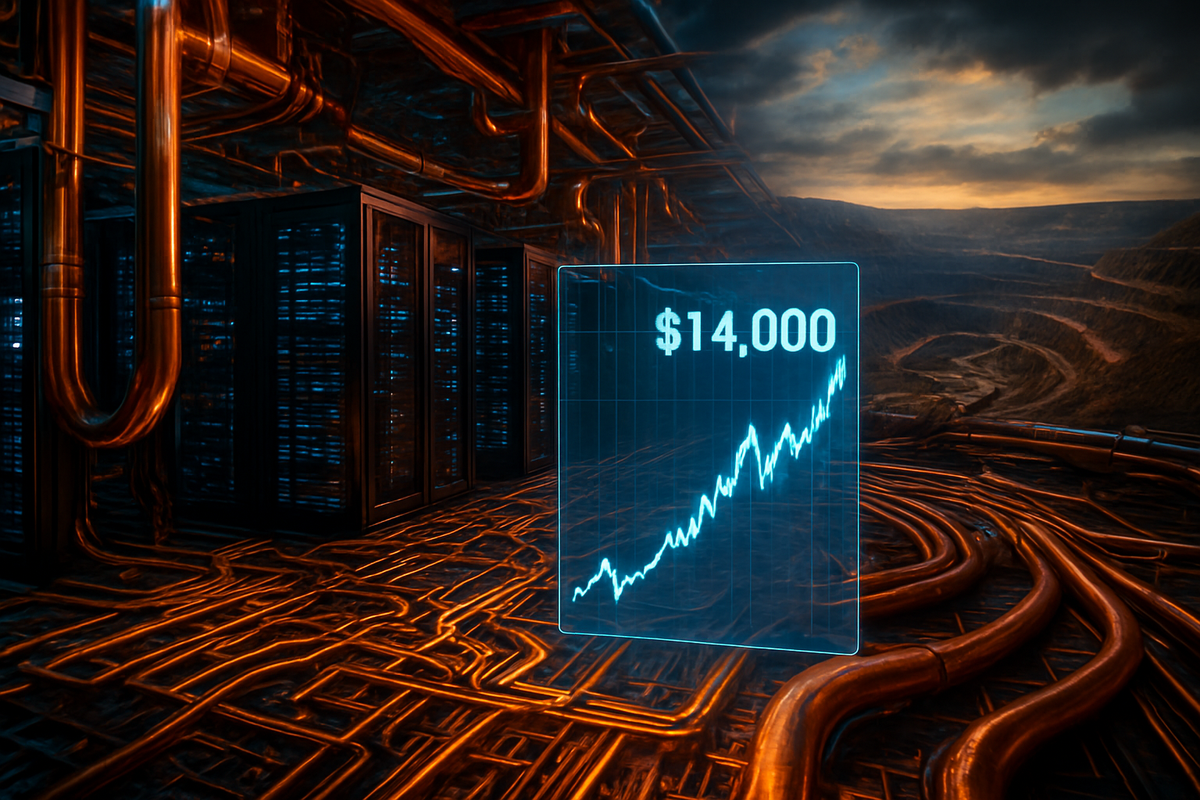
The global copper market has entered unchartered territory as prices for the "red metal" surged to a historic high of $14,527 per metric ton in early 2026, driven by an insatiable demand for artificial intelligence (AI) infrastructure and a series of crippling supply disruptions. As of February 24, 2026, the market remains in a state of high volatility, with prices currently hovering between $13,000 and $13,200 per ton. This unprecedented rally, often referred to as the "AI metals frenzy," has caught many industrial buyers off guard, as the transition to high-density AI data centers consumes vast quantities of copper far beyond traditional technological requirements.
The immediate implications of this price spike are being felt across the global economy, from the boardrooms of Silicon Valley to the manufacturing hubs of East Asia. While mining giants are reaping record profits, the extreme cost of copper is beginning to trigger "demand destruction" in traditional sectors like construction and appliance manufacturing. The market is now caught in a tug-of-war between the long-term structural needs of the digital revolution and the immediate reality of a supply chain that is buckling under the weight of labor strikes, natural disasters, and geopolitical trade barriers.
Detailed Coverage of the Surge
The road to $14,000 began in late 2025 but accelerated sharply in January 2026 when the true scale of AI-driven demand became clear to the broader market. Research from the Copper Development Association revealed that a single hyperscale AI data center can require up to 50,000 tons of copper—nearly ten times the amount used in a conventional data center. This massive intensity is required for the high-density busbars, sophisticated liquid cooling systems, and specialized power distribution needed to run next-generation GPU clusters from companies like NVIDIA (NASDAQ: NVDA). This "frenzy" reached a fever pitch in mid-January when major tech players like Microsoft (NASDAQ: MSFT) and Meta Platforms (NASDAQ: META) reportedly entered the physical market to secure long-term supplies, effectively crowding out traditional industrial consumers.
The supply side of the equation provided the perfect catalyst for this demand-driven explosion. On January 2, 2026, a major labor strike paralyzed the Mantoverde mine in Chile, owned by Capstone Copper (TSX:CS). The 35-day stoppage, which included a takeover of the mine's critical desalination plant, removed thousands of tons of supply from a market already in deficit. Simultaneously, Freeport-McMoRan (NYSE: FCX) confirmed that its Grasberg mine in Indonesia, the world’s second-largest copper producer, remained under force majeure following a catastrophic mudslide in September 2025. On February 23, 2026, Freeport leadership informed investors that 2026 output from the site would be 35% lower than originally projected, sending a fresh wave of panic through the London Metal Exchange (LME).
The timeline of the rally saw copper hit its peak of $14,527.50 on January 29, followed by a month of frantic trading as investors weighed the possibility of a permanent "supercycle" against the risk of a speculative bubble. The return of Chinese traders today, February 24, following the Lunar New Year holiday, has seen prices jump another 2% in early trading, buoyed by recent U.S. Supreme Court rulings that struck down certain reciprocal tariffs, raising hopes for a more fluid global trade environment.
Corporate Winners and Losers
The winners in this historic run are undoubtedly the major diversified miners who have pivoted their portfolios toward copper. BHP Group (NYSE: BHP) reported that for the first time in its 170-year history, copper has overtaken iron ore as its primary profit contributor, accounting for over 50% of its EBITDA. BHP shares hit an all-time high of A$55.33 in February as the company aggressively marketed its copper as the "currency of the AI age." Similarly, Rio Tinto (NYSE: RIO) has seen a significant boost in valuation as its long-term investments in copper assets begin to pay dividends in a high-price environment.
However, the "losers" are becoming more prominent as the price remains above the critical $13,000 mark. Industrial manufacturers, particularly in the HVAC and automotive sectors, are struggling to absorb the costs. Companies like Daikin Industries and various automotive parts suppliers are reporting squeezed margins, forcing a shift toward aluminum substitution where possible. Even within the mining sector, the gains are not uniform; Capstone Copper saw its stock drop 18% in February after failing to meet production expectations due to the Mantoverde strike, proving that high prices are only beneficial if a company can actually get the metal out of the ground.
Wider Significance and Industry Trends
The wider significance of this event lies in the "inventory paradox" currently distorting global markets. While copper prices are at record highs, nearly 60% of the world's visible stockpiles are currently "imprisoned" in U.S. warehouses. This is a direct result of U.S. Section 232 tariffs, which led American industrial giants to front-load inventories to avoid future levies. This has created a dual-price reality where the U.S. is technically oversupplied, while the rest of the world—particularly Europe and Asia—faces a severe physical shortage.
This crisis also marks a turning point in the relationship between technology and commodities. Historically, tech companies were shielded from the volatility of the metals market, but the sheer physical scale of AI infrastructure has made them major players in the commodity space. The "AI metals frenzy" suggests that future GPU performance may be constrained not just by semiconductor architecture, but by the physical availability of conductive materials. This has prompted a wave of "strategic resource hoarding," with tech firms potentially seeking direct equity stakes in mining projects to ensure their data centers can keep up with the pace of software evolution.
Future Outlook: What Comes Next?
Looking ahead, the market faces a critical juncture on June 30, 2026, when the U.S. Commerce Department is scheduled to review its copper tariff policies. If these tariffs are eased, the release of the "trapped" U.S. inventory could flood the global market, potentially causing a sharp correction. Short-term, analysts at StoneX, led by Natalie Scott-Gray, have warned that prices above $13,000 are "unsustainable" and disconnected from industrial fundamentals. Scott-Gray has identified $12,300 as a critical support level; a break below this could see copper tumble back to $11,500 by the third quarter of 2026.
Despite the potential for a short-term correction, the long-term outlook remains structurally bullish. The emergence of "demand destruction" and the shift to aluminum in low-margin applications like battery cables and heat exchangers may alleviate some pressure, but the non-negotiable requirements of AI power distribution and the global green energy transition suggest that a new, higher floor for copper prices has been established. Market opportunities are likely to emerge in leaching technologies and recycling, as companies like Freeport-McMoRan look to extract more copper from existing waste piles to bypass the long lead times of developing new mines.
Market Wrap-Up and Key Takeaways
In summary, the copper market's run to $14,000 represents a collision between the physical constraints of the Earth and the exponential growth of the digital world. The combination of the "AI metals frenzy" and unexpected supply shocks at Grasberg and Mantoverde has created a perfect storm for price appreciation. While the immediate peak may be speculative, the underlying shift in demand intensity from data centers has permanently altered the copper landscape.
Investors should watch for the resolution of the "inventory paradox" and the June 30 tariff review as the next major catalysts. Moving forward, the market will be defined by how quickly producers can ramp up output and whether tech giants continue their foray into physical commodity markets. As the world moves deeper into 2026, the "red metal" will remain at the center of the global conversation, serving as both a barometer for technological progress and a warning sign of the fragility of our global supply chains.
This content is intended for informational purposes only and is not financial advice.