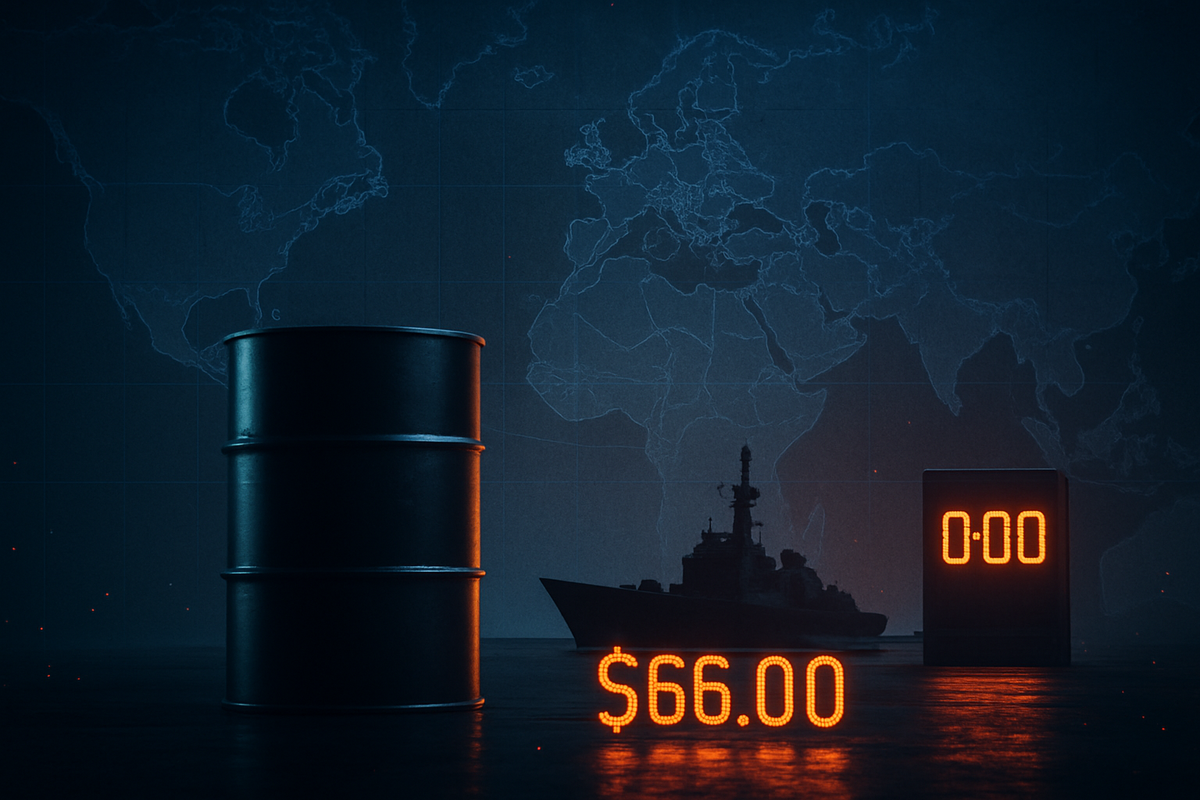
The global energy market finds itself locked in a high-stakes "geopolitical tug-of-war" this week, as West Texas Intermediate (WTI) crude oil prices hover near the $66.00 per barrel mark. On February 25, 2026, the commodity faced a dual-threat landscape: a staggering domestic oversupply indicated by the latest industry data and an escalating diplomatic crisis in the Middle East that threatens to choke off a fifth of the world’s oil supply.
While a massive 11.4 million-barrel build in U.S. crude inventories would typically send prices into a tailspin, the "war premium" stemming from a deteriorating nuclear standoff between Washington and Tehran has provided a firm floor. Investors are currently weighing the bearish reality of overflowing American tanks against the bullish prospect of a kinetic conflict in the Persian Gulf, leaving the energy sector in a state of volatile equilibrium.
A Tale of Two Forces: The API Shock and the SOTU Ultimatum
The immediate downward pressure on oil prices surfaced late yesterday when the American Petroleum Institute (API) released its weekly report, revealing a massive 11.43 million-barrel surge in U.S. crude stockpiles. This figure represents one of the largest single-week builds in recent years, a sharp reversal from the previous week's modest draw of 609,000 barrels. Under normal market conditions, a surplus of this magnitude would likely trigger a multi-dollar sell-off. However, WTI only retreated slightly from its daily high of $67.28, settling into the $65.80–$66.00 range as traders focused on geopolitical headlines.
The catalyst for this resilience was President Trump’s State of the Union address delivered on the evening of February 24, 2026. In a speech marked by a return to "Maximum Pressure 2.0" rhetoric, the President issued a 10-to-15-day deadline for Iran to agree to a "zero enrichment" nuclear framework or face "severe military consequences." Highlighting the development of Iranian missiles capable of reaching the U.S. mainland, the administration has signaled that the third round of nuclear talks—scheduled to commence in Geneva on February 26—may be the final diplomatic effort before a shift toward military deterrence.
This timeline has created an atmosphere of extreme uncertainty. While U.S. production has climbed to record levels of approximately 13.7 million barrels per day (bpd), the market remains hyper-sensitive to any threat involving the Strait of Hormuz. In mid-February, Iran briefly closed the strait during military exercises with regional partners, a maneuver that served as a stark reminder of Tehran’s ability to disrupt the 20 million barrels of oil that transit the 21-mile-wide waterway daily.
Corporate Resilience: Energy Giants Weather the Storm
In this climate of volatility, major American energy producers have become "safe-haven" proxies for investors seeking exposure to the oil sector without the direct operational risks associated with Middle Eastern instability. ExxonMobil (NYSE: XOM) has emerged as a leader in this regard, with its stock up 19% year-to-date as of February 2026. The company’s heavy investment in low-risk, high-return geographies like Guyana and the Permian Basin has shielded its production profile from the immediate fallout of a potential Persian Gulf blockade.
Similarly, Chevron (NYSE: CVX) has seen a 15% gain this year, driven by a 2026 capital program that prioritizes domestic spending. By allocating over $10.5 billion to U.S. operations, Chevron is insulating itself from the "tail risk" of geopolitical supply shocks while maintaining the ability to profit from any sudden price spikes. Both Exxon and Chevron have reportedly utilized advanced hedging strategies, such as "collar structures," to set price floors between $60 and $65, ensuring profitability even if domestic inventory builds continue to weigh on the spot market.
Occidental Petroleum (NYSE: OXY) has also caught the market's attention, jumping 10% in late February following strong earnings and a successful $9.7 billion asset sale. Occidental’s focus on maximizing Permian output aligns with the administration’s "energy dominance" agenda. For these companies, the current $66 price point represents a comfortable margin, but the true upside remains tied to the potential for a "scarcity premium" should the U.S.-Iran standoff lead to a disruption of sea lanes.
Strategic Implications and the Global Energy Chokepoint
The broader significance of the current $66 price point lies in the shifting dynamics of global energy security. Historically, a build of 11 million barrels would signal a demand slump or an economic slowdown. However, in 2026, the U.S. has effectively decoupled its price discovery from domestic supply levels. The market is now pricing in the "asymmetric military threat" posed by Iran’s "sea denial" strategy. Tehran’s refined "Mosquito Fleet" of fast attack craft and advanced Ghadr-380 cruise missiles represent a significant challenge to the U.S. Navy’s 5th Fleet.
Analysts at major financial institutions suggest that while the U.S. is currently awash in oil, a full blockade of the Strait of Hormuz would bypass domestic surpluses and send global prices into the $100–$150 per barrel range. Such a scenario would have devastating inflationary effects on Asian economies—specifically China, Japan, and South Korea—which remain heavily dependent on Middle Eastern imports. This provides the U.S. with significant diplomatic leverage but also increases the stakes for the upcoming Geneva talks.
The historical precedent for such a situation is often found in the "Tanker War" of the 1980s or the 2018 price fluctuations following the U.S. withdrawal from the JCPOA. However, the 2026 landscape is different due to the sheer volume of U.S. shale production. The "energy dominance" frequently cited by the White House acts as a strategic buffer, allowing the U.S. to take a harder line with Tehran than was possible in previous decades.
The Road to Geneva: What Comes Next?
As the 10-to-15-day deadline looms, the market will be hyper-fixated on the outcomes of the February 26 Geneva summit. A breakthrough in negotiations could lead to a rapid "de-risking" of the market, potentially causing WTI to break below $60 as the 11.4 million-barrel inventory build finally exerts its full bearish influence. Conversely, a breakdown in talks would likely see the geopolitical risk premium expand, pushing prices toward $80 or higher regardless of domestic supply levels.
In the short term, traders will also be watching for the official Energy Information Administration (EIA) data to confirm the API’s massive build. If the EIA confirms the 11 million-plus barrel figure, it will provide a test of the market's "geopolitical floor." Strategic pivots may be required for refineries and midstream players if the glut persists, potentially leading to increased exports to Europe and Latin America to clear the domestic surplus.
Summary and Outlook
The current state of the oil market is a paradox of plenty and peril. On one hand, the API's reported 11.4 million-barrel build highlights a robust, perhaps even excessive, domestic supply chain. On the other, the rhetoric from the 2026 State of the Union and the impending deadline for Iran have introduced a level of risk not seen in years. The $66 price point is the current "neutral zone" in a battle between physical reality and geopolitical fear.
Moving forward, the energy market will be defined by the outcome of the Geneva talks and the integrity of the Strait of Hormuz. Investors should keep a close eye on the 10-day ultimatum window and any signs of military posturing in the Persian Gulf. While U.S. energy giants like ExxonMobil and Chevron remain well-positioned to navigate either outcome, the broader global economy remains vulnerable to the volatile intersection of diplomacy and the deep-water channels of the Middle East.
This content is intended for informational purposes only and is not financial advice.