Maritime transportation company Matson (NYSE: MATX) reported Q4 CY2025 results beating Wall Street’s revenue expectations, but sales fell by 4.3% year on year to $851.9 million. Its GAAP profit of $4.60 per share was 24.8% above analysts’ consensus estimates.
Is now the time to buy Matson? Find out by accessing our full research report, it’s free.
Matson (MATX) Q4 CY2025 Highlights:
- Revenue: $851.9 million vs analyst estimates of $847.3 million (4.3% year-on-year decline, 0.5% beat)
- EPS (GAAP): $4.60 vs analyst estimates of $3.69 (24.8% beat)
- Adjusted EBITDA: $197.1 million vs analyst estimates of $189.3 million (23.1% margin, 4.1% beat)
- Operating Margin: 16.9%, down from 17.9% in the same quarter last year
- Free Cash Flow was -$99.5 million, down from $48.5 million in the same quarter last year
- Market Capitalization: $5.13 billion
Matt Cox, Matson's Chairman and Chief Executive Officer, commented, "Matson had a solid finish to the year with consolidated fourth quarter results that exceeded our expectations. For the quarter, Ocean Transportation operating income approached the level achieved in the prior year period primarily due to higher than expected freight rates and volume in our China service driven by strong e-commerce and e-goods demand. Our China service benefited from strong freight demand in our key customer segments as well as a more stable trading environment in the Transpacific tradelane as a result of the U.S.-China trade and economic deal announced on October 30, 2025, which reduced uncertainty regarding tariffs, port entry fees, global trade and other geopolitical factors. In our domestic ocean tradelanes, we saw higher year-over-year volumes in Hawaii and Guam and lower year-over-year volume in Alaska. In Logistics, quarterly operating income decreased year-over-year primarily due to a lower contribution from supply chain management. For the full year 2025, our consolidated operating income decreased year-over-year primarily due to lower volume and freight rates in our China service over the last three quarters as customers managed freight in a challenging environment marked by uncertainty and volatility arising from tariffs and global trade. "
Company Overview
Founded by a Swedish orphan, Matson (NYSE: MATX) is a provider of ocean transportation and logistics services.
Revenue Growth
A company’s long-term sales performance is one signal of its overall quality. Any business can experience short-term success, but top-performing ones enjoy sustained growth for years. Unfortunately, Matson’s 7% annualized revenue growth over the last five years was mediocre. This was below our standard for the industrials sector and is a rough starting point for our analysis.
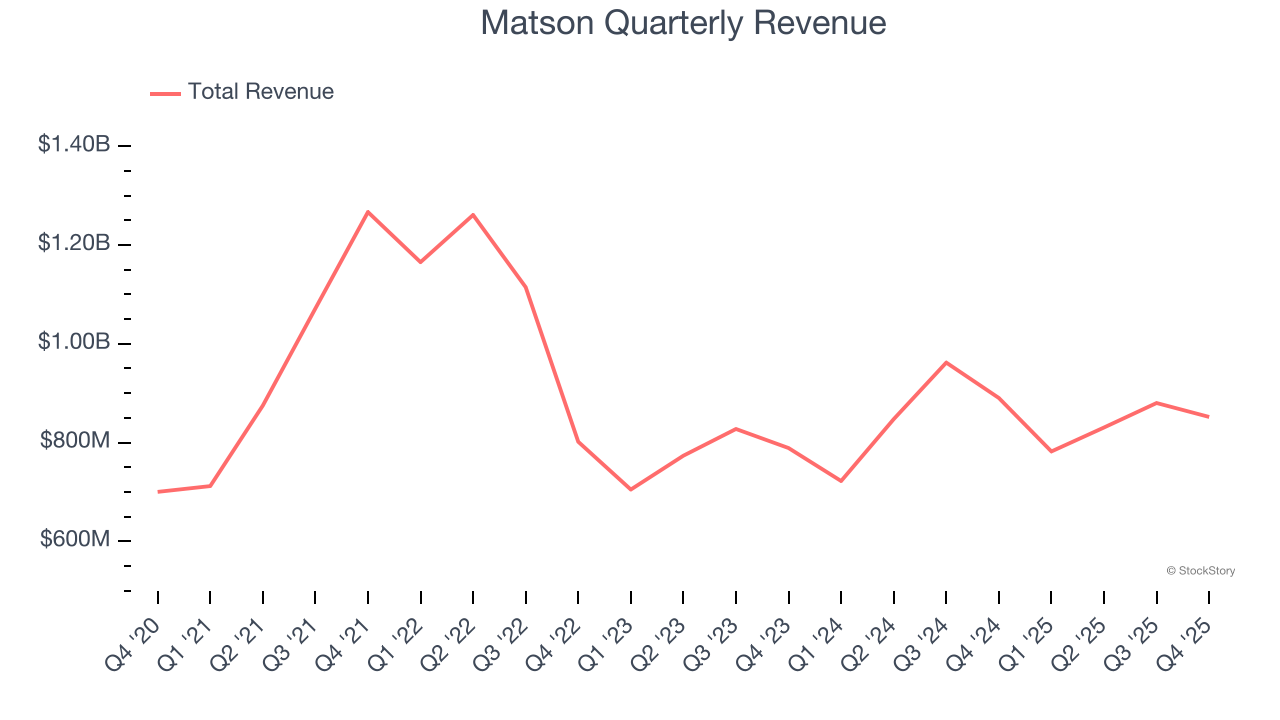
We at StockStory place the most emphasis on long-term growth, but within industrials, a half-decade historical view may miss cycles, industry trends, or a company capitalizing on catalysts such as a new contract win or a successful product line. Matson’s recent performance shows its demand has slowed as its annualized revenue growth of 4% over the last two years was below its five-year trend. We’re wary when companies in the sector see decelerations in revenue growth, as it could signal changing consumer tastes aided by low switching costs. 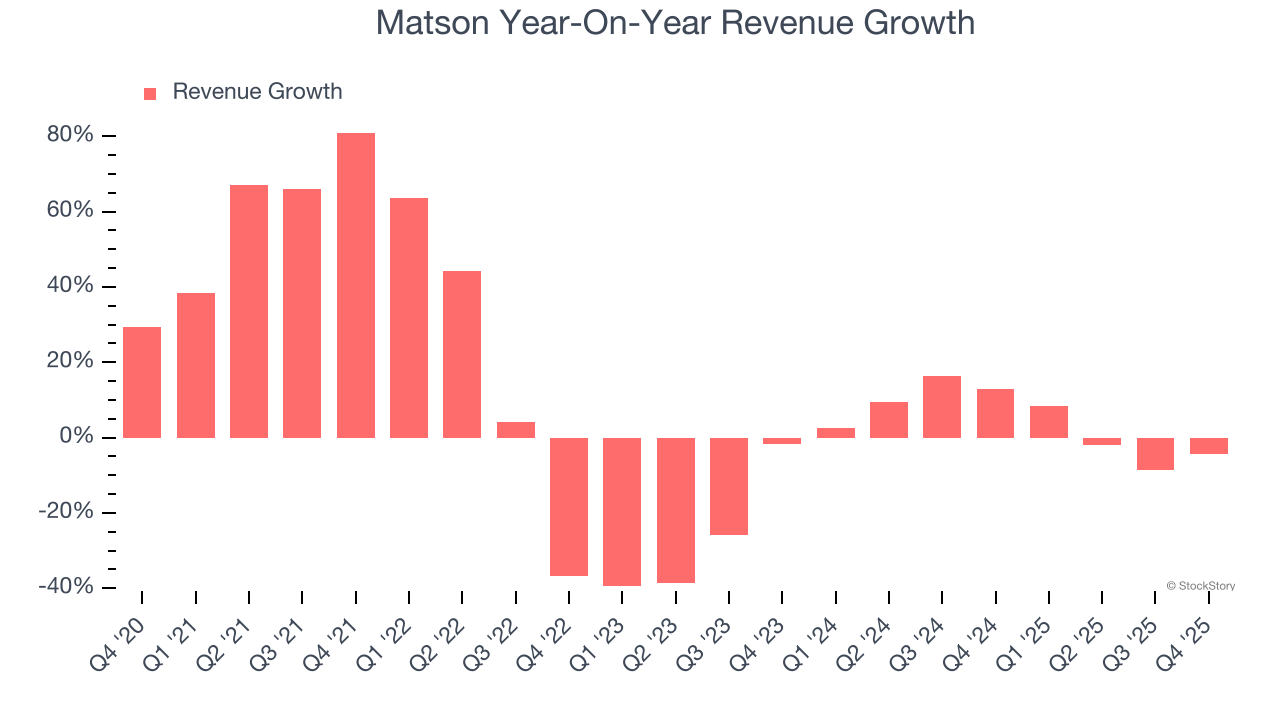
This quarter, Matson’s revenue fell by 4.3% year on year to $851.9 million but beat Wall Street’s estimates by 0.5%.
Looking ahead, sell-side analysts expect revenue to grow 2.6% over the next 12 months, similar to its two-year rate. This projection doesn't excite us and suggests its products and services will face some demand challenges.
Microsoft, Alphabet, Coca-Cola, Monster Beverage—all began as under-the-radar growth stories riding a massive trend. We’ve identified the next one: a profitable AI semiconductor play Wall Street is still overlooking. Go here for access to our full report.
Operating Margin
Operating margin is an important measure of profitability as it shows the portion of revenue left after accounting for all core expenses – everything from the cost of goods sold to advertising and wages. It’s also useful for comparing profitability across companies with different levels of debt and tax rates because it excludes interest and taxes.
Matson has been a well-oiled machine over the last five years. It demonstrated elite profitability for an industrials business, boasting an average operating margin of 21%. This result was particularly impressive because of its low gross margin, which is mostly a factor of what it sells and takes huge shifts to move meaningfully. Companies have more control over their operating margins, and it’s a show of well-managed operations if they’re high when gross margins are low.
Looking at the trend in its profitability, Matson’s operating margin decreased by 14.4 percentage points over the last five years. This raises questions about the company’s expense base because its revenue growth should have given it leverage on its fixed costs, resulting in better economies of scale and profitability.
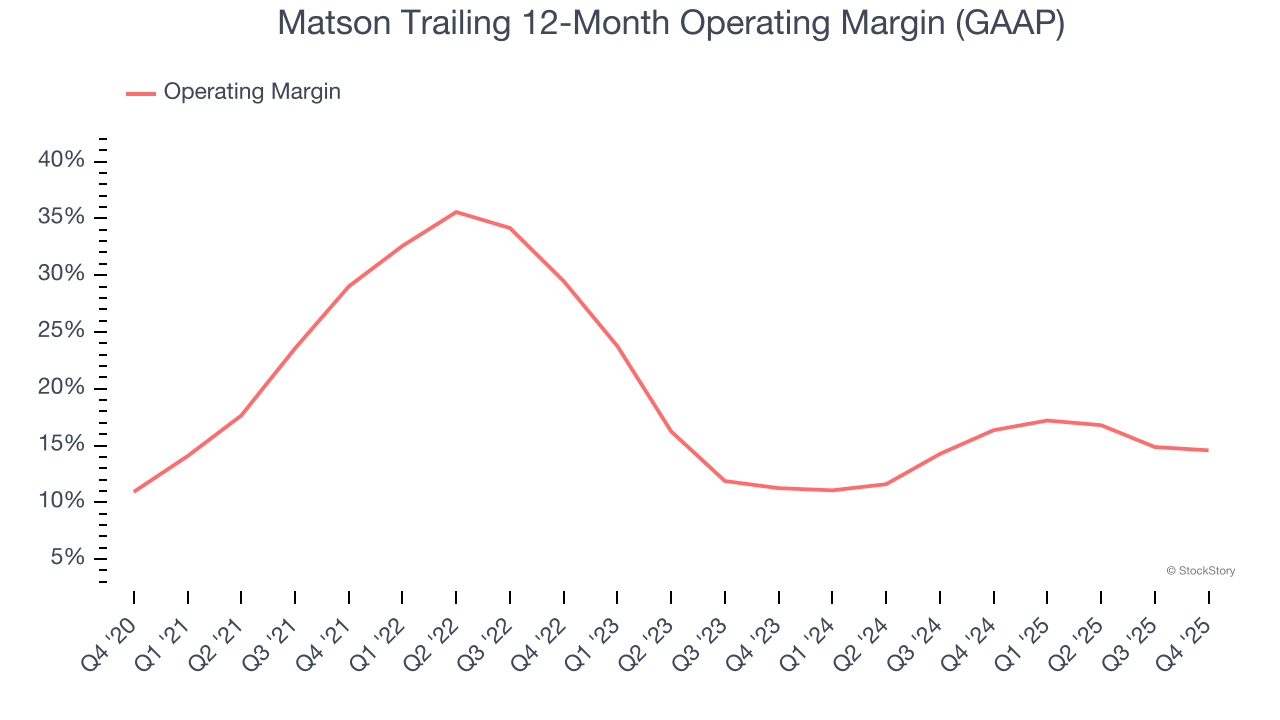
In Q4, Matson generated an operating margin profit margin of 16.9%, down 1 percentage points year on year. Since Matson’s gross margin decreased more than its operating margin, we can assume its recent inefficiencies were driven more by weaker leverage on its cost of sales rather than increased marketing, R&D, and administrative overhead expenses.
Earnings Per Share
Revenue trends explain a company’s historical growth, but the long-term change in earnings per share (EPS) points to the profitability of that growth – for example, a company could inflate its sales through excessive spending on advertising and promotions.
Matson’s EPS grew at an astounding 25.7% compounded annual growth rate over the last five years, higher than its 7% annualized revenue growth. This tells us the company became more profitable on a per-share basis as it expanded.
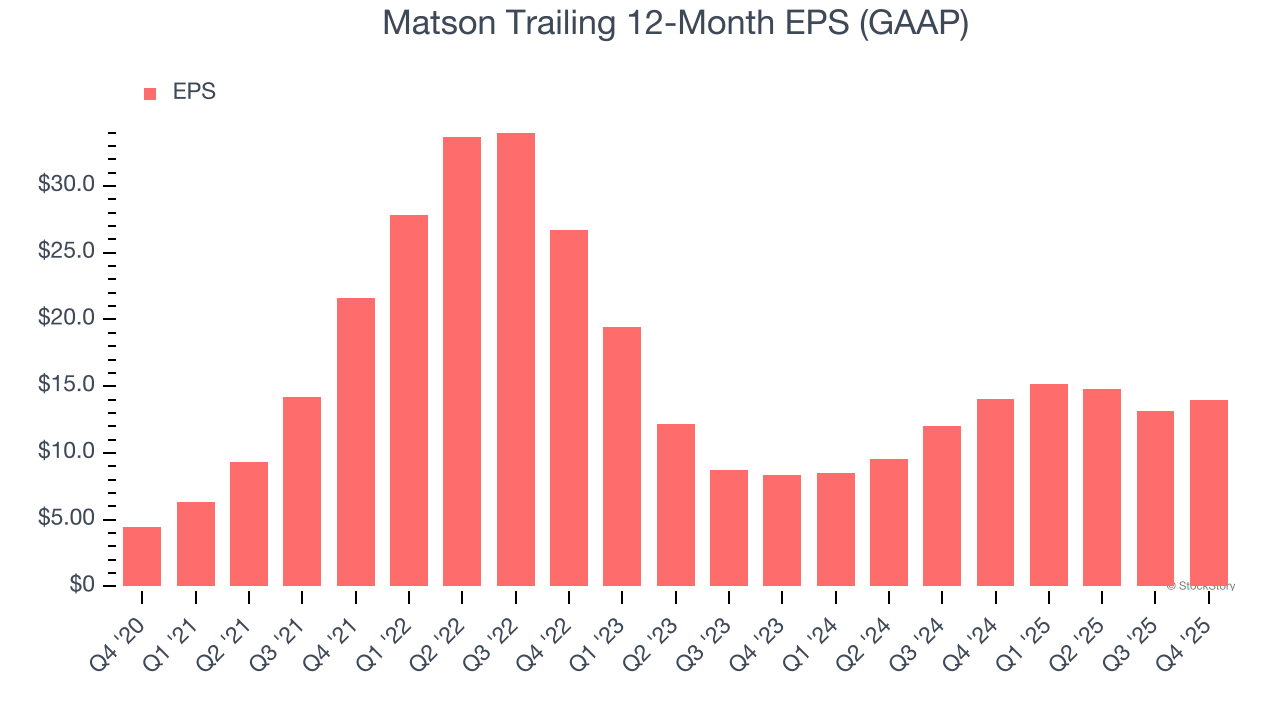
We can take a deeper look into Matson’s earnings quality to better understand the drivers of its performance. A five-year view shows that Matson has repurchased its stock, shrinking its share count by 28.8%. This tells us its EPS outperformed its revenue not because of increased operational efficiency but financial engineering, as buybacks boost per share earnings. 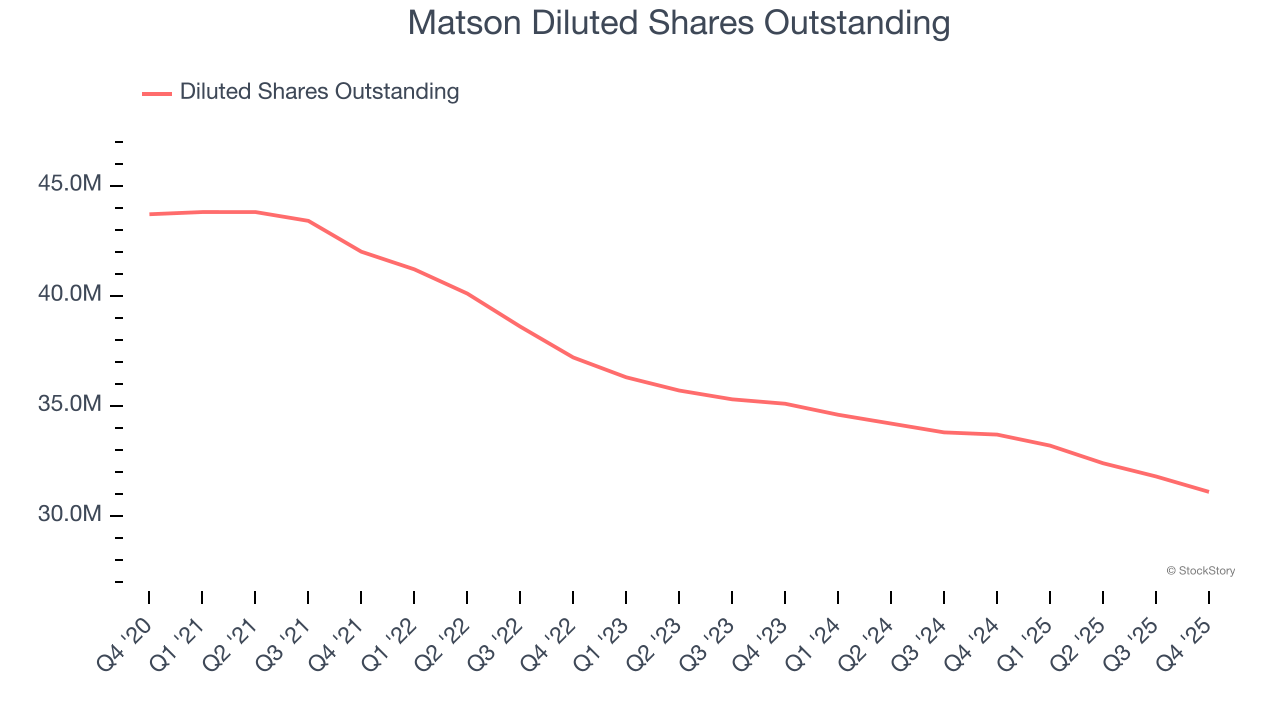
Like with revenue, we analyze EPS over a more recent period because it can provide insight into an emerging theme or development for the business.
For Matson, its two-year annual EPS growth of 29% was higher than its five-year trend. We love it when earnings growth accelerates, especially when it accelerates off an already high base.
In Q4, Matson reported EPS of $4.60, up from $3.80 in the same quarter last year. This print easily cleared analysts’ estimates, and shareholders should be content with the results. Over the next 12 months, Wall Street expects Matson’s full-year EPS of $13.94 to shrink by 6%.
Key Takeaways from Matson’s Q4 Results
It was good to see Matson beat analysts’ EPS expectations this quarter. We were also glad its EBITDA outperformed Wall Street’s estimates. Zooming out, we think this was a solid print. The stock remained flat at $166.07 immediately following the results.
Big picture, is Matson a buy here and now? We think that the latest quarter is only one piece of the longer-term business quality puzzle. Quality, when combined with valuation, can help determine if the stock is a buy. We cover that in our actionable full research report which you can read here (it’s free).