Looking back on electronic components & manufacturing stocks’ Q2 earnings, we examine this quarter’s best and worst performers, including Plexus (NASDAQ: PLXS) and its peers.
The sector could see higher demand as the prevalence of advanced electronics increases in industries such as automotive, healthcare, aerospace, and computing. The high-performance components and contract manufacturing expertise required for autonomous vehicles and cloud computing datacenters, for instance, will benefit companies in the space. However, headwinds include geopolitical risks, particularly U.S.-China trade tensions that could disrupt component sourcing and production as the Trump administration takes an increasingly antagonizing stance on foreign relations. Additionally, stringent environmental regulations on e-waste and emissions could force the industry to pivot in potentially costly ways.
The 10 electronic components & manufacturing stocks we track reported an exceptional Q2. As a group, revenues beat analysts’ consensus estimates by 4% while next quarter’s revenue guidance was 6% above.
While some electronic components & manufacturing stocks have fared somewhat better than others, they have collectively declined. On average, share prices are down 3.3% since the latest earnings results.
Plexus (NASDAQ: PLXS)
With over 20,000 team members across 26 global facilities, Plexus (NASDAQ: PLXS) designs, manufactures, and services complex electronic products for companies in aerospace/defense, healthcare, and industrial sectors.
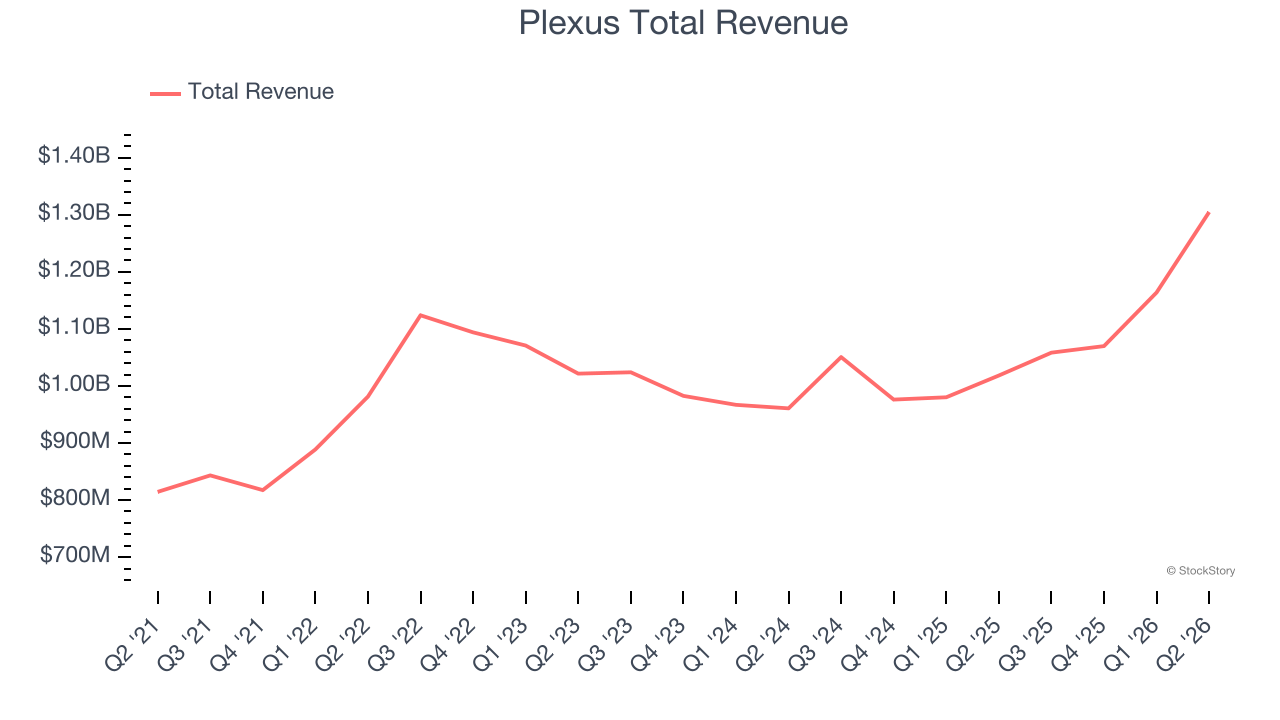
Plexus reported revenues of $1.30 billion, up 28.1% year on year. This print exceeded analysts’ expectations by 5.8%. Overall, it was a stunning quarter for the company with a solid beat of analysts’ EPS guidance for next quarter estimates and revenue guidance for next quarter exceeding analysts’ expectations.
Todd Kelsey, President and Chief Executive Officer, commented, “Plexus generated record quarterly revenue in the fiscal third quarter by capturing strengthening end market demand and successfully launching numerous new programs. Fiscal third quarter revenue of $1.305 billion exceeded guidance, increasing 12% sequentially and 28% year over year. In addition, non-GAAP operating margin of 6.3% met the high end of guidance, non-GAAP EPS of $2.32 exceeded guidance and we again delivered healthy working capital efficiency.”
Interestingly, the stock is up 2% since reporting and currently trades at $245.34.
We think Plexus is a good business, but is it a buy today? Read our full report here, it’s free.
Best Q2: Amphenol (NYSE: APH)
With over 90 years of connecting the world's technologies, Amphenol (NYSE: APH) designs and manufactures connectors, cables, sensors, and interconnect systems that enable electrical and electronic connections across virtually every industry.
Amphenol reported revenues of $8.76 billion, up 55% year on year, outperforming analysts’ expectations by 5.6%. The business had an incredible quarter with revenue guidance for next quarter exceeding analysts’ expectations.
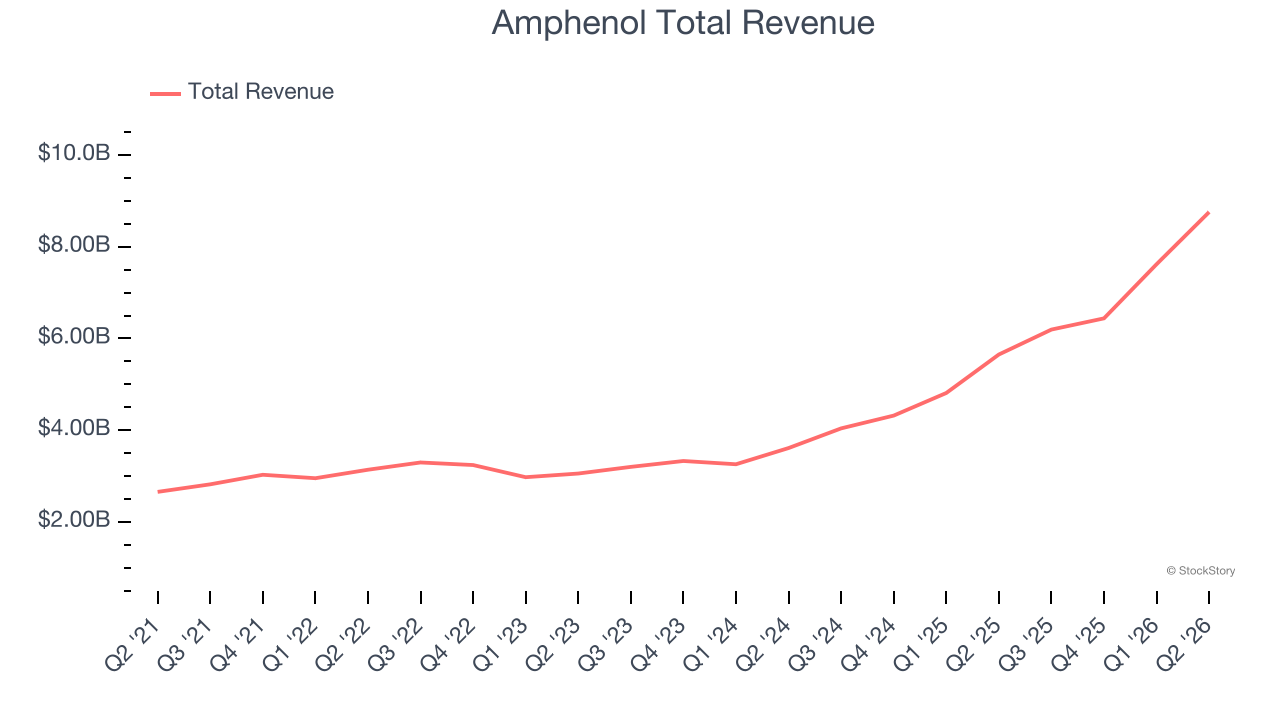
Amphenol achieved the fastest revenue growth among its peers. The market seems happy with the results as the stock is up 11.7% since reporting. It currently trades at $160.69.
Is now the time to buy Amphenol? Access our full analysis of the earnings results here, it’s free.
Weakest Q2: Rogers (NYSE: ROG)
With roots dating back to 1832, making it one of America's oldest continuously operating companies, Rogers (NYSE: ROG) designs and manufactures specialized engineered materials and components used in electric vehicles, telecommunications, renewable energy, and other high-performance applications.
Rogers reported revenues of $216.8 million, up 6.9% year on year, exceeding analysts’ expectations by 0.8%. Still, it was a mixed quarter as it posted a significant miss of analysts’ EPS estimates.
Rogers delivered the weakest performance against analyst estimates and slowest revenue growth of the whole group. Interestingly, the stock is up 8.5% since the results and currently trades at $129.33.
Read our full analysis of Rogers’s results here.
Coherent (NYSE: COHR)
Created through the 2022 rebranding of II-VI Incorporated, a company with roots dating back to 1971, Coherent (NYSE: COHR) develops and manufactures advanced materials, lasers, and optical components for applications ranging from telecommunications to industrial manufacturing.
Coherent reported revenues of $2.05 billion, up 33.7% year on year. This result beat analysts’ expectations by 2.9%. Overall, it was an exceptional quarter as it also recorded a solid beat of analysts’ EPS guidance for next quarter estimates and revenue guidance for next quarter exceeding analysts’ expectations.
The stock is down 18.2% since reporting and currently trades at $290.92.
Read our full, actionable report on Coherent here, it’s free.
Knowles (NYSE: KN)
With roots dating back to 1946 and a focus on components that must perform flawlessly in critical situations, Knowles (NYSE: KN) designs and manufactures specialized electronic components like high-performance capacitors, microphones, and speakers for medical technology, defense, and industrial applications.
Knowles reported revenues of $166.8 million, up 14.3% year on year. This number topped analysts’ expectations by 6.3%. It was a stunning quarter as it also put up a solid beat of analysts’ EPS guidance for next quarter estimates and revenue guidance for next quarter exceeding analysts’ expectations.
Knowles pulled off the biggest analyst estimate beat in the group. The stock is down 10% since reporting and currently trades at $34.95.
Read our full, actionable report on Knowles here, it’s free.
Market Update
Over the past year, investors have been forced to repeatedly answer the same question: what is the market’s biggest risk? The answer has changed several times, and each shift has reshaped market leadership.
Late in 2025 and early 2026, artificial intelligence became the market’s primary uncertainty. Investors questioned whether AI would erode software pricing power and weaken competitive moats as AI made it easier to replicate once-differentiated products.
By the spring, technology took a back seat to geopolitics. The U.S. conflict with Iran briefly became the market’s dominant narrative, raising concerns about oil prices, inflation, and global growth. But as energy markets remained orderly and fears of a prolonged supply disruption faded, investors quickly turned their focus back to fundamentals.
Want to invest in winners with rock-solid fundamentals? Check out our Top 5 Quality Compounder Stocks and add them to your watchlist. These companies are poised for growth regardless of the political or macroeconomic climate.