Belt Feeders Market Accelerates with Smart Automation and Mining Expansion, Driving Efficient Bulk Material Handling Across Global Industrial Ecosystems
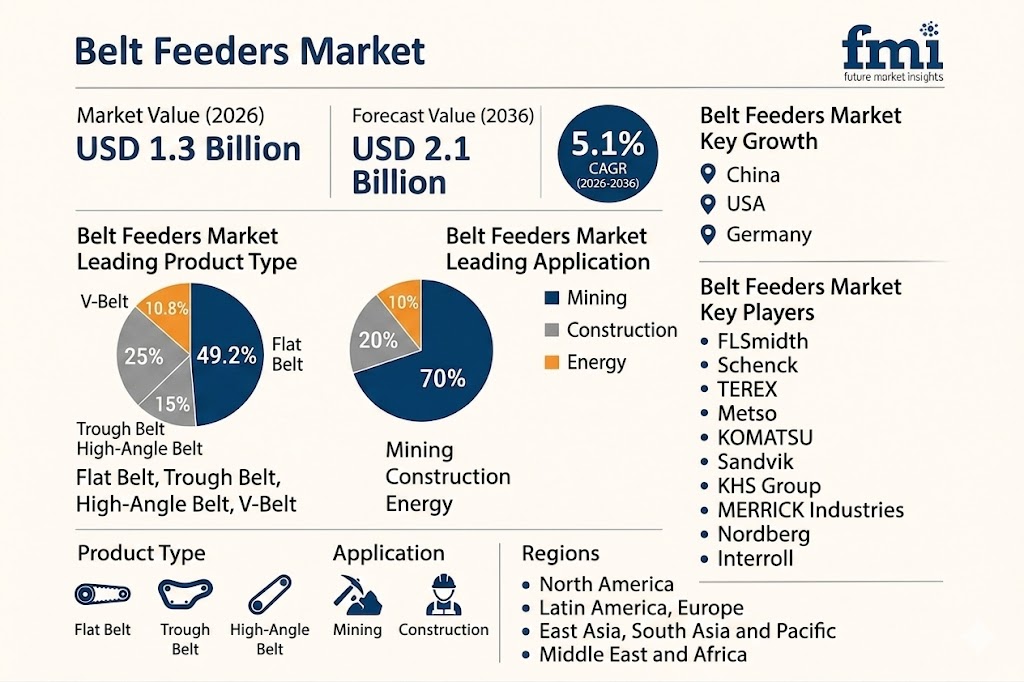
NEWARK, DE / ACCESS Newswire / April 24, 2026 / According to the latest analysis by Future Market Insights, the global belt feeders market is poised for steady growth, fueled by rising mining output, increasing investments in industrial automation, and expanding infrastructure development worldwide. Valued at USD 1.3 billion in 2026, the market is projected to reach USD 2.1 billion by 2036, registering a CAGR of 5.1% during the forecast period.
According to Future Market Insights (FMI), belt feeders are becoming indispensable in modern material handling systems, ensuring controlled, continuous flow of bulk materials across mining, construction, and processing industries.
Get detailed market forecasts, competitive benchmarking, and pricing trends: https://www.futuremarketinsights.com/reports/sample/rep-gb-8058
Quick Facts & Featured Snippet
Market Value (2026): USD 1.3 Billion
Forecast Value (2036): USD 2.1 Billion
CAGR (2026-2036): 5.1%
Incremental Opportunity: USD 0.9 Billion
Leading Product Type: Flat Belt (49.2% Share)
Top Application: Mining Industry (46.7% Share)
Key Growth Regions: China (6.9% CAGR), India (6.4% CAGR)
Mining-Led Demand: The Core Growth Engine
The belt feeders market is strongly anchored in the global mining sector, where rising extraction of coal, iron ore, copper, and lithium is driving demand for efficient material handling systems.
Each new processing plant requires multiple belt feeder units to regulate material flow from stockpiles to processing lines. Additionally, brownfield expansions and capacity upgrades are generating sustained replacement demand.
"Mining operations continue to be the backbone of belt feeder demand, as consistent and controlled material flow directly impacts processing efficiency and output," notes an FMI analyst.
Automation Revolution: From Manual Feeding to Smart Systems
A significant transformation is underway as industries shift from manual feeding systems to automated, precision-controlled belt feeders. Modern systems now integrate:
Load cells for accurate material measurement
Variable Frequency Drives (VFDs) for speed control
PLC-based automation for real-time feed adjustments
These advancements reduce material waste by 10% to 20%, improve plant efficiency, and enable operators to optimize throughput without manual intervention.
The emergence of IoT-enabled predictive maintenance systems is further enhancing equipment reliability by monitoring wear, motor performance, and operational health.
Infrastructure Boom Expanding Market Horizons
Beyond mining, rapid infrastructure development in emerging economies is creating a parallel demand surge. Increasing cement production and aggregate processing in regions such as Asia-Pacific and Latin America are driving the need for continuous bulk material feeding systems.
Countries including India, Vietnam, and Indonesia are witnessing heightened demand due to large-scale investments in transportation, housing, and urban infrastructure projects.
Segment Insights: Flat Belt and Mining Applications Lead
Product Type: Flat Belt Dominance
Flat belt feeders are expected to account for 49.2% of the market share in 2026, owing to their versatility in handling diverse bulk materials such as ores, aggregates, and chemicals. Their ability to ensure uniform material distribution makes them ideal for heavy-duty industrial applications.
Application: Mining Industry at the Forefront
The mining segment dominates with a 46.7% share, as operations require multiple feeder units operating under harsh conditions, including high loads, abrasive materials, and continuous cycles exceeding 20 hours per day.
Access the Complete Report in PDF Format: https://www.futuremarketinsights.com/reports/brochure/rep-gb-8058
Regional Insights: Asia-Pacific Leads Growth Momentum
China: Global Growth Leader (6.9% CAGR)
China dominates the market with the highest growth rate, driven by extensive mining operations, infrastructure expansion, and industrial modernization initiatives.
India: Emerging High-Growth Market (6.4% CAGR)
India's growth is supported by mining sector expansion, increasing cement production capacity, and large-scale infrastructure development programs.
Europe: Engineering Excellence and Export Strength
Germany maintains strong growth due to its advanced engineering capabilities and global exports of high-performance material handling systems.
United States & United Kingdom
Stable growth in these markets is supported by equipment replacement cycles, aggregate quarrying, and modernization of existing processing plants.
Market Drivers, Challenges, and Opportunities
Key Drivers
Expansion of global mining activities
Increasing adoption of industrial automation
Infrastructure development in emerging economies
Demand for efficient bulk material handling systems
Challenges
High capital investment (USD 50,000-500,000 per unit)
Maintenance complexity in harsh environments
Competition from alternative feeding technologies
Opportunities
Smart belt feeders with IoT and predictive maintenance
Modular and cost-efficient system designs
Expansion in emerging mining regions
Competitive Landscape: Innovation and Integration Define Success
The belt feeders market is highly competitive, with global players focusing on durability, automation integration, and service network expansion. Key companies include:
FLSmidth
Schenck
Metso
Sandvik
KOMATSU
TEREX
MERRICK Industries
These companies are investing in modular designs, hybrid feeder systems, and remote monitoring capabilities to enhance operational efficiency and reduce downtime.
Emerging players and regional manufacturers are gaining traction by offering cost-effective and customized solutions, particularly in Asia-Pacific markets.
Future Outlook: Smart Material Handling to Define the Next Decade
The belt feeders market is set to evolve from traditional mechanical systems to intelligent, connected material handling solutions. Automation, predictive analytics, and digital monitoring will redefine how industries manage bulk material flow.
As mining output rises and infrastructure projects accelerate globally, belt feeders will remain a critical component in ensuring efficiency, sustainability, and operational reliability across industrial ecosystems.
Buy Report: Unlock 360° insights for strategic decision making and investment planning:
https://www.futuremarketinsights.com/checkout/8058
Related Reports:
Pump Feeders Market- https://www.futuremarketinsights.com/reports/pump-feeders-market
Conveyor Belt Market- https://www.futuremarketinsights.com/reports/conveyor-belts-market
Industrial V Belts Market- https://www.futuremarketinsights.com/reports/industrial-variable-speed-belts-market
About Future Market Insights (FMI)
Future Market Insights (FMI) is a leading provider of market intelligence and consulting services, serving clients in over 150 countries. Headquartered in Delaware, USA, with a global delivery center in India and offices in the UK and UAE, FMI delivers actionable insights to businesses across industries including automotive, technology, consumer products, manufacturing, energy, and chemicals.
An ESOMAR-certified research organization, FMI provides custom and syndicated market reports and consulting services, supporting both Fortune 1,000 companies and SMEs. Its team of 300+ experienced analysts ensures credible, data-driven insights to help clients navigate global markets and identify growth opportunities.
For Press & Corporate Inquiries:
Rahul Singh
AVP - Marketing and Growth Strategy
Future Market Insights, Inc.
+91 8600020075
For Sales - sales@futuremarketinsights.com
For Media - Rahul.singh@futuremarketinsights.com
For web - https://www.futuremarketinsights.com/
SOURCE: Future Market Insights, Inc.
View the original press release on ACCESS Newswire