The market is growing steadily, driven by military modernization, demand for lightweight protection, and advanced fiber technologies enhancing defense performance and efficiency.
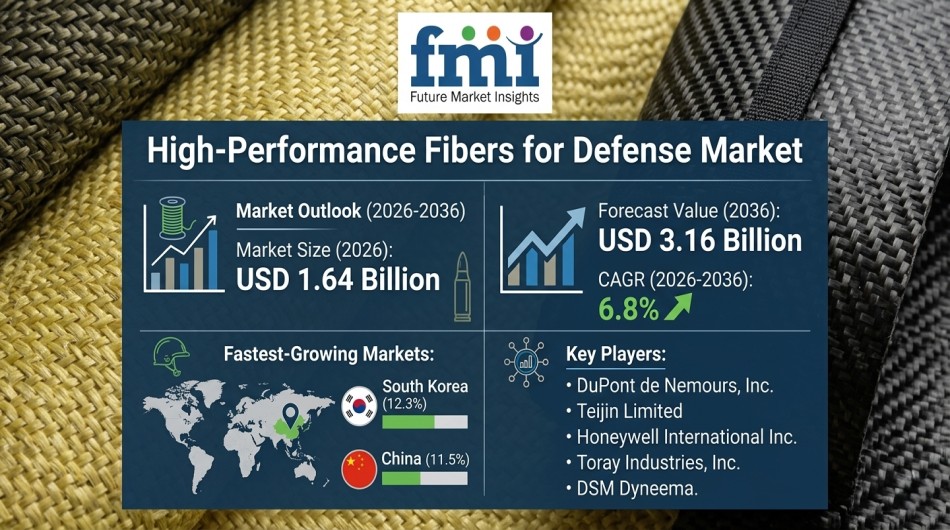
NEWARK, DE / ACCESS Newswire / April 24, 2026 / According to the latest analysis by Future Market Insights, the global high-performance fibers for defense market is witnessing sustained growth, driven by military modernization initiatives, rising demand for lightweight ballistic protection, and long-term defense procurement programs. The market is projected to grow from USD 1.64 billion in 2026 to USD 3.16 billion by 2036, registering a CAGR of 6.8% over the forecast period.
This expansion reflects increasing adoption of advanced fiber technologies that enhance protection while reducing weight and improving operational efficiency.
Market Snapshot: High-Performance Fibers for Defense Market
Market Size (2026): USD 1.64 Billion
Forecast Value (2036): USD 3.16 Billion
CAGR (2026-2036): 6.8%
Leading Product Segment: Aramids (34.6% share)
Dominant Form Segment: Fabrics (44.5% share)
Leading Technology Segment: Weaving Technology (36.0%)
Fastest-Growing Markets: South Korea (12.3%), China (11.5%)
Key Players: DuPont de Nemours, Inc., Teijin Limited, Honeywell International Inc., Toray Industries, Inc., DSM Dyneema
Get detailed market forecasts, competitive benchmarking, and pricing trends: https://www.futuremarketinsights.com/reports/sample/rep-gb-16568
Growth Dynamics and Demand Drivers
The market is expanding due to increasing investments in military modernization programs across NATO and Indo-Pacific regions. Defense forces are prioritizing lighter, high-strength materials to reduce soldier load burden while maintaining superior ballistic protection.
Another key growth driver is the rising demand for multi-threat protection systems in both personal armor and military vehicles. High-performance fibers such as aramids and UHMWPE provide enhanced ballistic resistance per unit weight, making them essential for next-generation defense applications.
Additionally, long-term procurement contracts and rising defense budgets are providing multi-year visibility for manufacturers, supporting stable demand and strategic planning.
Segment Insights
By Product Type
Aramids lead with 34.6% share, driven by widespread use in ballistic protection and flame resistance
UHMWPE and carbon fiber expanding in advanced protection systems
Specialty fibers (PBO, novoloid, fiberglass) supporting niche applications
By Form
Fabrics dominate with 44.5% share, preferred for armor and protective gear
Yarns, fibers, and prepregs supporting composite manufacturing and structural reinforcement
By Technology
Weaving technology leads with 36.0% share, enabling scalable and durable fabric production
Braiding, coating, and composite manufacturing gaining traction for specialized applications
By Application
Military segment holds 62.3% share, driven by body armor and vehicle protection
Law enforcement and homeland security contributing steady demand
Supply Chain and Industry Structure
The supply chain is characterized by high entry barriers due to stringent defense qualification requirements. Fiber producers supply directly to defense contractors through long-term agreements, ensuring consistent quality and compliance.
Manufacturers invest heavily in ballistic testing, certification, and regulatory approvals, which can take 2 to 5 years. This creates strong supplier lock-in and favors established players with proven track records.
Distribution is primarily conducted through direct sales to defense contractors and government procurement channels, reflecting the regulated nature of the industry.
Customize insights for your business strategy@ https://www.futuremarketinsights.com/customization-available/rep-gb-16568
Pricing and Value Trends
Pricing in the market is influenced by performance, certification, and lifecycle value rather than raw material costs alone. High-performance fibers command premium pricing due to:
Superior strength-to-weight ratio
Enhanced durability and reliability
Compliance with strict defense standards
Value perception is increasingly tied to long-term operational efficiency, including reduced weight, improved mobility, and extended product lifespan.
Competitive Landscape
The market is dominated by established global players with strong fiber portfolios and defense qualifications. Companies such as DuPont, Teijin, Honeywell, and Toray lead through:
Advanced material innovation
Global manufacturing capabilities
Long-standing defense relationships
Emerging players are entering through niche specialization and regional strategies, focusing on advanced composites and customized solutions.
Competition is centered on performance differentiation, qualification capabilities, and supply reliability, rather than price alone.
Regional Analysis
Asia-Pacific (High Growth Region)
South Korea (12.3% CAGR): Driven by defense modernization and domestic production
China (11.5% CAGR): Supported by large-scale defense manufacturing and upgrades
India (8.7% CAGR): Growth fueled by domestic defense expansion and modernization
North America
United States (6.8% CAGR): Largest defense budget and contractor ecosystem
Europe
Germany (6.9% CAGR): Supported by EU defense coordination
United Kingdom (6.5% CAGR): Driven by NATO programs and R&D investments
Other Markets
Japan (10.5% CAGR): Advanced materials manufacturing and defense tech investment
Future Outlook and Opportunities
The high-performance fibers for defense market is expected to evolve with advancements in material science, composite manufacturing, and fiber treatments. Growth opportunities are concentrated in:
Lightweight multi-threat armor systems
Advanced composite vehicle protection
Next-generation fiber technologies
Expansion into emerging defense markets
Companies that combine innovation with regulatory compliance and defense qualification will be best positioned to capture long-term growth.
Conclusion
The shift toward high-performance fibers represents a critical transformation in defense materials. As military forces prioritize mobility, protection, and efficiency, advanced fiber solutions are becoming essential components of modern defense systems. With steady investment and technological innovation, the market is set to achieve sustained growth through 2036.
Unlock 360° insights for strategic decision making and investment planning@ https://www.futuremarketinsights.com/checkout/16568
Explore More Related Studies Published by FMI Research:
Acetyl Tributyl Citrate market: https://www.futuremarketinsights.com/reports/acetyl-tributyl-citrate-market
Acetylcholine Market: https://www.futuremarketinsights.com/reports/acetylcholine-market
Volatile Corrosion Inhibitors Market: https://www.futuremarketinsights.com/reports/volatile-corrosion-inhibitors-market
Synthetic Musk Market: https://www.futuremarketinsights.com/reports/synthetic-musk-market
Machine Tool Oils Market: https://www.futuremarketinsights.com/reports/machine-tool-oils-market
About Future Market Insights (FMI)
Future Market Insights (FMI) is a leading provider of market intelligence and consulting services, serving clients in over 150 countries. Headquartered in Delaware, USA, with a global delivery center in India and offices in the UK and UAE, FMI delivers actionable insights to businesses across industries including automotive, technology, consumer products, manufacturing, energy, and chemicals.
An ESOMAR-certified research organization, FMI provides custom and syndicated market reports and consulting services, supporting both Fortune 1,000 companies and SMEs. Its team of 300+ experienced analysts ensures credible, data-driven insights to help clients navigate global markets and identify growth opportunities.
For Press & Corporate Inquiries
Rahul Singh
AVP - Marketing and Growth Strategy
Future Market Insights, Inc.
+91 8600020075
For Sales - sales@futuremarketinsights.com
For Media - Rahul.singh@futuremarketinsights.com
For web - https://www.futuremarketinsights.com/
SOURCE: Future Market Insights, Inc.
View the original press release on ACCESS Newswire