The protective packaging market is witnessing steady expansion as global logistics networks evolve and e-commerce fulfillment demands more efficient, damage-resistant, and cost-optimized packaging solutions.
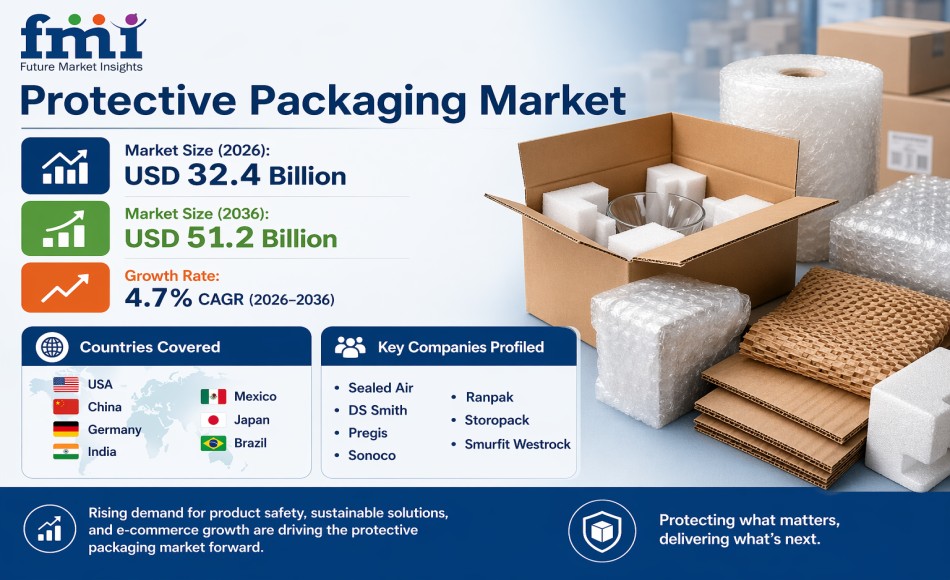
NEWARK, DE / ACCESS Newswire / April 24, 2026 / According to the latest market analysis by Future Market Insights (FMI), the global protective packaging market is entering a phase of operational optimization driven by rising parcel volumes, dimensional weight pricing pressures, and increasing automation across fulfillment centers. The market, valued at USD 30.9 billion in 2025, is projected to reach USD 32.4 billion in 2026 and further expand to USD 51.2 billion by 2036, registering a CAGR of 4.7% over the forecast period.
As logistics efficiency becomes critical, companies are prioritizing high-performance cushioning materials, automated dispensing systems, and right-sized packaging solutions to improve throughput and reduce shipping costs.
Quick Stats: Protective Packaging Market
Market Size (2026): USD 32.4 Billion
Market Size (2036): USD 51.2 Billion
Growth Rate: 4.7% CAGR (2026-2036)
Incremental Opportunity: USD 18.8 Billion
Top Growth Countries: India (6.4%), China (5.6%), USA (5.2%)
Leading Format Segment: Flexible Protective Packaging (44% share in 2026)
Top Application Segment: E-commerce Logistics (38% share in 2026)
Get detailed market forecasts, competitive benchmarking, and pricing trends: https://www.futuremarketinsights.com/reports/sample/rep-gb-626
Operational Efficiency Driving Market Transformation
The protective packaging market is expanding as fulfillment operations shift toward speed, precision, and cost control. High parcel volumes and dimensional weight pricing models are forcing logistics providers to minimize void space and optimize packaging materials.
Increasing reliance on automated dispensing systems
Rising need for right-sized packaging to reduce shipping costs
Growing importance of pack-station efficiency in high-volume environments
Pricing Trends and Procurement Shifts
Procurement strategies are evolving beyond material cost toward performance and efficiency metrics. Buyers now prioritize:
High dispensing speed for faster packing cycles
Consistent cushioning performance across shipment types
Compatibility with automated systems
Reduction of dimensional weight charges
Packaging efficiency is increasingly viewed as a direct contributor to operating margins.
Supply Chain and System Constraints
Despite growth, the market faces operational and integration challenges:
Compatibility issues with legacy warehouse systems
Delays in automation adoption due to infrastructure limitations
Moisture sensitivity in alternative materials like paper-based formats
Limited recycling infrastructure for flexible packaging
To address these issues, suppliers are investing in middleware integration and advanced material engineering.
Customize insights for your business strategy: https://www.futuremarketinsights.com/customization-available/rep-gb-626
Regional Demand and Growth Trends
Regional dynamics reflect differences in logistics maturity and regulatory frameworks:
India: Fastest growth driven by expanding e-commerce and logistics infrastructure
China: Export-driven demand supporting automation and lightweight packaging
United States: Cost pressure from carrier pricing accelerating automation adoption
Germany: Regulatory compliance driving sustainable material innovation
Brazil & Mexico: Growth supported by industrial expansion and cross-border trade
Key regional trends include:
Expansion of fulfillment infrastructure in emerging markets
Increased automation in developed logistics hubs
Rising focus on packaging efficiency over material cost
Product Innovation and Format Trends
Manufacturers are enhancing product performance and operational compatibility:
Flexible formats gaining traction due to lightweight properties
Development of precision dispensing technologies
Increased use of air-fill and inflatable solutions
Advancements in humidity-resistant paper-based materials
Segmental Demand Outlook
Flexible Packaging (44% share): Preferred for cost and storage efficiency
E-commerce Logistics (38% share): Driven by rising parcel shipments
Plastic Materials (48% share): Dominates due to durability and weight advantages
Cushioning (34% share): Essential for impact protection in transit
Key Buyers and Procurement Trends
Primary buyers include:
E-commerce fulfillment centers
Third-party logistics providers
Electronics manufacturers
Industrial goods distributors
Buyer expectations focus on:
High-speed packaging operations
Reliable material performance
Integration with automated systems
Cost optimization across shipping cycles
Regulatory Landscape and Market Pressure
Regulatory and cost pressures are reshaping the market:
Dimensional weight pricing by global carriers
Sustainability mandates and recycling requirements
Extended producer responsibility regulations in Europe
Increasing scrutiny on packaging waste
These factors are pushing companies toward efficient, compliant packaging solutions.
Competitive Landscape
Key players in the protective packaging market include:
Sealed Air
DS Smith
Pregis
Sonoco
Ranpak
Storopack
Smurfit Westrock
Competition is driven by:
Automation and equipment integration capabilities
Material innovation and performance validation
Supply chain reliability
Long-term contracts with logistics providers
Key Developments
Expansion of automated packaging systems
Integration of warehouse execution software with dispensing equipment
Development of lightweight and high-performance materials
Growth in leasing models for packaging machinery
Unlock 360° insights for strategic decision making and investment planning - https://www.futuremarketinsights.com/checkout/626
Outlook: Automation and Efficiency to Define Future Growth
The protective packaging market is evolving into a performance-driven industry where efficiency, automation, and cost optimization define competitive advantage. As global parcel volumes rise and logistics networks become more complex, demand for precision packaging solutions will continue to grow.
With strong expansion across emerging markets and ongoing innovation in materials and systems integration, the market is well-positioned for steady growth through 2036.
Explore More Research Reports by FMI
Unidirectional Tape (UD) Market Share Analysis: https://www.futuremarketinsights.com/reports/unidirectional-tape-market-share-analysis
Seam Tapes Market: https://www.futuremarketinsights.com/reports/seam-tapes-market
Demand for Boxboard Packaging in Japan: https://www.futuremarketinsights.com/reports/japan-boxboard-packaging-market
Metal Pallet Market: https://www.futuremarketinsights.com/reports/metal-pallet-market
Bio-Foam Insert Market: https://www.futuremarketinsights.com/reports/bio-foam-insert-market
About Future Market Insights (FMI)
Future Market Insights (FMI) is a leading provider of market intelligence and consulting services, serving clients in over 150 countries. Headquartered in Delaware, USA, with a global delivery center in India and offices in the UK and UAE, FMI delivers actionable insights to businesses across industries including automotive, technology, consumer products, manufacturing, energy, and chemicals.
An ESOMAR-certified research organization, FMI provides custom and syndicated market reports and consulting services, supporting both Fortune 1,000 companies and SMEs. Its team of 300+ experienced analysts ensures credible, data-driven insights to help clients navigate global markets and identify growth opportunities.
For Press & Corporate Inquiries
Rahul Singh
AVP - Marketing and Growth Strategy
Future Market Insights, Inc.
+91 8600020075
For Sales - sales@futuremarketinsights.com
For Media - Rahul.singh@futuremarketinsights.com
For web - https://www.futuremarketinsights.com/
SOURCE: Future Market Insights, Inc.
View the original press release on ACCESS Newswire