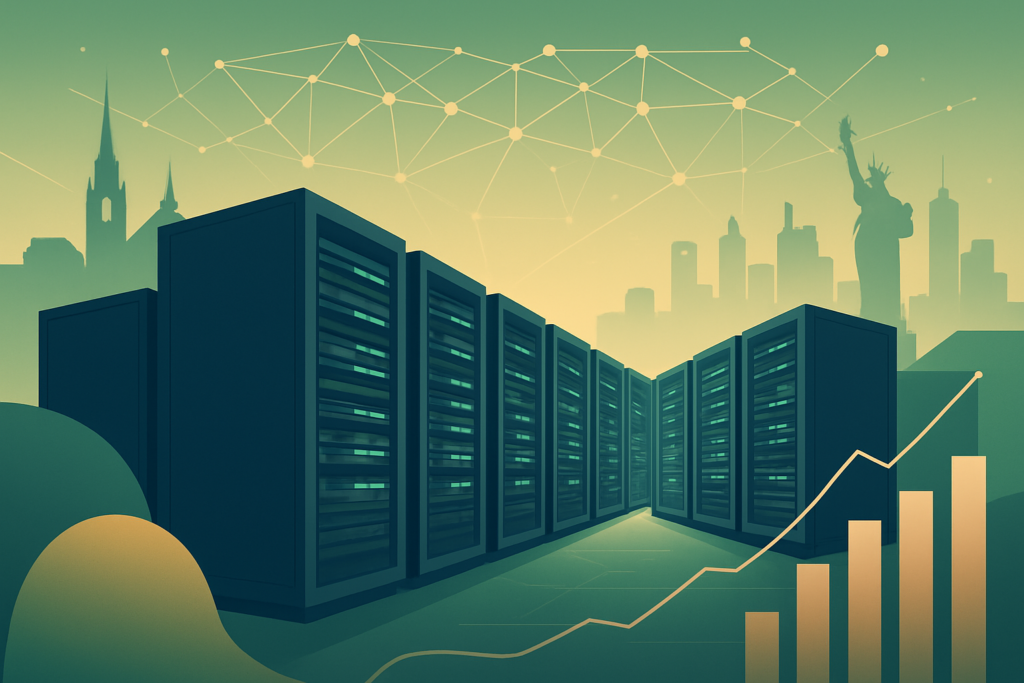
As of February 23, 2026, the global technology landscape is no longer defined merely by software, but by the physical infrastructure that powers artificial intelligence. Standing at the epicenter of this shift is Nebius Group (Nasdaq: NBIS). Once known as the international arm of a regional search giant, Nebius has successfully completed one of the most audacious pivots in corporate history, transforming into a pure-play AI infrastructure powerhouse. Today, investors view Nebius not just as a cloud provider, but as a critical "AI Factory" for the Western world, providing the massive compute required for the next generation of Large Language Models (LLMs) and generative applications. With a multi-billion dollar valuation and a rapidly expanding footprint across Europe and North America, Nebius is currently in focus as it scales to meet a projected $8 billion annual revenue run rate by the end of 2026.
Historical Background
The story of Nebius Group is inseparable from its predecessor, Yandex N.V., the Dutch parent company of Russia’s leading technology ecosystem. Founded by Arkady Volozh in the late 1990s, Yandex was often hailed as "the Google of Russia." However, the geopolitical tremors of 2022 necessitated a total structural divorce. After a grueling two-year negotiation process, Yandex N.V. sold its entire Russian-based business to a local consortium for $5.4 billion in mid-2024.
This divestment allowed the remaining Dutch entity to rebrand as Nebius Group, shedding its regional baggage and retaining its most valuable global assets: a world-class data center in Finland, a specialized engineering workforce of 1,300 experts who relocated to Europe and Israel, and a clean balance sheet. The company resumed trading on the Nasdaq in October 2024, marking its official "rebirth" as a Western-facing AI infrastructure specialist.
Business Model
Nebius operates under a "neocloud" model, specifically optimized for high-intensity AI workloads. Unlike legacy cloud providers that offer a broad range of general-purpose services, Nebius focuses on three core revenue streams:
- GPU-as-a-Service (GPUaaS): The primary driver, providing on-demand and reserved access to NVIDIA (Nasdaq: NVDA) H100, H200, and Blackwell B200 clusters.
- Vertical Integration: Nebius distinguishes itself by designing its own proprietary server racks and InfiniBand-based networking software, which significantly reduces the "latency tax" during large-scale model training.
- AI Lifecycle Management: Through its "AI Studio" and "Token Factory," Nebius provides the software layer for enterprises to fine-tune open-source models (such as Llama 4 or Mistral) and manage deployment pipelines.
By owning the full stack—from the data center cooling systems to the orchestration software—Nebius aims to offer better performance-per-dollar than the "Big Three" hyperscalers.
Stock Performance Overview
Since its return to the Nasdaq in late 2024, NBIS has been a high-beta favorite for AI investors.
- 1-Year Performance: Over the past 12 months, the stock has surged over 210%, significantly outperforming the S&P 500 and the Nasdaq 100.
- Recent Trends: After hitting a high of $142 in late 2025, the stock has consolidated to approximately $99.45 as of today, February 23, 2026. This pullback is largely attributed to a market-wide rotation into "infrastructure value" and concerns over the company's massive $18 billion capital expenditure plan for 2026–2027.
- Historical Context: Compared to its pre-2022 valuation as a search engine, the "New Nebius" trades at a significantly higher multiple, reflecting its transition from a high-margin advertising business to a high-growth, asset-heavy infrastructure play.
Financial Performance
Nebius’s financial trajectory is characterized by explosive top-line growth and heavy capital intensity.
- Revenue Growth: The company exited 2025 with an Annual Recurring Revenue (ARR) of $1.25 billion. Management’s guidance for 2026 is aggressively set between $7 billion and $9 billion, fueled by recent capacity expansions.
- Margins: Gross margins currently sit near 35%, lower than software-based AI plays but competitive within the GPUaaS sector. EBITDA is expected to turn consistently positive by the second half of 2026.
- Liquidity and Debt: Nebius maintains a robust cash position following its 2024 divestment, but the cost of securing Blackwell GPUs and building out 300MW data centers in the U.S. has led to increased debt-to-equity ratios. Investors are closely monitoring its "burn rate" relative to the deployment of new GPU clusters.
Leadership and Management
The company is led by Arkady Volozh, whose return to the helm in 2024 was seen as a major win for the group. Volozh, a pioneer in search and distributed systems, has successfully transitioned from a consumer-tech CEO to an infrastructure visionary.
The leadership team is bolstered by a deep bench of former Yandex engineers—often cited as some of the best distributed-systems architects in the world. This technical pedigree is a core part of the company’s governance reputation, providing confidence that Nebius can manage the extreme complexities of 50,000-GPU clusters without the downtime that has plagued smaller rivals.
Products, Services, and Innovations
Nebius’s competitive edge lies in its "AI Factory" concept.
- Blackwell Deployment: Nebius was among the first in Europe to deploy NVIDIA’s Blackwell architecture at scale, particularly in its Israel and Finland nodes.
- The Mäntsälä Data Center: Located in Finland, this facility is a marvel of efficiency. It uses a unique heat-recovery system that provides heating for the local town, resulting in a Power Usage Effectiveness (PUE) score that is among the lowest in the industry.
- Proprietary Networking: The company’s in-house "Nebius Fabric" allows for seamless multi-node training, essential for models with trillions of parameters.
Competitive Landscape
Nebius competes in a crowded but segmented market:
- Hyperscalers: Amazon (Nasdaq: AMZN) AWS, Microsoft (Nasdaq: MSFT) Azure, and Google (Nasdaq: GOOGL) Cloud. While they have more scale, their clouds are often seen as "generalist" and more expensive for specialized AI training.
- Specialized Rivals: CoreWeave and Lambda Labs are its closest competitors. CoreWeave currently leads in the U.S. market, while Nebius has a dominant foothold in Europe and is rapidly expanding into the U.S.
- The "Sovereign AI" Edge: Nebius is positioning itself as the preferred partner for European governments and enterprises that want to avoid reliance on U.S.-based hyperscalers.
Industry and Market Trends
As of early 2026, the AI market has shifted from "experimental" to "industrial."
- Sovereign AI: Nations are increasingly funding their own localized AI infrastructure to ensure data privacy and strategic autonomy. Nebius’s European roots make it a prime beneficiary of this trend.
- Inference vs. Training: While 2024-2025 was the era of training, 2026 is seeing a massive surge in inference demand. Nebius is adapting by building smaller, low-latency "edge" nodes in cities like Paris and London.
- Energy Constraints: Power availability is now the primary bottleneck for AI growth. Nebius’s ability to secure long-term power contracts in Finland and France is a significant competitive moat.
Risks and Challenges
Despite its growth, Nebius faces several hurdles:
- Capital Requirements: Scaling to meet $8 billion in revenue requires tens of billions in CapEx. Any tightening in credit markets could slow their expansion.
- NVIDIA Dependency: Like all GPUaaS providers, Nebius is beholden to NVIDIA’s supply chain. Any shift in NVIDIA’s allocation strategy could harm Nebius’s growth.
- Geopolitical Shadow: While legally separated from Russia, the company still navigates the complexities of its origins, which occasionally surfaces in ESG (Environmental, Social, and Governance) discussions or sensitive government contract bids.
- Proprietary Silicon: As hyperscalers develop their own chips (e.g., Google’s TPU, Amazon’s Trainium), the demand for third-party NVIDIA clouds could face long-term pressure.
Opportunities and Catalysts
Several near-term catalysts could drive NBIS higher in 2026:
- U.S. Expansion: The upcoming launch of its 300MW facility in Vineland, New Jersey, will signal its true arrival as a global player.
- Major Contracts: Recent rumors of a multi-year, multi-billion dollar partnership with Meta (Nasdaq: META) for Llama 4 training could serve as a massive validation of the Nebius platform.
- M&A Potential: As the specialized cloud market consolidates, Nebius could be an attractive acquisition target for a Tier-2 cloud provider or a large sovereign wealth fund looking for a turnkey AI platform.
Investor Sentiment and Analyst Coverage
Wall Street sentiment is currently "cautiously bullish."
- Analyst Ratings: The consensus remains a "Strong Buy," with a median price target of $155. Analysts at Northland and various boutique tech research firms highlight Nebius as a "pure-play" way to gain exposure to AI compute without the "bloat" of legacy cloud businesses.
- Institutional Moves: There has been a notable increase in institutional ownership in Q1 2026, with several large hedge funds pivoting from "Mag 7" stocks into infrastructure specialists like Nebius.
- Retail Sentiment: On social platforms, NBIS is frequently compared to "early-stage NVIDIA," though more sophisticated retail investors are closely watching the debt levels.
Regulatory, Policy, and Geopolitical Factors
Nebius is a key player in the "Sovereign AI" movement, particularly within the framework of the EU AI Act. By providing localized, transparent infrastructure, it helps European companies comply with strict data residency laws.
Geopolitically, the company has successfully navigated the "de-risking" phase. The lifting of EU sanctions on Arkady Volozh in 2024 was a pivotal moment, and since then, the company has operated with full transparency under Dutch and U.S. regulatory oversight. However, the ongoing tech cold war between the U.S. and China indirectly affects Nebius by tightening global GPU supply and export controls.
Conclusion
Nebius Group (NBIS) represents one of the most compelling and high-stakes transitions in the technology sector. By February 2026, it has proven that it is more than just a "rebranded Yandex"—it is a technically superior, vertically integrated AI powerhouse that has captured the "Sovereign AI" narrative in Europe while making aggressive inroads into the United States.
Investors must weigh the company’s extraordinary revenue growth and engineering excellence against the reality of its capital-heavy business model and the competitive pressure from hyperscalers. If Nebius can execute on its $8 billion ARR target while successfully launching its U.S. data centers, today's $100 price point may eventually be viewed as a floor in a much longer ascent. For now, it remains a "conviction play" for those who believe that AI infrastructure is the new "digital oil" of the 21st century.
This content is intended for informational purposes only and is not financial advice. Today's Date: 2/23/2026.