 A three-year-old electric van rolls into a body shop with a dented quarter panel and a cracked underbody tray. Cosmetically, it's a Tuesday. Structurally, it's fine. The repair estimate for the visible damage comes in at a number the fleet manager barely blinks at.
Then the adjuster asks whether the pack was breached.
That single question can turn a routine claim into a write-off, and it is the reason EV total-loss maths has stopped resembling anything the insurance industry spent the last eighty years perfecting.
The pack is the asset
On an internal combustion vehicle, value is distributed. Engine, transmission, body, interior, drivetrain. Damage one and you replace one. The write-off threshold sits somewhere around 60 to 75 percent of actual cash value depending on the jurisdiction and the insurer's own appetite, and getting there usually takes a genuinely severe impact.
On an EV, somewhere between a third and half of the vehicle's replacement cost is sitting in a sealed structural box under the floor. That box is not a component in the traditional sense. It is frequently a load-bearing part of the chassis, it cannot be opened by most independent shops, and in a growing number of models it cannot be partially repaired at all because the modules are bonded rather than bolted.
So the arithmetic collapses fast. A moderate side impact that would have cost a five-figure repair on a diesel equivalent can breach the write-off threshold on an EV purely because nobody is willing to certify the pack afterwards. Not because it's definitely damaged. Because it can't be cheaply proven undamaged.
That distinction matters enormously for anyone carrying EVs on the balance sheet as capital assets, and it is badly understood outside claims departments.
Degradation is not damage, except when it is
Here's where it gets genuinely awkward for underwriters.
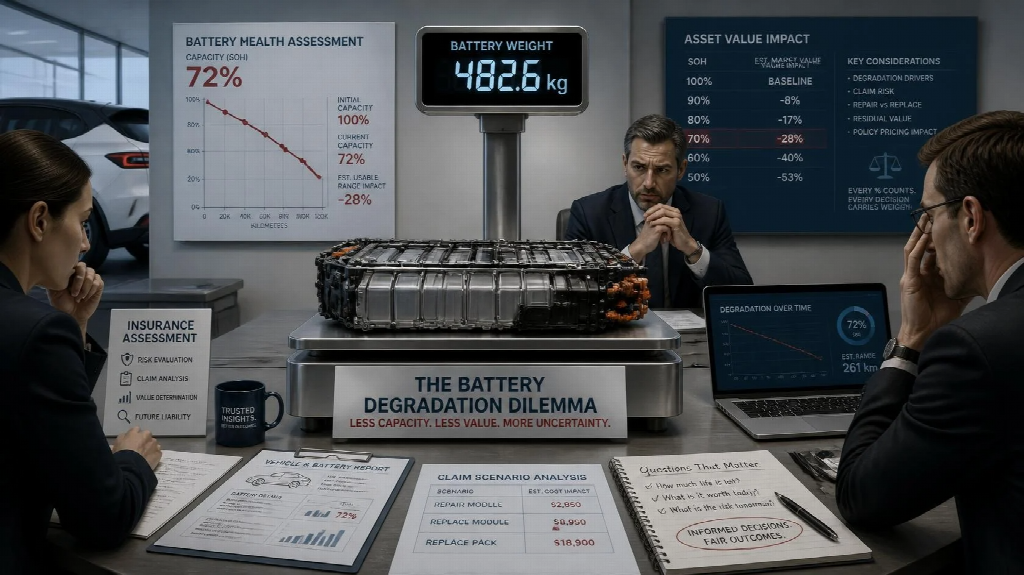
Every lithium-ion pack loses capacity over time. That's chemistry, not a fault. Work from the National Renewable Energy Laboratory on lithium-ion ageing has mapped how calendar life, cycle count, depth of discharge, and thermal history all compound, and the resulting curve is fairly predictable in aggregate. Most modern packs shed something in the region of 1.5 to 2.5 percent of usable capacity a year under normal duty, with the first year steeper than the rest.
Normal wear, in insurance terms. Excluded. Nobody covers a battery for simply getting older, any more than they cover tyre tread.
The problem is that degradation and damage produce overlapping symptoms. A pack that took a thermal event during a rapid-charging fault and a pack that has simply been abused by five years of daily DC fast charging in high ambient heat can present with similar capacity loss and similar cell imbalance. Distinguishing them requires reading battery management system logs, and those logs are proprietary, manufacturer-locked, and frequently unavailable to the loss adjuster on any reasonable timeline.
So the adjuster faces a choice between an expensive dealer diagnostic, a conservative write-off, or a guess. Guess wrong in the generous direction and you've paid for wear. Guess wrong in the strict direction and you've got a complaint and possibly a dispute.
Why residual values keep moving under everyone's feet
Total loss is a ratio, and the denominator is the vehicle's value. On EVs that denominator has been unusually volatile.
Manufacturer price cuts on new models have repeatedly reset used values overnight, in a way that has no real precedent in combustion markets. A fleet that bought at one price found its book value marked down within eighteen months by a decision taken in a boardroom on another continent. The International Energy Agency's annual EV outlook tracks how quickly battery and vehicle costs have fallen, and the trend that makes electrification affordable is the same trend that keeps demolishing the residuals underneath existing assets.
Lower vehicle value, unchanged repair cost, and the write-off threshold arrives sooner. A repair that was economic at purchase becomes uneconomic at year four without anything about the repair changing.
The bits that quietly wreck claims
Two categories of loss show up constantly in EV claims and are routinely uncovered under standard motor policies.
Charging equipment is the first. Portable cables walk off, get run over, get damaged by a faulty domestic circuit, or fail and take the onboard charger with them. They are expensive, they are frequently classed as accessories rather than vehicle parts, and a surprising number of fleet policies simply don't mention them.
Battery damage from non-collision causes is the second. Water ingress, road debris strikes to the underbody, charging faults, and thermal incidents that don't involve an impact at all. Whether these are covered depends entirely on policy wording rather than on anything obvious about the event, and the wording varies wildly between insurers. Anyone managing EVs as capital assets should be reading their schedule specifically for this, because the gap between what people assume is covered and what actually is turns out to be wide. This breakdown of the Crucial EV Insurance Add-ons: Charging Cable and Battery Damage Coverage is a useful check against your own policy, and it takes about ten minutes to work through.
The pattern is that EV losses cluster in places conventional motor policies were never drafted to handle. Not more frequent, necessarily. Just differently shaped.
What underwriters are actually doing about it
Three adaptations are emerging, and none of them is finished.
The first is state-of-health benchmarking at inception. Record pack health when the policy is written, not after the claim, so degradation and damage can be separated by comparison rather than by argument. Simple, obvious, and still not standard practice.
The second is separating the battery from the vehicle in the schedule entirely, with its own sum insured and its own depreciation treatment. This mirrors how leased packs are already handled in some markets and it stops one component's replacement cost from dictating the fate of an otherwise sound asset.
The third is pressure on repairability. Crash-test and repair-cost research from bodies like the Insurance Institute for Highway Safety has historically shaped how manufacturers design for damage, and the same lever is being pulled on pack architecture. Modular packs with individually replaceable sections cost more to build and dramatically less to repair. Insurers are starting to price that difference, which is the only signal manufacturers reliably respond to.
The practical takeaway
If you hold EVs as capital assets, the risk you're carrying is not really the risk of a crash. It's the risk that a moderate, survivable incident gets classified as a total loss because verifying the pack is harder than replacing the vehicle.
That risk is managed on paper, before anything happens. Document pack state of health annually. Confirm in writing whether charging equipment and non-collision battery damage sit inside or outside your cover. Ask your insurer what diagnostic evidence they will accept, and from whom, because discovering the answer during a claim is expensive.
The vehicles are fine. It's the paperwork underneath them that hasn't caught up.