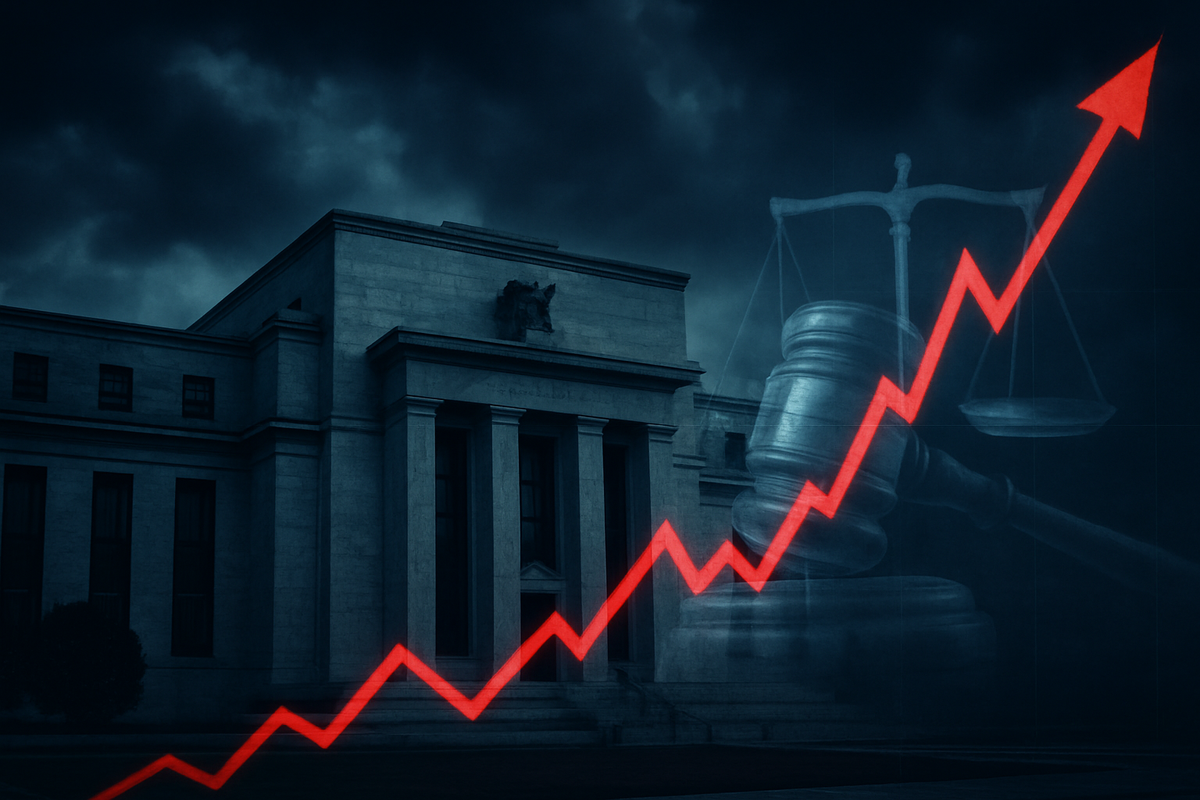
The bedrock of global financial stability was shaken on Monday, January 12, 2026, as U.S. Treasury yields surged in response to an unprecedented Department of Justice (DOJ) investigation into the Federal Reserve. The benchmark 10-year Treasury yield climbed to 4.20%, reflecting a sudden and sharp "political risk premium" as investors grappled with the news that the DOJ has issued grand jury subpoenas to the central bank. The probe, which targets Federal Reserve Chair Jerome Powell personally, has ignited fears that the era of central bank independence in the United States may be under existential threat.
The market reaction represents a "Sell America" trade, characterized by a simultaneous drop in the U.S. Dollar and a flight to hard assets like gold. With the 30-year Treasury yield jumping to 4.86%, the bond market is signaling deep unease over the potential for political interference in monetary policy. For investors, the immediate implication is clear: the perceived safety of U.S. sovereign debt is being questioned as the executive branch and the central bank enter a high-stakes legal and political confrontation.
The Renovation Scandal: A Pretext for Power?
The investigation, officially announced by Attorney General Pam Bondi on January 11, 2026, centers on allegations that Chair Jerome Powell misled Congress during his June 2025 testimony. The core of the DOJ's case involves a $2.5 billion renovation of the Federal Reserve’s Marriner S. Eccles Building. Prosecutors are investigating whether Powell committed perjury regarding cost overruns—which ballooned from an initial $1.9 billion—and the inclusion of "extravagant" luxury features such as VIP dining suites and custom marble finishes that he had previously denied under oath.
The timeline of the escalation was rapid. On Friday, January 9, grand jury subpoenas were served to the Fed’s Board of Governors, but the news did not break until the weekend, leaving markets to process the shock on Monday morning. In a defiant video statement released Sunday evening, Powell framed the probe as a retaliatory measure for the Fed’s refusal to lower interest rates in line with the administration's demands. "The threat of criminal charges is a consequence of the Federal Reserve setting interest rates based on our best assessment of the public interest," Powell stated, vowing to serve out his term until May 2026.
The initial market reaction has been one of defensive posturing. While short-term rates remained somewhat anchored by expectations of future economic slowing, the long end of the yield curve experienced a "bear steepening." This indicates that while the Fed might still control the short-term cost of money, the market is losing confidence in its long-term ability to keep inflation in check if it is subjected to political whims.
Winners and Losers in a High-Yield Environment
The sudden spike in yields has created immediate carnage in the technology and growth sectors. High-profile firms like Apple Inc. (NASDAQ: AAPL) and Microsoft Corp. (NASDAQ: MSFT) saw their shares underperform in pre-market and early session trading, as higher discount rates diminished the present value of their future cash flows. Technology stocks, which have led the market for much of the mid-2020s, are particularly sensitive to the rising "risk-free" rate represented by the 10-year Treasury.
Conversely, the chaos has been a boon for precious metals and the companies that extract them. As the U.S. Dollar Index (DXY) fell to 98.72, spot gold prices hit a historic record of $4,640 an ounce. This surge provided a massive tailwind for Newmont Corporation (NYSE: NEM) and other major miners, which are being viewed as the ultimate hedge against institutional instability. Investors are increasingly rotating out of "paper assets" and into "hard assets" as a safeguard against a potential de-anchoring of inflation expectations.
The real estate sector is bracing for a significant chill. Homebuilders like Lennar Corporation (NYSE: LEN) are facing the prospect of mortgage rates climbing back toward the 8% mark, which could stifle a housing market that was just beginning to stabilize. For banks like JPMorgan Chase & Co. (NYSE: JPM), the impact is mixed; while higher yields can improve net interest margins, the heightened systemic risk and the potential for a "political discount" on U.S. assets could lead to wider credit spreads and reduced investment banking activity.
A Dangerous Precedent for Central Bank Autonomy
The DOJ’s move against the Fed is not just a legal hurdle; it is a fundamental shift in the American institutional landscape. Historically, the Federal Reserve has operated with a degree of insulation from the executive branch to ensure that monetary policy is driven by data rather than election cycles. The current probe into Powell’s testimony is being viewed by many economists as a "pretextual" attack designed to force a more dovish policy stance. This mirrors historical pressures, such as those famously exerted by Richard Nixon on Arthur Burns in the 1970s, which many credit with fueling the "Great Inflation" of that decade.
The ripple effects are already being felt globally. Bipartisan groups of former Fed chairs, including Ben Bernanke and Alan Greenspan, issued a rare joint statement warning that the investigation threatens the rule of law. If global investors begin to view the Federal Reserve as an arm of the White House, the "exorbitant privilege" of the U.S. dollar as the world’s reserve currency could be permanently eroded. This would lead to permanently higher borrowing costs for the U.S. government and a more volatile environment for international trade.
Regulatory and policy implications are also looming. There is now a growing chorus in Congress, led by figures such as Senator Thom Tillis (R-NC), calling for emergency legislation to clarify the protections afforded to Fed officials. However, with the administration’s allies pushing the "taxpayer accountability" narrative, the path to a legislative solution remains blocked by deep partisan divides.
The Road Ahead: Volatility and Transition
In the short term, markets should prepare for a period of extreme volatility as the legal proceedings unfold. The DOJ is expected to begin reviewing internal Fed documents by the end of the month, and any further leaks regarding the "extravagant" renovations could provide more fodder for political attacks. For the Fed, the challenge will be to maintain a "business as usual" approach to monetary policy while its leadership is under criminal scrutiny.
The long-term outlook depends heavily on whether Powell chooses to resign or fight the charges from his office. If he resigns, the appointment of a successor will become the most significant financial event of the decade. Investors will be looking for a candidate who can restore the market’s faith in the Fed's independence. However, any nominee perceived as a "political appointee" could trigger a secondary sell-off in the bond market, potentially pushing 10-year yields toward 5%.
Strategic pivots are already underway at major hedge funds and institutional desks. We are seeing a shift toward "inflation-protected" portfolios and an increase in hedging against a potential sovereign credit downgrade. The "Treasury-Gold" ratio is becoming the most watched metric on Wall Street, as it serves as a barometer for the market’s trust in the federal government’s institutional integrity.
Navigating the New Risk Paradigm
The DOJ probe into the Federal Reserve has introduced a level of institutional risk that most modern investors have never had to model. The key takeaway from today’s market action is that the "independence" of the Fed is no longer a guaranteed constant, but a variable that can be impacted by political shifts. As yields remain elevated and the dollar remains under pressure, the traditional "60/40" portfolio is being tested by a correlation spike where both stocks and bonds sell off in tandem.
Moving forward, the market will be hyper-sensitive to any communication from the Treasury Department and the White House. Treasury Secretary Scott Bessent has already hinted at internal friction regarding the probe, and any sign of a "truce" could spark a massive relief rally. Conversely, if the DOJ moves toward a formal indictment of Powell, the floor could fall out from under the Treasury market.
Investors should watch for the next FOMC meeting minutes and any testimony from Attorney General Bondi. The primary focus should remain on the "term premium" in the bond market—if it continues to rise, it signals that the market's loss of faith is becoming structural rather than temporary. In this new era of financial history, the most valuable asset may not be capital, but credibility.
This content is intended for informational purposes only and is not financial advice.