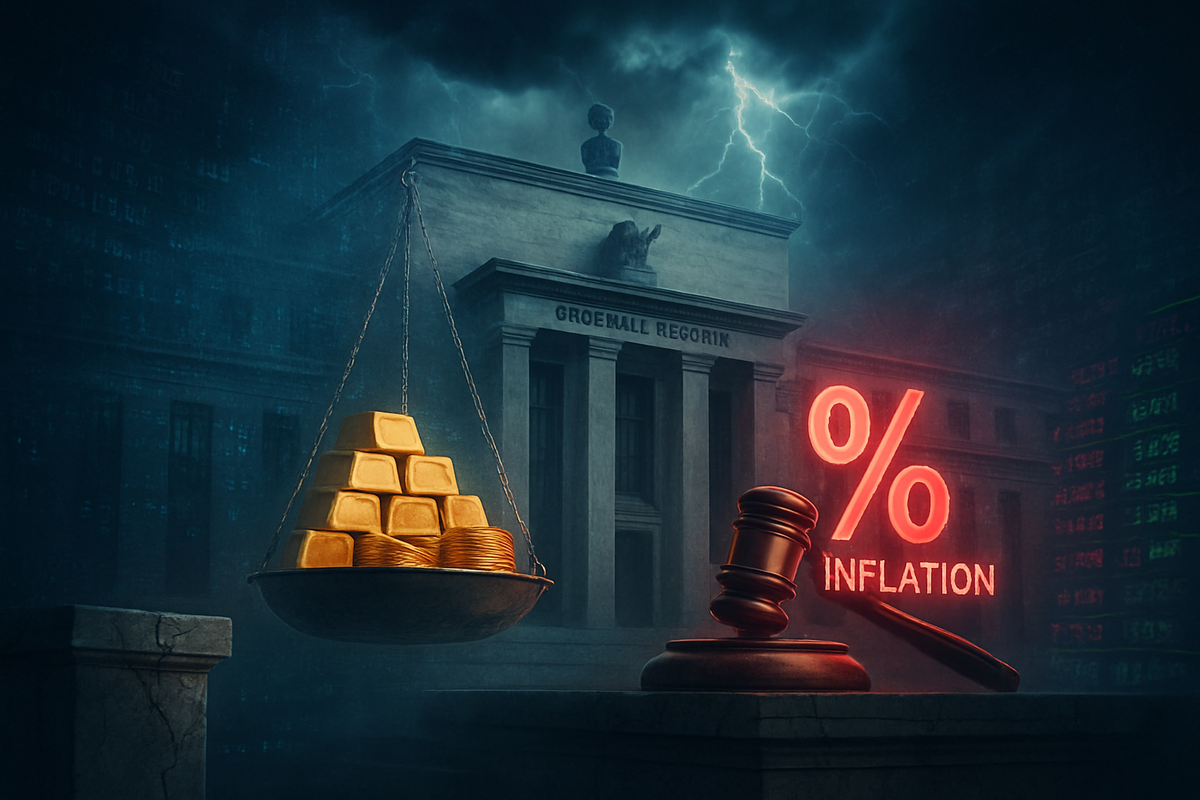
On the eve of one of the most consequential weeks for U.S. economic data in years, investors find themselves navigating a landscape of unprecedented volatility. The Bureau of Labor Statistics is set to release the December Consumer Price Index (CPI) on Tuesday, January 13, 2026, marking the first major "clean" look at inflation following a chaotic federal government shutdown that paralyzed data reporting in late 2025. This "data dump" arrives at a moment of extreme tension, as the Federal Reserve is currently embroiled in a high-stakes legal and political battle with the executive branch that threatens the very foundation of central bank independence.
The market is currently caught in a vice between sticky inflation figures and a "constitutional crisis" involving the Fed's leadership. With the Department of Justice (DOJ) serving grand jury subpoenas to Fed Chair Jerome Powell over the weekend, the upcoming inflation readings are no longer just economic indicators; they have become political ammunition. A high CPI reading would bolster the Fed’s argument for keeping interest rates steady at 3.50%–3.75%, while a lower-than-expected number would likely intensify the White House’s public campaign for immediate, aggressive rate cuts.
The Data Delay and the DOJ Subpoena: A Perfect Storm
The reporting schedule for January 2026 has been upended by the fallout from a late-2025 government shutdown. While the December CPI is scheduled for its standard release on January 13, the Producer Price Index (PPI) has been fractured. A "catch-up" report for November PPI is due on Wednesday, January 14, while the official December PPI figures have been pushed back to January 30. Economists are currently forecasting a headline CPI increase of 0.3% month-over-month, bringing the year-over-year rate to 2.7%. Core CPI is also expected to sit at 2.7%, a level that Fed officials have previously described as "stubbornly above target."
The technical aspects of the data release, however, have been overshadowed by the explosive news that the DOJ is investigating Chair Jerome Powell for alleged "criminal false statements" related to a $2.5 billion renovation of the Federal Reserve’s Washington headquarters. In a defiant video statement released on Sunday evening, January 11, Powell characterized the investigation as a "pretext" designed to intimidate the Federal Open Market Committee (FOMC) into lowering rates. This public rift has sent shockwaves through the financial system, as the President continues to label Powell a "numbskull" for his refusal to slash rates to 1% to fuel domestic growth.
The timeline leading to this week’s showdown began in mid-2025 when the administration implemented broad new tariffs, which many economists believe contributed to the current "sticky" inflation environment. As the Fed maintained a restrictive stance to combat these price pressures, political rhetoric escalated into legal action. The current standoff now includes a Supreme Court case regarding the President's authority to remove Fed Governors "at will," a move that would fundamentally dismantle the central bank's shield from political interference.
Winners and Losers: Gold Surges While Banks Retreat
The immediate market reaction to the "Fed chaos" and the impending CPI data has been a stark "flight to safety." Newmont (NYSE: NEM) (NEM: NYSE), the world’s largest gold miner, has seen its stock price surge by over 4% as spot gold prices shattered records, exceeding $4,600 per ounce. Investors are increasingly viewing "hard assets" as the only reliable hedge against a potential devaluation of the U.S. Dollar (DXY), which has weakened significantly as international trust in the American monetary framework wavers.
In contrast, the banking sector is reeling. JPMorgan Chase (JPM: NYSE) saw its shares drop nearly 4% in early Monday trading. Beyond the macro-uncertainty, the financial giant is facing a dual threat: the administration's proposed 10% cap on credit card interest rates and the rising "political risk premium" now attached to U.S. banks. With JPM scheduled to report earnings on January 13—the same day as the CPI release—investors are bracing for a period of intense volatility for "Big Finance."
In the technology sector, the reaction has been more nuanced. NVIDIA (NVDA: NASDAQ) has remained relatively flat, as its massive AI-driven growth story provides a buffer against interest rate anxieties. Recent billion-dollar deals in the AI infrastructure space have kept sentiment high, though a "hot" CPI reading tomorrow could trigger a rotation out of high-multiple growth stocks. Similarly, Amazon (AMZN: NASDAQ) is being watched as a potential "turnaround" play for 2026, with investors weighing accelerating AWS revenue against the risk of a consumer slowdown if inflation remains elevated.
A Historical Precedent and the End of Independence
The current conflict between the White House and the Federal Reserve has invited comparisons to the 1970s, specifically the pressure President Richard Nixon exerted on then-Fed Chair Arthur Burns to keep rates low ahead of the 1972 election. That era resulted in a decade of "Great Inflation" that was only broken by the draconian rate hikes of Paul Volcker. Analysts warn that if the Fed’s independence is compromised by the ongoing DOJ investigation or the Supreme Court’s eventual ruling on Governor removals, the market may lose its "inflation anchor," leading to long-term instability in the bond markets.
This event fits into a broader global trend of "fiscal dominance," where central banks are increasingly pressured to coordinate with government spending and debt management rather than focusing solely on price stability. The ripple effects are already being felt by international partners; the Euro and Yen have gained strength not because of their own economic merit, but because of the perceived erosion of the U.S. institutional "rule of law." If the CPI data tomorrow shows inflation is re-accelerating, the Fed will be forced to choose between its mandate and its survival.
Regulatory implications are also looming large. Senator Thom Tillis has already vowed to block any future Fed nominees until the DOJ's investigation into Powell is resolved. This legislative gridlock could leave the Fed Board understaffed at a time when it needs to make its most critical decisions in decades. The precedent being set today—using criminal investigations as a tool of monetary policy—is one that could haunt the U.S. financial system for generations.
What Comes Next: The January FOMC Meeting and Beyond
In the short term, all eyes are on the January 27-28 FOMC meeting. Despite the political firestorm, the market currently assigns a 95% probability that the Fed will hold rates steady. However, a significant surprise in tomorrow’s CPI data could shift those odds. If the CPI comes in well above 2.7%, the Fed may be emboldened to maintain its "higher for longer" stance, essentially daring the administration to take further legal action. Conversely, a soft reading could provide a "face-saving" exit for both parties, allowing for a rate cut that the market would interpret as data-driven rather than politically coerced.
Longer-term, the strategic pivot for investors will likely involve a permanent increase in exposure to non-dollar assets. The "market opportunity" in 2026 appears to be shifting toward companies with high capital efficiency and low debt, such as the major tech players, or those tied to commodities. The potential scenario of a "forced" rate cut in the face of rising inflation—a "nightmare scenario" for bondholders—is no longer a fringe theory but a primary risk factor being priced into the 10-year Treasury yield.
Strategic adaptations will also be required for multinational corporations. If the U.S. enters a period of high political volatility regarding its currency, companies like Amazon and NVIDIA may accelerate their international diversification to mitigate "home country" risk. The coming months will likely see a flurry of corporate restructuring as businesses prepare for a more interventionist and less predictable Federal Reserve.
The Investor’s Outlook: Watching the Pillars of Stability
The convergence of delayed inflation data and a full-blown constitutional crisis at the Federal Reserve marks a turning point for the American economy. The key takeaway for investors is that the "Fed Put"—the long-held belief that the central bank will always step in to support the market—is now entangled in a web of legal and political maneuvers. The upcoming CPI and PPI reports are the first hurdles in a year that promises to redefine the relationship between the U.S. government and its currency.
Moving forward, the market will likely remain in a defensive posture until there is clarity on Jerome Powell’s status and the Supreme Court’s stance on Fed independence. Investors should watch the 10-year Treasury yield and the price of gold as the primary barometers of institutional trust. While individual company fundamentals like those of NVIDIA remain strong, they are currently secondary to the macro-political "earthquake" centered in Washington D.C.
In the coming months, the focus will shift from "how much" the Fed will cut to "who" is making the decision. If the December inflation data proves to be the last report issued under a truly independent Federal Reserve, the market’s valuation models will need a total overhaul. For now, the watchword is caution, as the world’s most powerful financial institution fights for its life against the backdrop of a 2.7% inflation rate that refuses to go away.
This content is intended for informational purposes only and is not financial advice.