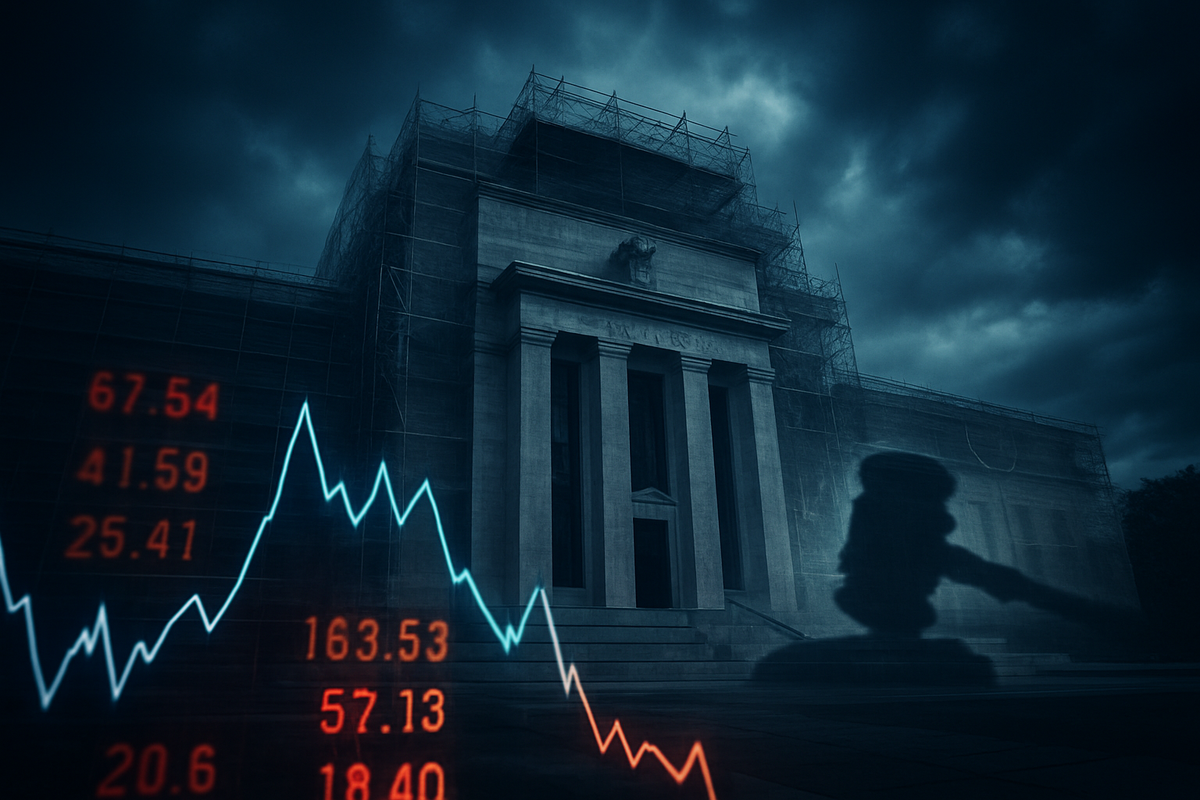
The global financial landscape was thrust into a state of high anxiety this week as the Department of Justice (DOJ) intensified its criminal investigation into Federal Reserve Chair Jerome Powell. The probe, which centers on alleged misrepresentations regarding the multi-billion dollar renovation of the Federal Reserve's headquarters in Washington, D.C., has moved beyond a mere administrative dispute into a full-blown constitutional standoff. Investors are now grappling with the terrifying possibility of a politicized central bank, a scenario that has historically preceded periods of runaway inflation and institutional decay in emerging markets.
The immediate implications for the market have been stark. Since the revelation on Sunday, January 11, that the Federal Reserve had been served with grand jury subpoenas, market volatility has spiked. While the primary indices have shown some resilience due to mega-cap earnings, the underlying "independence premium"—the cost of insuring against political interference in monetary policy—is being priced into everything from Treasury yields to the price of gold. As of January 19, 2026, the standoff remains the primary driver of institutional caution on Wall Street.
The Renovation Scandal: Fact or Political Pretext?
The investigation targets testimony provided by Powell before the Senate Banking Committee in June 2025. At the heart of the matter is the renovation of the Marriner S. Eccles Building and its adjacent structures. What began as a $1.9 billion modernization project in 2019 has since ballooned to a staggering $2.6 billion. DOJ investigators, reportedly prompted by the Office of Management and Budget (OMB), are examining whether Powell knowingly misled Congress by characterizing these cost overruns as necessary structural expenses—such as asbestos removal and foundation stabilization—rather than the "lavish" upgrades alleged by his critics.
The timeline of the escalation is as rapid as it is unprecedented. Following a series of public attacks from the executive branch regarding the Fed's refusal to cut interest rates by the requested 200 basis points, the DOJ moved to formalize the probe in late 2025. On Friday, January 9, 2026, the subpoenas were delivered, and by the following Monday, the markets were in a tailspin. Federal Reserve officials have countered the DOJ's narrative, asserting that the cost increases were driven by post-pandemic inflation and the discovery of hazardous materials within the historic 1930s-era building.
The political dimension of the probe is impossible to ignore. Powell has publicly framed the investigation as a "consequence of the Federal Reserve setting interest rates based on our best assessment of the economic data, rather than following the preferences of the President." This defense has resonated with institutional investors but has done little to calm the nerves of those who fear a leadership vacuum at the world’s most powerful central bank. Key stakeholders, including U.S. Attorney for D.C. Jeanine Pirro, have maintained that no government official is above the law, regardless of the potential for market disruption.
Winners and Losers in the Wake of Institutional Instability
The market’s reaction has created a clear divide between defensive assets and the financial sector. Shares of major banking institutions, including JPMorgan Chase & Co. (NYSE: JPM) and The Goldman Sachs Group, Inc. (NYSE: GS), faced immediate selling pressure as the probe raised questions about the future of the regulatory environment. Large-scale lenders are particularly sensitive to shifts in central bank leadership, and the prospect of a more compliant, politically-appointed Chair has stoked fears of a return to the inflationary cycles of the 1970s.
Conversely, safe-haven assets have seen a historic surge. SPDR Gold Shares (NYSEARCA: GLD) and physical gold prices reached record highs of over $4,600 per ounce this week, as the "independence premium" drove investors away from the dollar. While the SPDR S&P 500 ETF Trust (NYSEARCA: SPY) was initially buoyed by a $4 trillion valuation milestone for Alphabet Inc. (NASDAQ: GOOGL), the broader index has remained under pressure as the VIX volatility index hovered near 16.0, indicating a growing demand for downside protection.
U.S. Treasuries have also seen a "political risk premium" attached to their yields. The yield on the 10-year Treasury note edged up to 4.2%, a move that analysts say reflects a loss of confidence in the long-term stability of U.S. economic governance. If the DOJ's pursuit of Powell leads to a forced resignation before his term expires in May 2026, fixed-income markets could face even more significant turbulence as the prospect of a "shadow Fed" guided by the White House becomes a reality.
A Precarious Precedent for Global Markets
The significance of this event extends far beyond the renovation costs of a building in Washington. In the broader context of industry trends, the probe marks a watershed moment for the doctrine of central bank independence. Since the Volcker era, the Fed’s ability to act as a non-political arbiter of the economy has been a cornerstone of global financial stability. The current DOJ action threatens to dismantle that precedent, effectively treating the Fed as just another executive agency subject to political discipline.
The ripple effects are being felt globally. Central banks in Europe and Asia are closely watching the situation, fearing that a weakening of the Fed’s autonomy could trigger a global shift toward more interventionist monetary policies. Historical precedents are few and far between; while Fed chairs have faced political pressure in the past—most notably during the Nixon and LBJ administrations—never before has a sitting Chair been the subject of a criminal grand jury investigation related to his official duties and Congressional testimony.
Regulatory and policy implications are also looming. The standoff has already triggered a bipartisan backlash in the Senate, with some lawmakers pledging to block all future Fed appointments until the DOJ withdraws its subpoenas. This legislative gridlock could leave the Federal Open Market Committee (FOMC) understaffed and unable to respond effectively to future economic shocks, creating a systemic risk that the market is only beginning to price in.
The Road Ahead: A Grueling Standoff
In the short term, all eyes are on the upcoming FOMC meeting scheduled for January 27–28. Market participants are divided on how the Fed will react; some believe the committee may hold rates steady to demonstrate its defiance of political pressure, while others fear the legal distractions could lead to a policy error. Powell has vowed to remain in his post, stating that public service requires "standing firm in the face of threats." However, the looming expiration of his term in May 2026 means that the administration will soon have a formal opportunity to install a successor, regardless of the probe's outcome.
Strategic pivots may be required for institutional investors who have long relied on the "Fed Put"—the idea that the central bank will step in to support markets during a crisis. If the Fed becomes an arm of the executive branch, its priorities could shift from inflation targeting and maximum employment to supporting the government’s fiscal and political agenda. This would necessitate a massive reallocation of capital into inflation-protected securities and hard assets, a move that is already beginning to manifest in current trading volumes.
Conclusion and Investor Takeaways
The DOJ probe into Jerome Powell represents one of the most significant challenges to the U.S. financial system in decades. The core takeaway for investors is that the institutional guardrails that have protected the Fed from political interference are currently being tested to their breaking point. The market is no longer just evaluating economic data; it is evaluating the survival of an institution.
Moving forward, investors should watch for any movement in the grand jury proceedings and the tone of the Fed’s January policy statement. Any sign of a leadership transition under duress will likely lead to further spikes in volatility and a continued flight to gold and other non-dollar assets. The "independence premium" is here to stay, and for the next several months, the halls of the Eccles Building will be the site of a battle that will define the future of the American economy.
This content is intended for informational purposes only and is not financial advice.