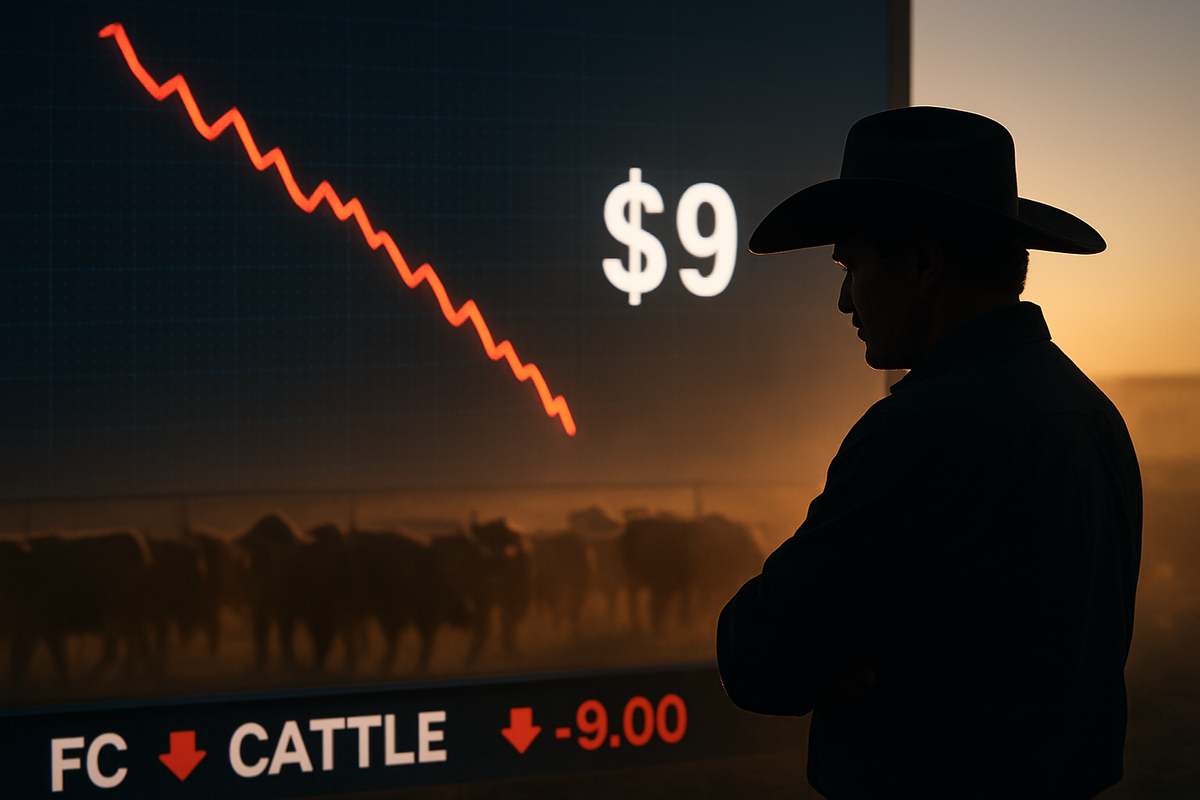
CHICAGO — The cattle market, which had been charging through the early weeks of 2026 with historic momentum, hit a punishing wall on Friday, January 16. In a session that sent shockwaves through the agricultural sector, feeder cattle futures experienced a staggering collapse, with some contracts falling by more than $8 to $9 in a single day of trading. This sudden reversal has wiped out a week’s worth of gains and forced a grim re-evaluation of risk management strategies for producers across the Great Plains and beyond.
The immediate implications of this "mini-collapse" are profound. While the fundamental story of the American cattle industry remains one of critically tight supplies, the volatility displayed on Friday serves as a stark warning: supply scarcity does not guarantee a linear path upward for prices. For ranchers and feedlot operators, the crash is a painful reminder that the market can "take the stairs up and the elevator down," leaving those without price protection exposed to massive equity erosion in a matter of hours.
A Technical Freefall: Behind the Friday Crash
The volatility began in earnest on Monday, January 12, as feeder cattle futures hit new highs, buoyed by optimistic demand forecasts. However, the tide turned abruptly on Friday. March feeder cattle contracts plummeted $8.10, settling at $356.45 per hundredweight (cwt). Other feeder contracts were hit even harder, with some sessions seeing total slides of nearly $9.00. The live cattle complex was not spared either; April live cattle contracts fell $4.45 to $233.98 per cwt, dragged down by the sheer velocity of the feeder sell-off.
Analysts point to a "perfect storm" of factors that converged on Friday. First, a bearish report from the United States Department of Agriculture (USDA) revealed a surprising 1.3-million-acre increase in harvested acreage for key grain crops, which weighed heavily on the broader agricultural sentiment. Second, the market reached a state of "technical exhaustion" after months of rallying. As prices hit resistance levels, a wave of profit-taking by institutional investors triggered automated sell orders, accelerating the decline. Furthermore, feedlots have recently been purchasing heavier yearlings to minimize days on feed, a strategy that backfired as the high cost of these "heavy" replacements suddenly met a falling futures market, squeezing margins to the breaking point.
Winners and Losers: The Corporate Impact
The ripple effects of the cattle price collapse are being felt across the balance sheets of several major public companies. Beef processors, or "packers," often find themselves in a complex position during such volatility. Tyson Foods, Inc. (NYSE: TSN) and JBS S.A. (OTC: JBSAY) could theoretically benefit from lower live cattle prices in the short term, as their procurement costs for slaughter-ready animals decrease. However, extreme volatility often disrupts the steady flow of supply, and if ranchers respond to the crash by withholding cattle from the market, these processors could face operational inefficiencies at their facilities.
Conversely, the drop in feeder prices is a direct blow to the valuation of current inventories for large-scale ranching operations and diversified agricultural firms. On the feed side, Archer-Daniels-Midland Company (NYSE: ADM) and Bunge Global SA (NYSE: BG) are watching the situation closely. While the USDA report suggested higher grain acreage (potentially lowering feed costs), a destabilized livestock sector can reduce overall demand for high-protein feed additives. Meanwhile, major retailers like Walmart Inc. (NYSE: WMT) and The Kroger Co. (NYSE: KR) may see a delayed benefit if the collapse leads to lower wholesale beef prices, allowing them to either improve retail margins or offer promotional pricing to price-weary consumers.
The End of "Hope-Based" Marketing
This event fits into a broader industry trend toward extreme price swings driven by low liquidity in cattle futures. With fewer participants in the feeder cattle pits compared to grains or oilseeds, even moderate shifts in sentiment can lead to outsized price movements. Historically, this level of volatility was rare, but in the post-pandemic era of 2024–2026, it has become a recurring nightmare for producers.
The primary lesson emerging from the January 16 crash is the absolute necessity of "marketing discipline." For years, many cattle producers operated on a "wait and see" approach, hoping for the absolute peak of the market before booking sales. Agricultural economists are now urging a pivot toward structured risk management. The shift involves using options—specifically purchasing "put" options—to establish a floor under cattle prices while leaving the upside open. The Jan 16 collapse proved that "marketing never takes a day off," and those who failed to protect a $350+ feeder price are now facing the reality of selling into a much weaker window.
Looking Ahead: A Volatile Horizon
In the short term, the market will look for signs of stabilization. If the $350 level for feeder cattle holds, it may provide a base for a tactical recovery. However, the psychological damage to the market is significant. Producers are expected to become much more aggressive in hedging their remaining 2026 inventories, which could create "overhead resistance" that prevents prices from returning to their early January highs anytime soon.
Long-term, the industry remains constrained by the smallest U.S. cattle herd in decades. This structural supply shortage should provide a long-term "bid" under the market, but the path forward will likely be characterized by "violent sideways" trading. Strategic adaptations will include a move toward "break-even based selling," where producers sell based on their specific cost of gain rather than speculative market targets. We may also see an increase in direct-to-consumer sales or specialized "value-added" programs as ranchers seek to decouple themselves from the volatility of the CME futures exchange.
Closing the Books on a Dark Friday
The cattle market collapse of January 2026 will likely be remembered as the moment the "bull market" entered its most volatile and dangerous phase. The $8 to $9 drop in feeder futures was not just a numbers game; it represented a massive transfer of wealth and a wake-up call for an industry that had grown perhaps too comfortable with record-high prices.
Moving forward, investors and stakeholders should keep a close eye on weekly slaughter rates and cash trade reports. The disconnect between "paper" futures and "physical" cash cattle will be the key narrative to watch. While the fundamentals of tight supply remain intact, the Friday crash proved that in a modern, high-speed trading environment, fundamentals are often secondary to momentum and technical triggers. For the American rancher, the message is clear: the days of "hope" as a marketing strategy are over; the era of discipline has arrived.
This content is intended for informational purposes only and is not financial advice.