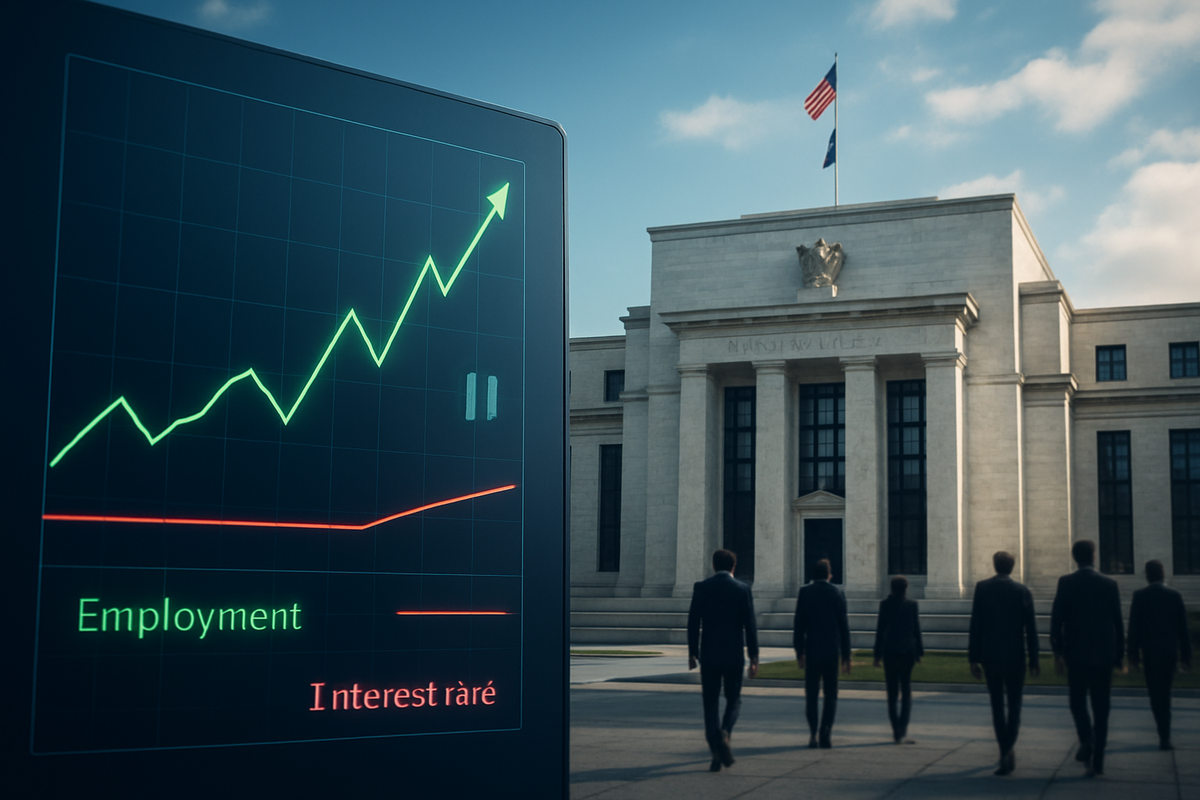
Federal Reserve Governor Christopher Waller delivered a sobering message to financial markets on February 23, 2026, signaling that the central bank is likely to skip a widely anticipated interest rate cut at its upcoming March meeting. Speaking at the National Association for Business Economics (NABE) conference, Waller cited a surprisingly robust January employment report as a primary reason for the Fed to exercise caution. The shift in tone marks a significant departure from the "dovish" expectations that had dominated investor sentiment early in the year, as the central bank grapples with a labor market that appears far more resilient than previously feared.
The immediate implications of Waller’s "wait-and-see" approach have reverberated across global markets, effectively dashing hopes for a series of aggressive rate cuts in the first half of 2026. By characterizing the March decision as a "coin flip" that hinges on further data, Waller has forced a repricing of risk assets and spurred a surge in U.S. Treasury yields. Investors, who were once betting on a steady descent of borrowing costs, are now facing the reality that the Fed's "higher-for-longer" mantra may have more staying power than anticipated as the "last mile" of the inflation fight proves stubborn.
A Hawkish Pivot at the NABE Conference
Governor Waller’s speech, titled "Labor Market Data: Signal or Noise?", served as the definitive catalyst for a market-wide recalibration. Waller, who had been a vocal proponent of easing just months ago, admitted that the January "upside surprise" in hiring had fundamentally altered his risk assessment. The January jobs report, released on February 11, 2026, revealed that the U.S. economy added 130,000 jobs—nearly double the consensus estimate of 70,000—while the unemployment rate unexpectedly ticked down to 4.3%.
This data followed a grueling 2025, which benchmark revisions now show was a "hiring recession" with only 181,000 total jobs added for the entire year. The sudden burst of activity in January suggests to policymakers that the economy may be finding its footing after a period of stagnation. Waller emphasized that while he does not want to overreact to a single month of data, skipping the March meeting would allow the Federal Open Market Committee (FOMC) to verify if this strength is a sustainable trend or merely a statistical anomaly caused by post-shutdown volatility.
Initial market reactions were swift. The CME FedWatch Tool, a barometer for interest rate expectations, saw the probability of a March rate cut plummet to just 6%, down from nearly 50% just weeks prior. The U.S. Dollar Index (DXY) climbed as international investors sought the yield advantage of the greenback, while Bitcoin and other risk-on assets faced selling pressure, with the premier cryptocurrency falling below the $66,500 mark in late February trading.
The Corporate Landscape: Winners and Losers in a High-Rate Environment
The prospect of sustained higher rates has created a stark divide in the corporate world. Among the clear winners are institutional custody banks like The Bank of New York Mellon Corp (NYSE: BK) and State Street Corp (NYSE: STT). These firms benefit immensely from higher Net Interest Income (NII) on the massive uninvested cash balances they manage for global clients. As long as the Fed holds rates in the 3.50%–3.75% range, these "cash-heavy" institutions can capture wider margins on their lending and security portfolios, a trend that has already begun to lift their share prices following Waller's remarks.
Conversely, the consumer discretionary sector is bearing the brunt of the "higher-for-longer" reality. Retail giants such as Nike Inc. (NYSE: NKE) and Starbucks Corp (NASDAQ: SBUX) have seen their recovery efforts hampered by high borrowing costs that continue to squeeze middle-class disposable income. Similarly, The Wendy's Co (NASDAQ: WEN) recently reported a decline in full-year sales, citing a cautious consumer base that is increasingly sensitive to the cost of credit. For these companies, a skipped rate cut in March means another quarter of elevated debt servicing costs and potentially softer foot traffic.
The technology sector remains a mixed bag. While AI infrastructure behemoths like NVIDIA Corp (NASDAQ: NVDA) continue to see record capital expenditures regardless of interest rates, smaller growth-stage tech firms and fintechs are feeling the squeeze. For these firms, the "venture and startup hiring channel" remains largely closed as the cost of capital stays high, forcing a focus on "survival over strategic expansion." Meanwhile, real estate firms like Cushman & Wakefield PLC (NYSE: CWK) continue to navigate a landscape where high rates delay new project starts, despite robust demand in the multifamily housing sector.
Analyzing the Broader Significance: The End of the Hiring Recession?
Waller’s shift fits into a broader industry trend of "data-dependent" central banking that has characterized the post-pandemic era. The transition from the 2025 "hiring recession" to the robust January numbers suggests a "soft landing" may be back on the table, but it comes with the price of delayed monetary easing. This event signals to global markets that the Fed is more terrified of a premature cut that reignites inflation than it is of a slight overshoot in restrictive policy.
The ripple effects extend to the Fed's partners and competitors in global finance. As the Fed stays its hand, other central banks—such as the European Central Bank and the Bank of England—may find it difficult to cut rates significantly without triggering currency depreciation against a strong U.S. dollar. This creates a "global policy synchronization" issue where the Fed effectively sets the floor for borrowing costs worldwide. Historically, this mirrors the mid-1990s "soft landing" attempt, where the Fed successfully navigated a growth slowdown without plunging the economy into a deep recession, albeit at the cost of prolonged market volatility.
Navigating the Path to May and June
Looking ahead, the short-term focus shifts entirely to the March 6 labor report. If that data confirms the January strength, the March "skip" becomes a certainty, and all eyes will move to the May FOMC meeting. Investors should prepare for a period of heightened sensitivity to "second-tier" economic indicators, such as retail sales and regional manufacturing surveys, which will now be scrutinized for any signs of economic cooling that might justify a late-spring pivot.
In the long term, companies may be forced to adapt their capital structures to a world where 3% or 4% is the "new neutral" rather than the 0% floor seen in the previous decade. This could lead to a strategic pivot toward organic growth and profitability over debt-fueled expansion. Market opportunities may emerge in "value" sectors and small-caps, as seen in the recent resilience of the Russell 2000 index, provided the economy avoids a full-blown contraction. However, the challenge remains for the Fed to time its eventual cut perfectly—too late, and they risk a hard landing; too early, and they lose the hard-won progress against inflation.
Summary and Investor Outlook
The pivot by Christopher Waller is a reminder that the Federal Reserve remains the ultimate arbiter of market liquidity, and its path is rarely linear. The key takeaways are clear: the labor market's resilience has bought the Fed time, the "hiring recession" of 2025 may be ending, and the hurdle for a March rate cut is now exceptionally high. For the market moving forward, the focus is no longer on "when" the cuts begin, but "if" the economy can sustain its momentum without the crutch of cheaper credit.
For investors, the coming months require a defensive yet opportunistic posture. Watch for the performance of custody banks and high-quality "cash cows" that thrive in high-rate environments, while remaining cautious of over-leveraged consumer and real estate stocks. As we move closer to the March 17-18 FOMC meeting, the volatility seen in February is likely to persist. The Fed has made its stance clear: they are willing to wait for the data to speak, and for now, the data is shouting for caution.
This content is intended for informational purposes only and is not financial advice.