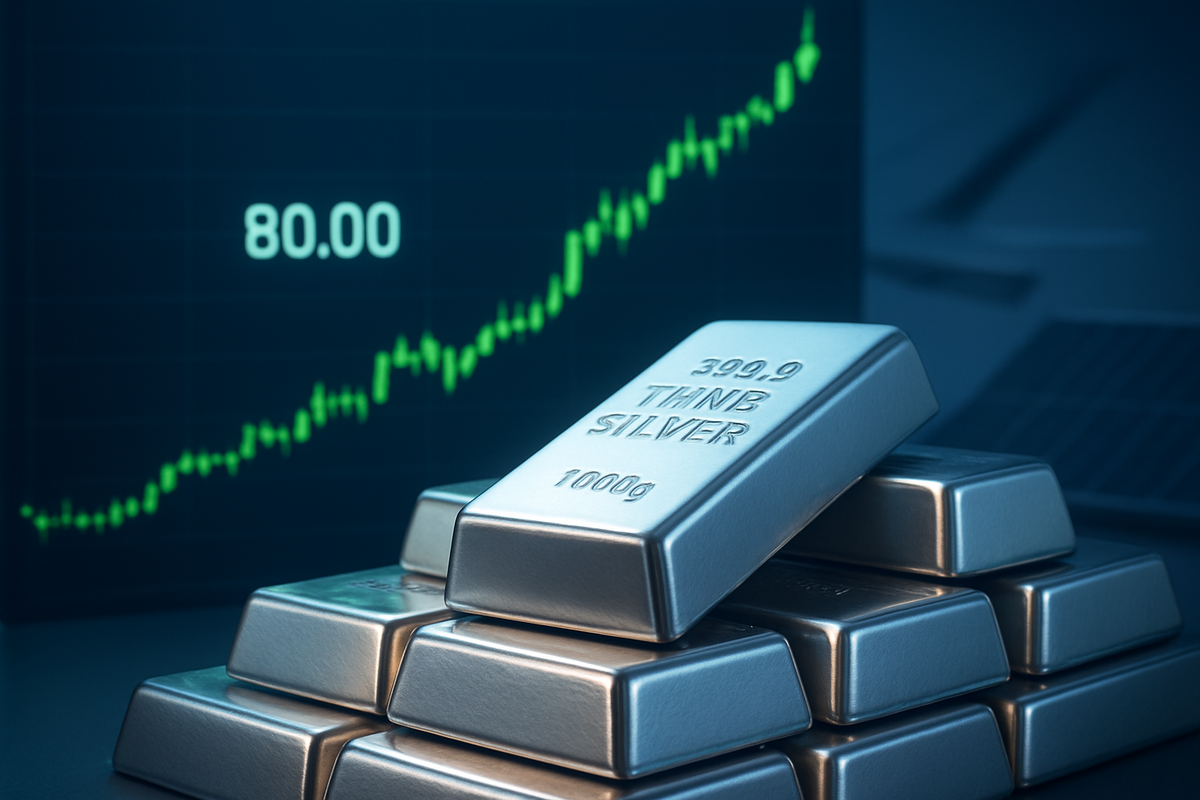
As of February 23, 2026, the global silver market is witnessing a historic "catch-up" rally, with spot prices firmly reclaiming the $80 per ounce milestone after a month of extreme volatility. In a high-octane trading session today, silver futures on the COMEX surged by more than 5%, extending a four-session winning streak that has effectively erased much of the "flash crash" losses seen earlier in the month. This resurgence signals a robust return of buyer conviction, driven by a convergence of structural supply deficits and a significant injection of liquidity from Asian markets following the conclusion of the Lunar New Year holidays.
The immediate implications of this rally are profound for both institutional investors and industrial end-users. With silver now trading in the $84.00 to $87.80 range, the metal has successfully flipped its previous $80 resistance level into a formidable zone of technical support. This price action is not merely speculative; it is underpinned by a sixth consecutive year of global supply deficits and the metal’s newly minted status as a "U.S. Critical Mineral." As the market stabilizes, the focus has shifted toward the sustainability of this move and the potential for silver to retest its January all-time highs of $121 per ounce.
The Resurrection of the "Poor Man’s Gold"
The path to $80 has been anything but linear. After a speculative frenzy in late January 2026 pushed prices to a record $121.67, the market suffered a dramatic "flash crash" in early February, with prices plunging as low as $63.85 in a matter of days. This correction was fueled by hiked margin requirements at major exchanges and a temporary liquidity vacuum during the Lunar New Year celebrations in China. However, since the reopening of markets in Shanghai and Hong Kong on February 17, a tidal wave of physical and paper demand has returned. Large-scale Chinese industrial buyers and retail investors have stepped back into the fray, viewing the sub-$70 prices as a generational buying opportunity.
Beyond the seasonal liquidity return, geopolitical tensions have added fuel to the fire. Renewed trade uncertainty, sparked by a 15% global tariff implementation following a recent U.S. Supreme Court ruling, has bolstered silver’s appeal as a safe-haven asset. Simultaneously, escalating military posturing between the U.S. and Iran has reintroduced a significant risk premium into precious metals. Unlike gold, which has remained relatively stable, silver’s dual role as an industrial powerhouse and a monetary hedge has allowed it to outperform its yellow sibling, with the gold-to-silver ratio narrowing to a lean 64:1.
The stakeholders involved in this move are diverse, ranging from central banks diversifying their reserves to massive industrial conglomerates in the green energy space. Initial market reactions suggest a "fear of missing out" (FOMO) among institutional players who were sidelined during the early February dip. This is evident in the record-high trading volumes seen on the Multi Commodity Exchange (MCX) and COMEX today, where the 5% jump in futures was accompanied by a significant spike in open interest, suggesting that this is a trend-following move with legs.
Windfalls for Miners and Woes for Manufacturers
For the primary silver producers, this rally represents a "goldilocks" scenario where profit margins are expanding at an unprecedented rate. Wheaton Precious Metals (NYSE: WPM) has emerged as a primary winner; as a streaming company, WPM maintains a low-cost structure while capturing the full upside of the $80+ spot price, leading to projected 2026 revenues that could double year-over-year. Similarly, Pan American Silver (NYSE: PAAS) has seen its shares jump 6% this week as it leverages its record free cash flow to accelerate production targets at its primary Latin American mines.
Other mining majors are also feeling the boost. Coeur Mining (NYSE: CDE) recently reported that silver now accounts for 42% of its total revenue, up from 35% just a year ago, as the company transitions into a net-cash-positive position for the first time in recent history. Meanwhile, First Majestic Silver (NYSE: AG) remains the "pure-play" favorite for high-beta exposure, though it faces rising operational costs in Mexico. These companies are currently operating with All-In Sustaining Costs (AISC) significantly below the current spot price, allowing for massive capital returns to shareholders and aggressive exploration budgets.
Conversely, the industrial sector is grappling with "margin-destroying" input costs. In the solar industry, which is expected to consume over 200 million ounces of silver this year, the price surge has become a crisis. Manufacturers like JinkoSolar (NYSE: JKS) have noted that silver paste now accounts for nearly 30% of total solar cell production costs, forcing a 15% hike in panel prices. Even First Solar (NASDAQ: FSLR), which utilizes a thin-film technology that requires less silver than traditional crystalline silicon, is feeling the pressure to accelerate "thrifting" initiatives. In the aerospace sector, Boeing (NYSE: BA) has flagged a $1 billion supply chain headwind, largely attributed to the rising cost of silver-aluminum alloys essential for modern fuel-efficient airframes.
Industrial Desperation and the Green Energy Transition
The wider significance of this silver surge lies in its role as a bottleneck for the global green energy transition. As of 2026, the world is on track to install 665 GW of solar capacity, a feat that is physically impossible without vast quantities of silver for photovoltaic cells. This structural demand is relatively "inelastic," meaning that while companies try to "thrift" or use less silver, the sheer volume of production keeps demand at record highs. This has transformed silver from a speculative commodity into a strategic industrial asset, similar to lithium or cobalt in previous years.
Historically, silver rallies have been driven by monetary inflation, but the 2026 spike is unique for its "dual-engine" nature. While the U.S. debt load—now exceeding $38.5 trillion—provides a monetary floor, the industrial "pull" from AI data centers and EV infrastructure is providing the ceiling-shattering momentum. This event fits into a broader trend of "resource nationalism," where countries are beginning to stockpile silver as a critical mineral, potentially leading to future export restrictions from major producers like Mexico and Peru.
Furthermore, the ripple effects are being felt in the aluminum sector. High-performance silver-aluminum alloys are becoming the standard for high-end automotive and aerospace applications due to their superior conductivity and strength-to-weight ratios. As silver prices climb, the cost of these specialty alloys is skyrocketing, potentially slowing the adoption of certain lightweight technologies in the broader consumer market. This mirrors the cobalt squeeze of the late 2010s, forcing engineers to look for substitutes that, as of yet, do not offer the same performance profile as silver-based components.
Technical Patterns and the Road to $100
Looking ahead, technical analysts are pointing to a "Cup and Handle" formation on the long-term charts that suggests the current rally is only the beginning. The "handle" of this formation was created by the volatile consolidation between $63 and $80 over the last few weeks. With the price now breaking above the $84 "neckline," many chartists have set a measured move target of $110 per ounce. The 50-day Simple Moving Average (SMA) at $80.87 is currently the most critical level to watch; as long as silver remains above this mark, the bullish structure remains intact.
In the short term, the next major hurdle is the $92.30 resistance zone, which represents a key harmonic rotation level. If silver can clear this hurdle by the end of Q1 2026, a retest of the $121.66 all-time high becomes the most likely scenario. However, the market remains susceptible to "volatility shocks." The CME Group has already hinted at further margin increases if the daily moves continue to exceed 5%, which could lead to temporary liquidations or another "flash" correction if speculative positioning becomes too skewed.
For strategic adaptation, industrial users are expected to pivot harder toward copper-based metallization in solar cells, though this transition could take years to perfect at scale. In the meantime, the market may see an increase in "strategic stockpiling" by both governments and large corporations, a move that would ironically tighten the physical market even further. This "feedback loop" of rising prices leading to more urgent buying is a classic hallmark of a secular bull market in commodities.
Final Assessment for the 2026 Market
The silver rally of February 2026 is a watershed moment for the commodities market. By reclaiming $80 and witnessing a 5% futures jump in a single day, the metal has proven that its January peak was not a fluke but a precursor to a new pricing regime. The return of Asian liquidity and the unyielding demand from the solar and aerospace sectors have created a "perfect storm" that is overwhelming the available supply. While volatility will remain a constant companion, the underlying fundamentals of a multi-year supply deficit suggest that the path of least resistance remains upward.
Investors should closely monitor the gold-silver ratio and the $92.30 technical resistance level in the coming months. A sustained move above $100 would likely trigger a new wave of institutional capital, further decoupling silver from traditional market correlations. However, the "margin-squeeze" being felt by companies like JinkoSolar (NYSE: JKS) and Boeing (NYSE: BA) serves as a reminder that silver's gain is often a cost-center's pain. The "Metal of the Moon" has finally found its place in the sun, and the coming months will determine if it can maintain its orbit above the $100 mark.
This content is intended for informational purposes only and is not financial advice.