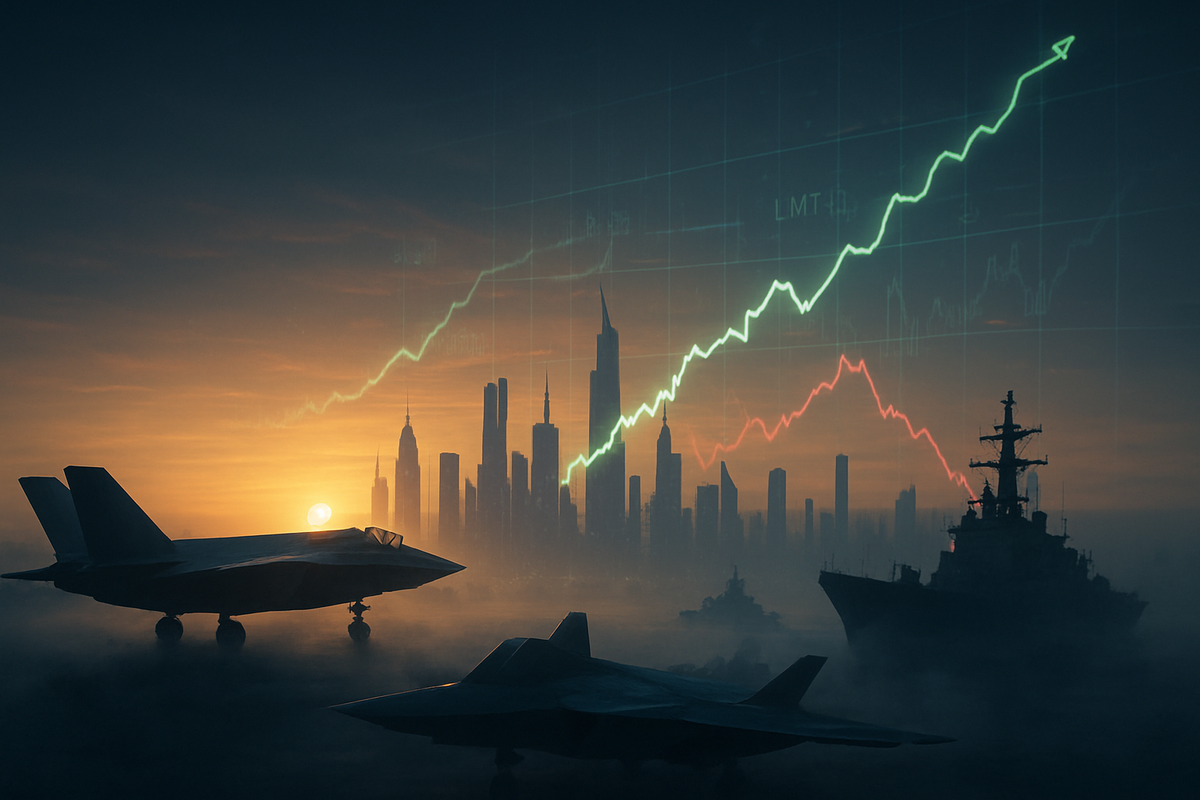
WASHINGTON D.C. — In a dramatic divergence that has redefined the start of 2026, the aerospace and defense sector is grappling with a sudden "peace scare" that has sent shockwaves through boardrooms from Bethesda to Falls Church. As of March 10, 2026, the broader markets are celebrating a potential cessation of hostilities in the Middle East, but for the titans of the "Security Supercycle," the news has triggered a painful decoupling from the S&P 500’s relief rally. As geopolitical risk premiums evaporate on the back of recent diplomatic overtures, investors are reassessing the multi-billion dollar backlogs of the world's largest defense contractors.
The immediate catalyst for this market schism is twofold: the remnants of the short-lived "Geneva Breakthrough" in late February and today’s bold declaration from the White House that "major combat operations" against Iranian infrastructure have reached a successful conclusion. While the Nasdaq and S&P 500 have surged over 1.5% in morning trading on hopes of a "peace dividend" and stabilized energy prices, the defense sector has slumped, with major primes seeing 3% to 5% pullbacks as the "war premium" that has propped up valuations for months begins to thin.
The Geneva "Peace Scare" and the February Decoupling
The roots of this sector-wide volatility trace back to the final week of February 2026. On February 25, international mediators led by Oman announced a tentative draft for a "New Nuclear Deal" in Geneva. The news acted as a cold shower for a defense sector that had been trading at all-time highs. Lockheed Martin (NYSE: LMT) and Northrop Grumman (NYSE: NOC), which had outperformed the broader market by nearly 30% year-to-date, suddenly plummeted 4% and 5% respectively in a single session. This occurred while the broader market experienced its most significant relief rally in eighteen months, fueled by a collapse in the CBOE Volatility Index (VIX) from 40 down to 22.
However, the "Peace Mirage" proved short-lived. Within 36 hours of the Geneva announcement, the collapse of diplomatic trust led to the launch of "Operation Epic Fury"—a massive, coordinated strike campaign by the U.S. and Israel against Iranian military assets. The subsequent "war premium" returned with a vengeance, pushing RTX Corporation (NYSE: RTX) to record highs as the consumption of Patriot and AMRAAM missiles skyrocketed. Yet, as of March 10, the cycle is repeating; a fresh round of "victory" rhetoric from Washington has once again caused defense stocks to decouple, falling even as the general market gains ground on the prospect of regional stabilization.
Winners, Losers, and the "Backlog Trap"
The primary casualties of this diplomatic-driven volatility are the traditional "Big Five" contractors. Lockheed Martin (NYSE: LMT), despite holding a staggering $194 billion backlog, has become a lightning rod for "peace-related" profit-taking. Analysts worry that if the current "victory" declaration leads to a sustained diplomatic freeze, the planned $1.5 trillion 2027 defense budget—which included a massive quadruple-down on THAAD interceptors—could face significant "peace-time" hair-cuts in Congress.
Similarly, General Dynamics (NYSE: GD) has seen its stock performance lag behind its aerospace peers. While its marine systems division is insulated by long-term nuclear submarine contracts, its combat systems wing is highly sensitive to the immediate demand for ground-based munitions and armored vehicles. If the "Iran Peace News" holds, the urgent "Security Supercycle" narrative that drove GD’s 8% YTD gain could quickly stall. Conversely, the "winners" in this environment are the consumer-discretionary and transportation sectors. Airlines and logistics firms are rallying today as WTI crude prices tumbled from $119 to $84, a direct result of the perceived reduction in the threat to the Strait of Hormuz.
A Fundamental Shift in the Security Supercycle
The current decoupling marks a significant shift in how Wall Street views the defense sector. For the past decade, these stocks were often treated as cyclical industrials; however, the events of early 2026 had transformed them into "national security infrastructure." The evaporation of the geopolitical risk premium is forcing a return to valuation fundamentals that many investors had ignored during the height of Operation Epic Fury.
This event fits into a broader trend of "asymmetric market reactions." In 2025, the Russia-Ukraine peace rumors caused similar, albeit smaller, sector rotations. The 2026 Iran scenario is more extreme because of the scale of the "War Premium" that had been baked into these stocks. Regulatory and policy implications are also looming; if a lasting peace is brokered, the Department of Defense may pivot its focus from "quantity-at-scale" (ammunition) back to "high-tech R&D" (hypersonics and AI), which could favor smaller, more agile tech-defense firms over the traditional hardware giants.
The Road Ahead: Transitioning to a Post-Conflict Economy
Looking forward, the defense sector faces a "strategic pivot." In the short term, if the March 10 "victory" holds, companies like RTX Corporation (NYSE: RTX) will have to manage the transition from high-rate production to "inventory replenishment" mode. This phase is often characterized by lower margins as the urgency of war-time procurement gives way to the scrutiny of government auditing and competitive bidding.
The long-term challenge will be the "Budget Cliff" of 2027. If the Middle East stabilizes, the political appetite for a $1.5 trillion military budget may vanish, replaced by domestic spending priorities. Defense contractors will likely need to accelerate their diversification into commercial aerospace and cybersecurity to protect their bottom lines. Market opportunities may emerge in "verification technologies"—satellites and sensors used to monitor the very peace treaties that are currently causing their stock prices to fall.
Navigating the Volatility
The takeaway for investors as of mid-March 2026 is clear: the defense sector has entered a period of "mean reversion." The spectacular gains of the first quarter were built on the assumption of a multi-year, high-intensity conflict. As diplomacy re-enters the conversation, that "war premium" is being stripped away, leading to the current decoupling where defense stocks trade in the red while the rest of the market turns green.
Moving forward, the market will be hyper-focused on the Strait of Hormuz. Even if "victory" is declared, any lingering asymmetric drone warfare or shipping disruptions will prevent the risk premium from evaporating entirely. Investors should watch the upcoming Q1 earnings calls for LMT and GD, specifically looking for guidance on "production sustainment" versus "emergency surges." While the "Peace Mirage" may have caused a temporary stumble, the structural reality of a re-armed world suggests that the "Security Supercycle" isn't over—it’s just entering a more sober, price-sensitive chapter.
This content is intended for informational purposes only and is not financial advice.