Regional bank Cathay General Bancorp (NASDAQ: CATY) reported Q1 CY2026 results topping the market’s revenue expectations, with sales up 11.9% year on year to $214.8 million. Its GAAP profit of $1.29 per share was 6.3% above analysts’ consensus estimates.
Is now the time to buy Cathay General Bancorp? Find out by accessing our full research report, it’s free.
Cathay General Bancorp (CATY) Q1 CY2026 Highlights:
- Net Interest Income: $194.2 million vs analyst estimates of $194.1 million (9.9% year-on-year growth, in line)
- Net Interest Margin: 3.4% vs analyst estimates of 3.4% (5.8 basis point beat)
- Revenue: $214.8 million vs analyst estimates of $211.5 million (11.9% year-on-year growth, 1.6% beat)
- Efficiency Ratio: 40.4% vs analyst estimates of 43.5% (306 basis point beat)
- EPS (GAAP): $1.29 vs analyst estimates of $1.21 (6.3% beat)
- Tangible Book Value per Share: $38.95 vs analyst estimates of $38.59 (9.7% year-on-year growth, 0.9% beat)
- Market Capitalization: $3.59 billion
“Our ability to expand net interest margin while keeping deposit costs contained underscores the strength of our franchise and the loyalty of our customers,” commented Chang M. Liu, President and Chief Executive Officer of the Company.
Company Overview
Founded in 1962 with its first branch in Los Angeles' Chinatown, Cathay General Bancorp (NASDAQ: CATY) operates Cathay Bank, providing commercial banking services to businesses and individuals with a strong presence in Asian-American communities.
Sales Growth
Two primary revenue streams drive bank earnings. While net interest income, which is earned by charging higher rates on loans than paid on deposits, forms the foundation, fee-based services across banking, credit, wealth management, and trading operations provide additional income. Regrettably, Cathay General Bancorp’s revenue grew at a tepid 7% compounded annual growth rate over the last five years. This fell short of our benchmark for the banking sector and is a tough starting point for our analysis.
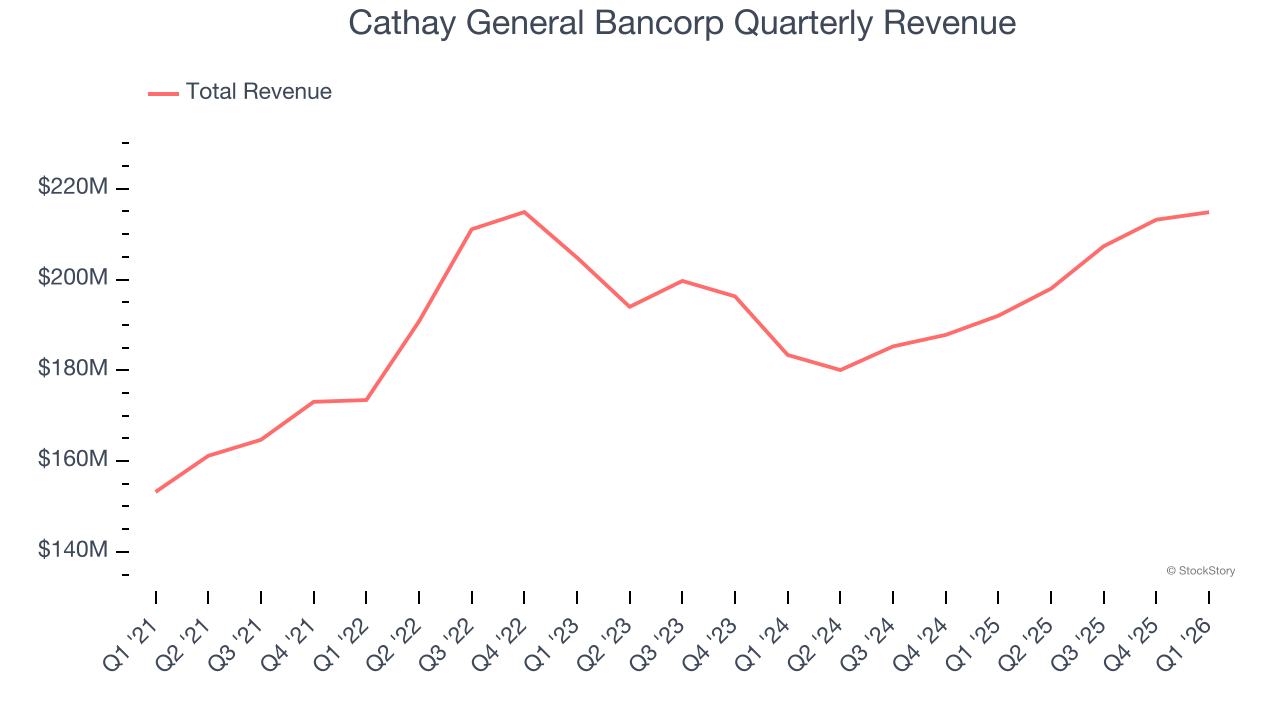
We at StockStory place the most emphasis on long-term growth, but within financials, a half-decade historical view may miss recent interest rate changes, market returns, and industry trends. Cathay General Bancorp’s recent performance shows its demand has slowed as its annualized revenue growth of 3.8% over the last two years was below its five-year trend. We’re wary when companies in the sector see decelerations in revenue growth, as it could signal changing consumer tastes aided by low switching costs. 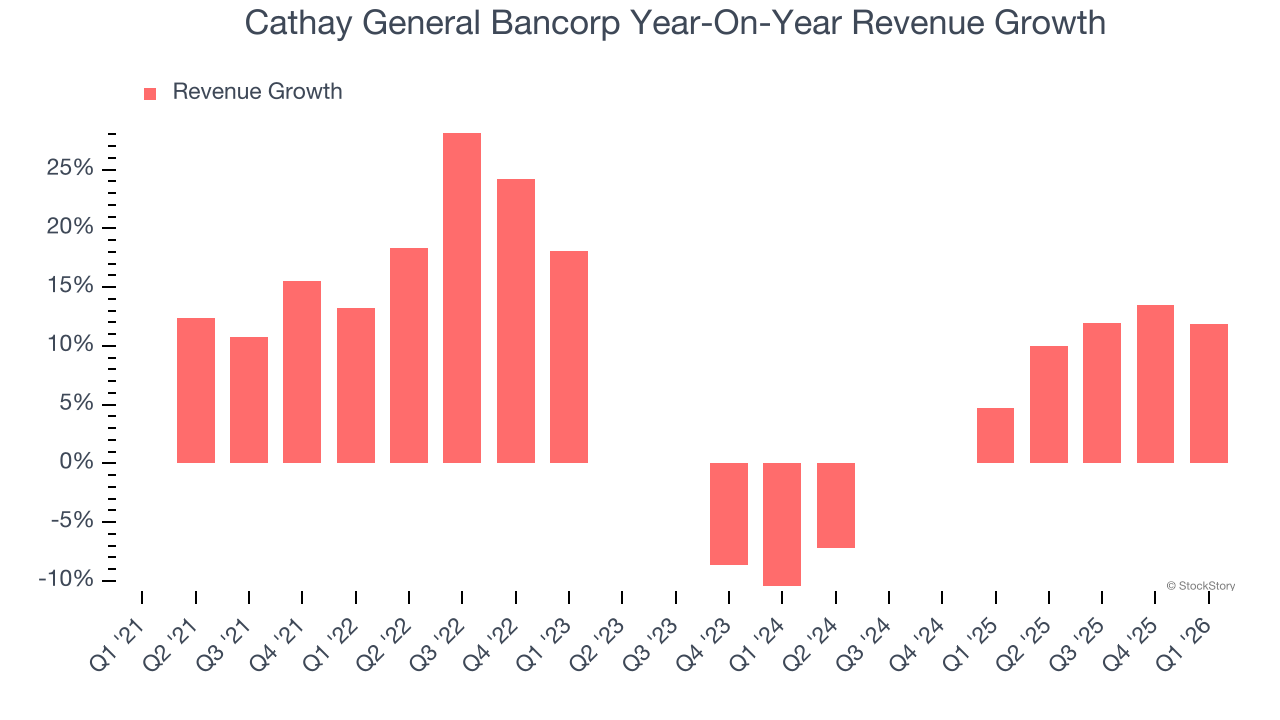 Note: Quarters not shown were determined to be outliers, impacted by outsized investment gains/losses that are not indicative of the recurring fundamentals of the business.
This quarter, Cathay General Bancorp reported year-on-year revenue growth of 11.9%, and its $214.8 million of revenue exceeded Wall Street’s estimates by 1.6%.
Net interest income made up 92.1% of the company’s total revenue during the last five years, meaning Cathay General Bancorp lives and dies by its lending activities because non-interest income barely moves the needle.
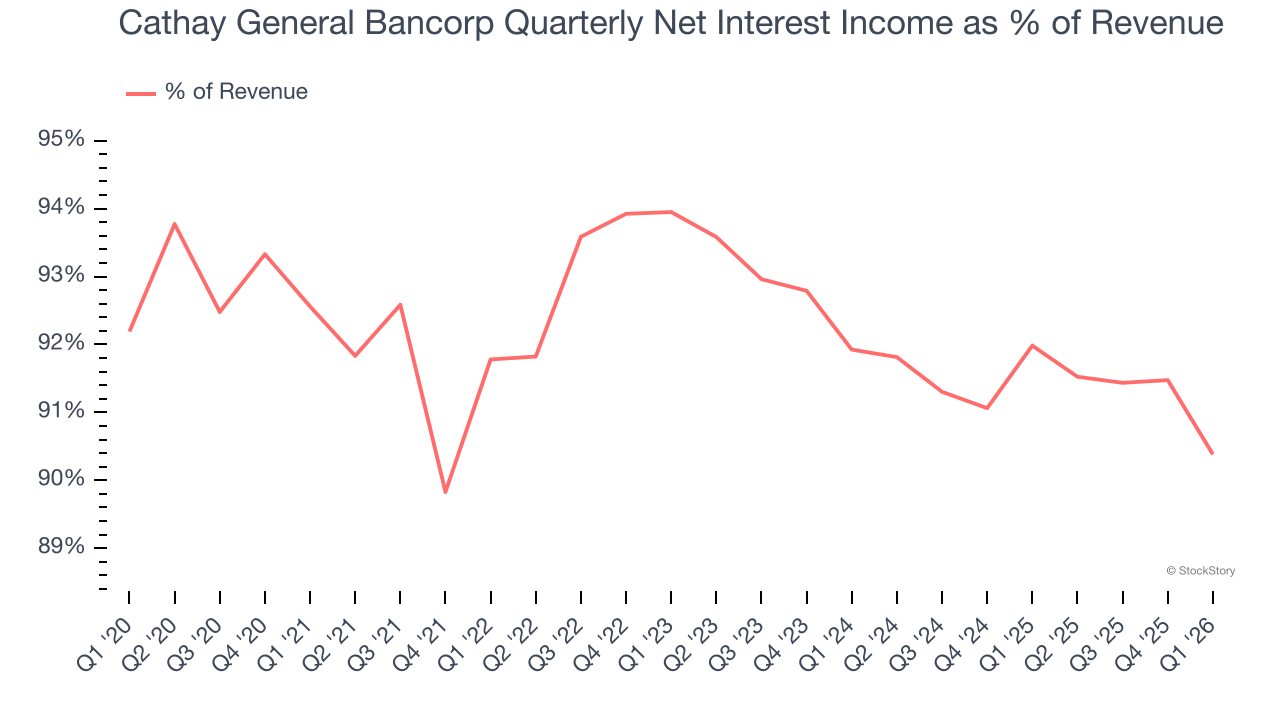
While banks generate revenue from multiple sources, investors view net interest income as the cornerstone - its predictable, recurring characteristics stand in sharp contrast to the volatility of non-interest income.
ONE MORE THING: The $21 AI Application Stock Wall Street Forgot. While Wall Street obsesses over who’s building AI, one company is already using it to print money. And nobody’s paying attention.
AI chip stocks trade at ridiculous valuations. This company processes a trillion consumer signals monthly using AI and trades at a third of the price. The gap won’t last. The institutions will figure it out. You need to see this first. Read the FREE Report Before They Notice.
Tangible Book Value Per Share (TBVPS)
Banks profit by intermediating between depositors and borrowers, making them fundamentally balance sheet-driven enterprises. Market participants emphasize balance sheet quality and sustained book value growth when evaluating these institutions.
Because of this, tangible book value per share (TBVPS) emerges as the critical performance benchmark. By excluding intangible assets with uncertain liquidation values, this metric captures real, liquid net worth per share. Traditional metrics like EPS are helpful but face distortion from M&A activity and loan loss accounting rules.
Cathay General Bancorp’s TBVPS grew at an excellent 8.2% annual clip over the last five years. The last two years show a similar trajectory as TBVPS grew by 8.7% annually from $32.99 to $38.95 per share.
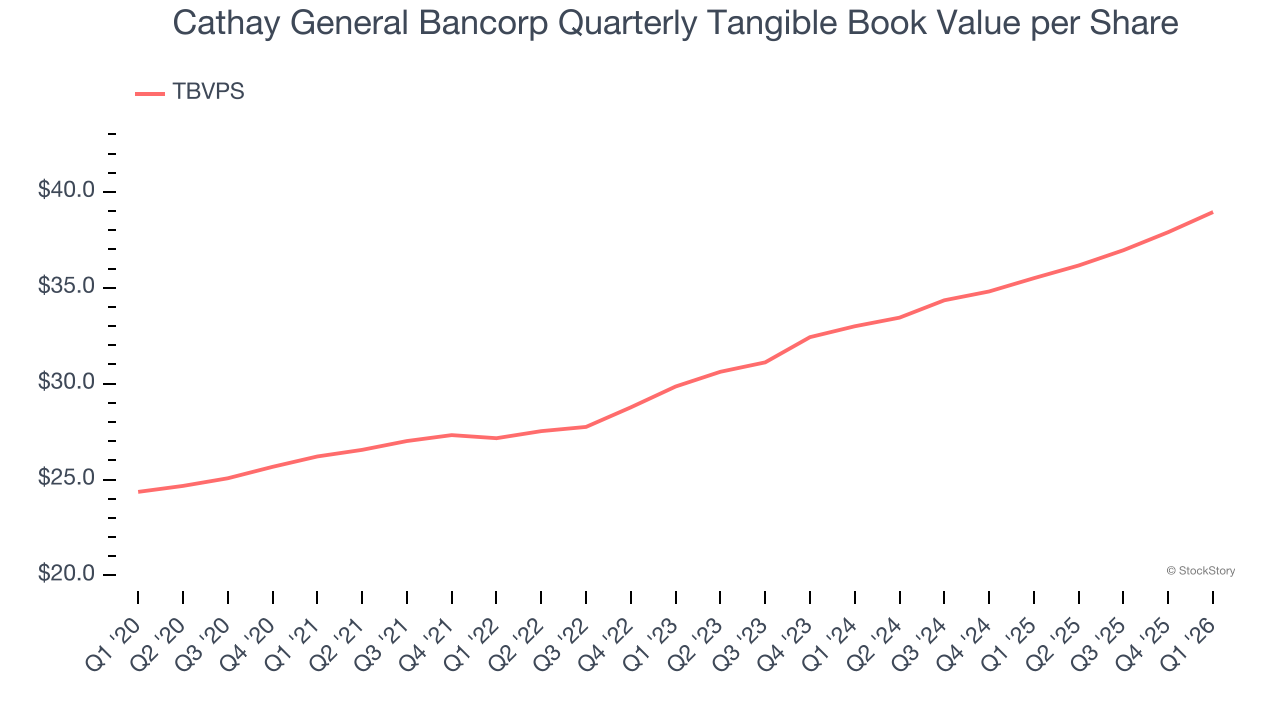
Over the next 12 months, Consensus estimates call for Cathay General Bancorp’s TBVPS to grow by 9.2% to $42.54, paltry growth rate.
Key Takeaways from Cathay General Bancorp’s Q1 Results
It was encouraging to see Cathay General Bancorp beat analysts’ revenue expectations this quarter. We were also happy its tangible book value per share narrowly outperformed Wall Street’s estimates. Overall, this print had some key positives. The stock remained flat at $53.80 immediately following the results.
Is Cathay General Bancorp an attractive investment opportunity right now? We think that the latest quarter is only one piece of the longer-term business quality puzzle. Quality, when combined with valuation, can help determine if the stock is a buy. We cover that in our actionable full research report which you can read here (it’s free).