Auto parts and accessories retailer O’Reilly Automotive (NASDAQ: ORLY) reported revenue ahead of Wall Street’s expectations in Q2 CY2026, with sales up 8.1% year on year to $4.89 billion. The company expects the full year’s revenue to be around $19.05 billion, close to analysts’ estimates. Its GAAP profit of $0.86 per share was in line with analysts’ consensus estimates.
Is now the time to buy O'Reilly? Find out by accessing our full research report, it’s free.
O'Reilly (ORLY) Q2 CY2026 Highlights:
- Revenue: $4.89 billion vs analyst estimates of $4.86 billion (8.1% year-on-year growth, 0.6% beat)
- EPS (GAAP): $0.86 vs analyst estimates of $0.86 (in line)
- The company lifted its revenue guidance for the full year to $19.05 billion at the midpoint from $18.85 billion, a 1.1% increase
- EPS (GAAP) guidance for the full year is $3.25 at the midpoint, roughly in line with what analysts were expecting
- Operating Margin: 20.2%, in line with the same quarter last year
- Free Cash Flow Margin: 14.2%, up from 9.9% in the same quarter last year
- Locations: 6,695 at quarter end, up from 6,483 in the same quarter last year
- Same-Store Sales rose 6% year on year (4.1% in the same quarter last year)
- Market Capitalization: $75.55 billion
Brad Beckham, O’Reilly’s CEO, commented, “I would like to thank all of Team O’Reilly for their tremendous hard work and unwavering commitment to taking care of our customers each and every day. We are very pleased to report another quarter of strong performance, highlighted by a comparable store sales increase of 6.0% and a 10% increase in diluted earnings per share. Our Team continues to consistently execute our proven dual market strategy at a high level and delivered solid growth in both professional and DIY during the quarter. We remain committed to taking market share by providing unsurpassed levels of service to our customers, supported by best-in-class parts availability.”
Company Overview
Serving both the DIY customer and professional mechanic, O’Reilly Automotive (NASDAQ: ORLY) is an auto parts and accessories retailer that sells everything from fuel pumps to car air fresheners to mufflers.
Revenue Growth
A company’s long-term sales performance can indicate its overall quality. Any business can put up a good quarter or two, but the best consistently grow over the long haul.
With $18.57 billion in revenue over the past 12 months, O'Reilly is one of the larger companies in the consumer retail industry and benefits from a well-known brand that influences purchasing decisions. However, its scale is a double-edged sword because it’s harder to find incremental growth when you’ve penetrated most of the market. To expand meaningfully, O'Reilly likely needs to tweak its prices or enter new markets.
As you can see below, O'Reilly’s sales grew at a tepid 6.9% compounded annual growth rate over the last three years, but to its credit, it opened new stores and increased sales at existing, established locations.
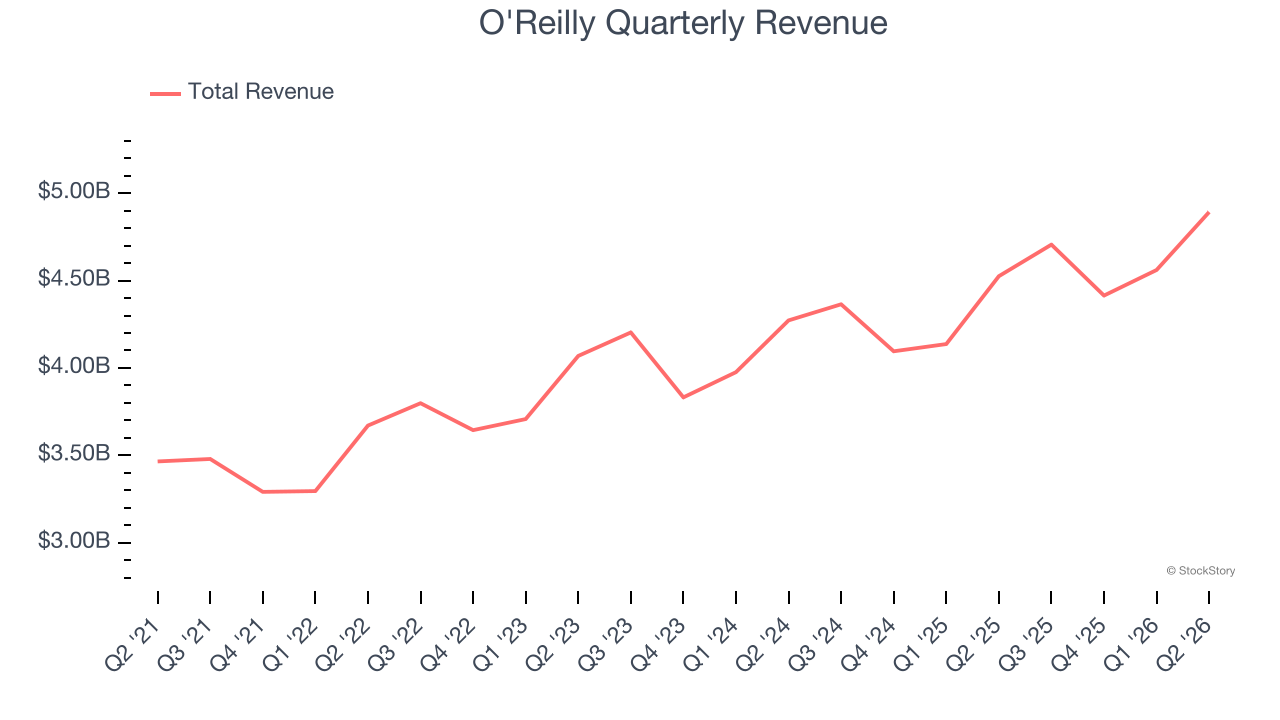
This quarter, O'Reilly reported year-on-year revenue growth of 8.1%, and its $4.89 billion of revenue exceeded Wall Street’s estimates by 0.6%.
Looking ahead, sell-side analysts expect revenue to grow 5.4% over the next 12 months, similar to its three-year rate. We still think its growth trajectory is attractive given its scale and suggests the market is forecasting success for its products.
ALSO WORTH WATCHING: Nvidia’s Quiet Partner. Nvidia’s chips cost a hundred grand. The connectors that make them work cost even more. One company makes them all.
Every AI server needs specialized infrastructure the chip companies don’t make. High-speed cables. Power connectors. Thermal sensors. This 90-year-old company built a monopoly on it. The AI boom just started. This stock is still flying under the radar. Claim The Stock Ticker Here for FREE.
Store Performance
Number of Stores
A retailer’s store count influences how much it can sell and how quickly revenue can grow.
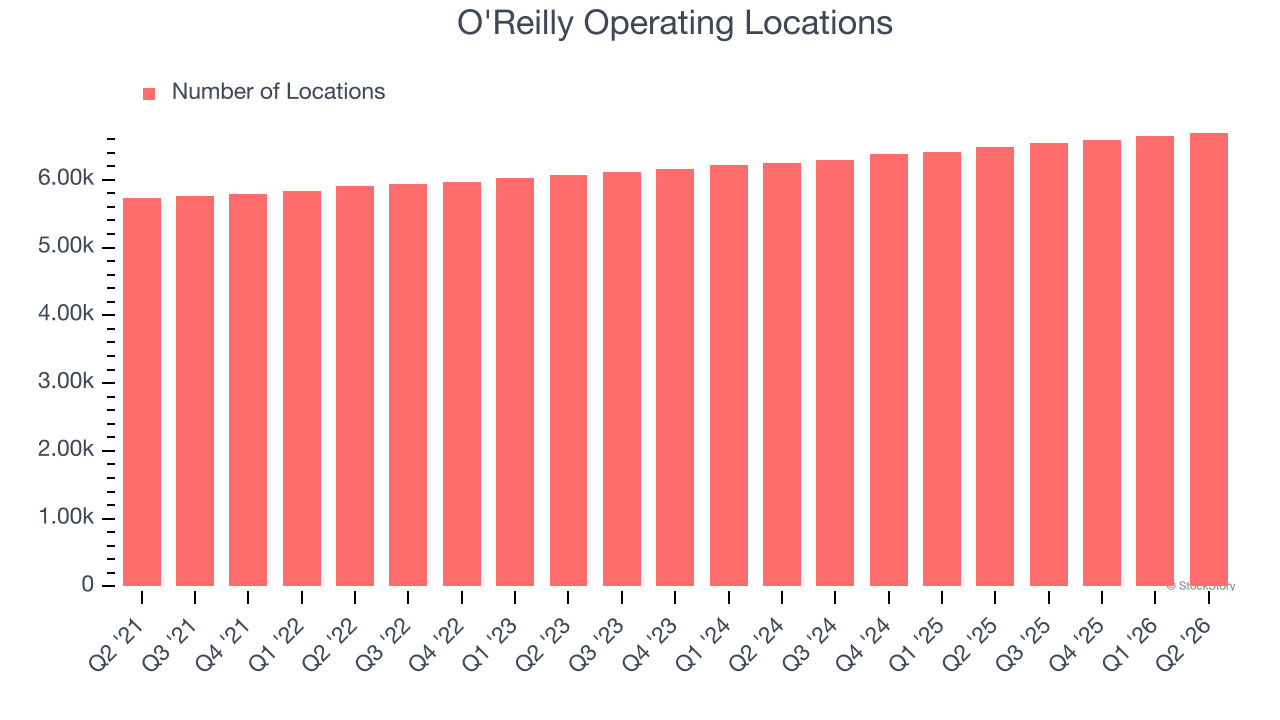
O'Reilly sported 6,695 locations in the latest quarter. Over the last two years, it has opened new stores quickly, averaging 3.4% annual growth. This was faster than the broader consumer retail sector.
When a retailer opens new stores, it usually means it’s investing for growth because demand is greater than supply, especially in areas where consumers may not have a store within reasonable driving distance.
Same-Store Sales
A company’s store base only paints one part of the picture. When demand is high, it makes sense to open more. But when demand is low, it’s prudent to close some locations and use the money in other ways. Same-store sales is an industry measure of whether revenue is growing at those existing stores and is driven by customer visits (often called traffic) and the average spending per customer (ticket).
O'Reilly has been one of the most successful retailers over the last two years thanks to skyrocketing demand within its existing locations. On average, the company has posted exceptional year-on-year same-store sales growth of 4.9%. This performance suggests its rollout of new stores is beneficial for shareholders. We like this backdrop because it gives O'Reilly multiple ways to win: revenue growth can come from new stores, e-commerce, or increased foot traffic and higher sales per customer at existing locations.
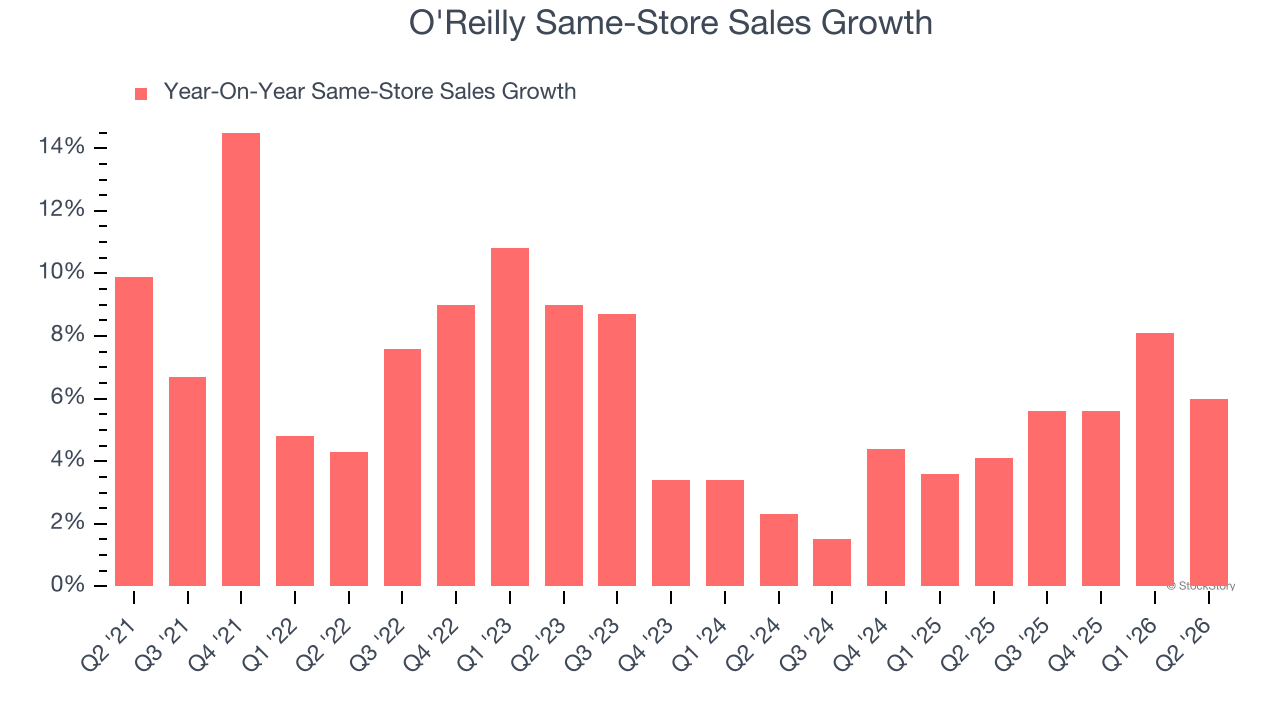
In the latest quarter, O'Reilly’s same-store sales rose 6% year on year. This growth was an acceleration from its historical levels, which is always an encouraging sign.
Key Takeaways from O'Reilly’s Q2 Results
This was essentially an in-line quarter, with both quarter results and guidance roughly meeting expectations. The market seemed to be hoping for more, and the stock traded down 3.5% to $87.54 immediately following the results.
Should you buy the stock or not? What happened in the latest quarter matters, but not as much as longer-term business quality and valuation, when deciding whether to invest in this stock. We cover that in our actionable full research report which you can read here (it’s free).