Let’s dig into the relative performance of Match Group (NASDAQ: MTCH) and its peers as we unravel the now-completed Q2 consumer subscription earnings season.
Consumers today expect goods and services to be hyper-personalized and on demand. Whether it be what music they listen to, what movie they watch, or even finding a date, online consumer businesses are expected to delight their customers with simple user interfaces that magically fulfill demand. Subscription models have further increased usage and stickiness of many online consumer services.
The 7 consumer subscription stocks we track reported a mixed Q2. As a group, revenues beat analysts’ consensus estimates by 1.6% while next quarter’s revenue guidance was 2.4% below.
Amidst this news, share prices of the companies have had a rough stretch. On average, they are down 5.3% since the latest earnings results.
Match Group (NASDAQ: MTCH)
Originally started as a dial-up service before widespread internet adoption, Match (NASDAQ: MTCH) was an early innovator in online dating and today has a portfolio of apps including Tinder, Hinge, Archer, and OkCupid.
Match Group reported revenues of $853.1 million, down 1.2% year on year. This print was in line with analysts’ expectations, but overall, it was a mixed quarter for the company with EBITDA guidance for next quarter topping analysts’ expectations but a decline in its users.
"Tinder finally looks and feels like the app young daters want to use. We have improved our recommendation algorithms, strengthened Trust and Safety, introduced new ways to connect with features like Double Date and Music Mode, and completed Tinder's first full rebrand in nearly a decade, and these changes are driving meaningful gains in metrics like DAU and retention to date. The next step is winning back singles who've drifted away, and reaching those who've never tried Tinder at all. In-person Events, now live in the U.S. and Europe, are an important part of that strategy," said CEO Spencer Rascoff.
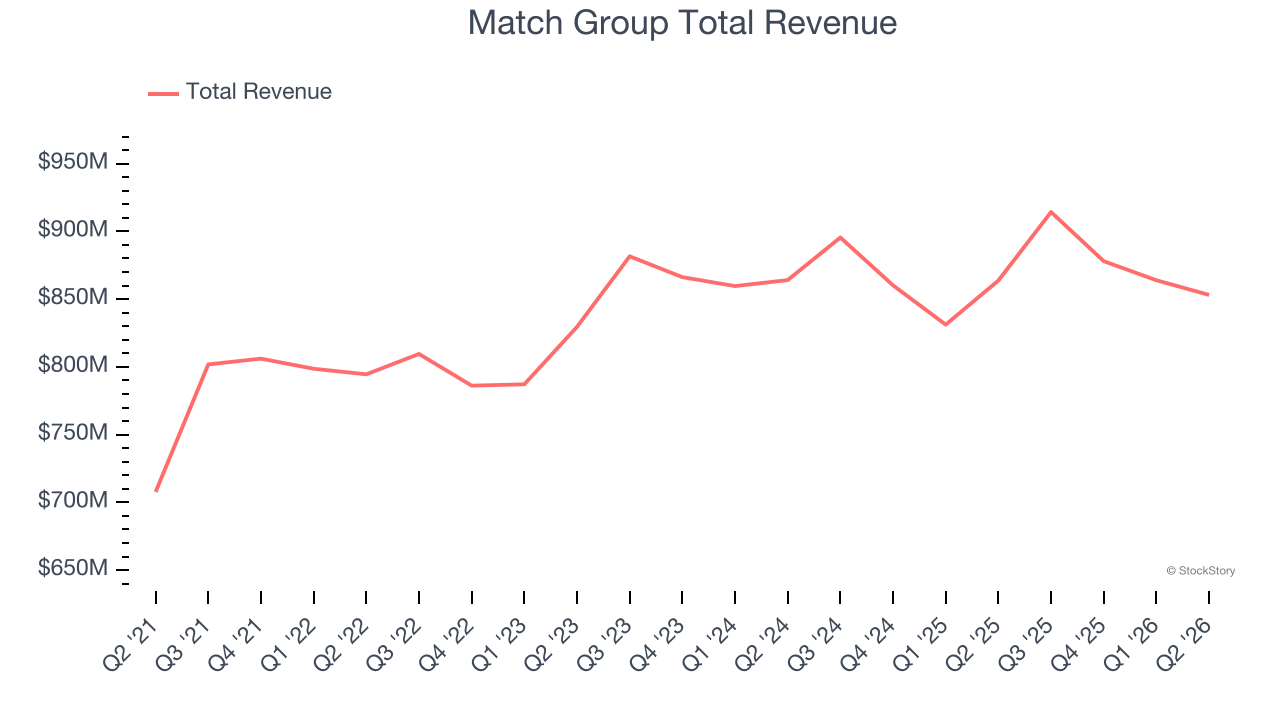
Match Group delivered the weakest performance against analyst estimates in the group. The company reported 13.3 million users, down 5.7% year on year. The market seems disappointed with the results as the stock is down 10.5% since reporting and currently trades at $36.91.
Is now the time to buy Match Group? Access our full analysis of the earnings results here, it’s free.
Best Q2: Roku (NASDAQ: ROKU)
With a name meaning six in Japanese because it was the founder's sixth company that he started, Roku (NASDAQ: ROKU) makes hardware players that offer access to various online streaming TV services.
Roku reported revenues of $1.35 billion, up 21.9% year on year, outperforming analysts’ expectations by 4.4%. The business had an exceptional quarter with an impressive beat of analysts’ EBITDA estimates and solid growth in its requests.
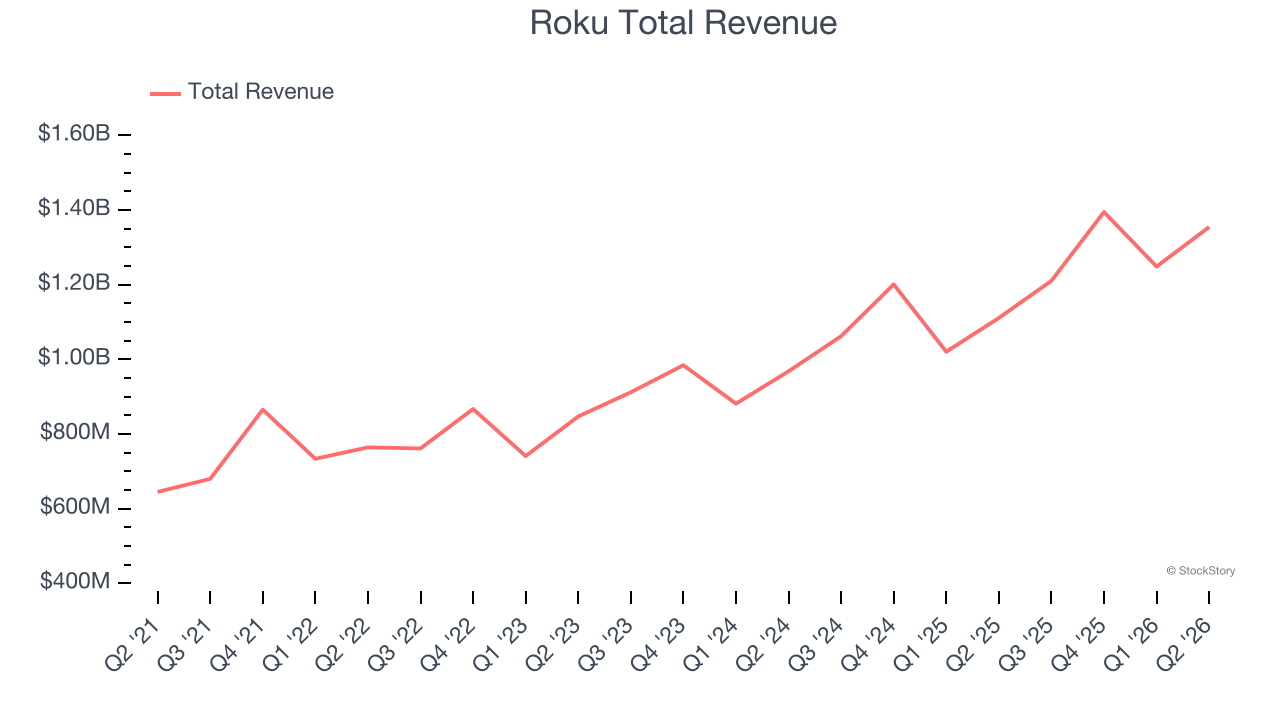
The market seems content with the results as the stock is up 1.1% since reporting. It currently trades at $151.73.
Is now the time to buy Roku? Access our full analysis of the earnings results here, it’s free.
Weakest Q2: Netflix (NASDAQ: NFLX)
Launched by Reed Hastings as a DVD mail rental company until its famous pivot to streaming in 2007, Netflix (NASDAQ: NFLX) is a pioneering streaming content platform.
Netflix reported revenues of $12.56 billion, up 13.4% year on year, in line with analysts’ expectations. It was a softer quarter as it posted EPS guidance for next quarter missing analysts’ expectations and full-year revenue guidance meeting analysts’ expectations.
Netflix delivered the weakest full-year guidance update among its peers. Interestingly, the stock is up 2.7% since the results and currently trades at $76.33.
Read our full analysis of Netflix’s results here.
Coursera (NYSE: COUR)
Founded by two Stanford University computer science professors, Coursera (NYSE: COUR) is an online learning platform that offers courses, specializations, and degrees from top universities and organizations around the world.
Coursera reported revenues of $298.6 million, up 59.6% year on year. This number beat analysts’ expectations by 1.7%. It was a strong quarter as it also put up a solid beat of analysts’ EBITDA estimates and full-year revenue guidance meeting analysts’ expectations.
Coursera scored the highest guidance raise, fastest revenue growth, and highest full-year guidance raise of the whole group. The stock is down 5.5% since reporting and currently trades at $5.84.
Read our full, actionable report on Coursera here, it’s free.
Bumble (NASDAQ: BMBL)
Started by the co-founder of Tinder, Whitney Wolfe Herd, Bumble (NASDAQ: BMBL) is a leading dating app built with women at the center.
Bumble reported revenues of $210.5 million, down 15.2% year on year. This print met analysts’ expectations. However, it was a slower quarter as it logged a decline in its buyers and revenue guidance for next quarter missing analysts’ expectations significantly.
The company reported 3.16 million active buyers, down 16.4% year on year. The stock is down 9.2% since reporting and currently trades at $2.76.
Read our full, actionable report on Bumble here, it’s free.
Market Update
Over the past year, investors have been forced to repeatedly answer the same question: what is the market’s biggest risk? The answer has changed several times, and each shift has reshaped market leadership.
Late in 2025 and early 2026, artificial intelligence became the market’s primary uncertainty. Investors questioned whether AI would erode software pricing power and weaken competitive moats as AI made it easier to replicate once-differentiated products.
By the spring, technology took a back seat to geopolitics. The U.S. conflict with Iran briefly became the market’s dominant narrative, raising concerns about oil prices, inflation, and global growth. But as energy markets remained orderly and fears of a prolonged supply disruption faded, investors quickly turned their focus back to fundamentals.
Want to invest in winners with rock-solid fundamentals? Check out our Hidden Gem Stocks and add them to your watchlist. These companies are poised for growth regardless of the political or macroeconomic climate.