As the craze of earnings season draws to a close, here’s a look back at some of the most exciting (and some less so) results from Q2. Today, we are looking at consumer discretionary - media stocks, starting with Warner Music Group (NASDAQ: WMG).
The Consumer Discretionary sector, by definition, is made up of companies selling non-essential goods and services. When economic conditions deteriorate or tastes shift, consumers can easily cut back or eliminate these purchases. For long-term investors with five-year holding periods, this creates a structural challenge: the sector is inherently hit-driven, with low switching costs and fickle customers. As a result, only a handful of companies can reliably grow demand and compound earnings over long periods, which is why our bar is high and High Quality ratings are rare. Media companies create, aggregate, and distribute content—including news, entertainment, and advertising—across television, print, digital, and out-of-home channels. Tailwinds include growing digital advertising budgets, content licensing opportunities, and global audience expansion through streaming and social platforms. Headwinds are substantial: traditional advertising revenue from print and linear TV continues its structural decline as audiences migrate to digital alternatives. Content creation costs are escalating amid intense competition for talent and intellectual property. Media fragmentation makes it difficult to build sustainable audience scale, while AI-generated content threatens to commoditize production and disrupt established business models.
The 7 consumer discretionary - media stocks we track reported a satisfactory Q2. As a group, revenues missed analysts’ consensus estimates by 0.8%.
In light of this news, share prices of the companies have held steady as they are up 2.2% on average since the latest earnings results.
Warner Music Group (NASDAQ: WMG)
Launching the careers of legendary artists like Frank Sinatra, Warner Music Group (NASDAQ: WMG) is a music company managing a diverse portfolio of artists, recordings, and music publishing services worldwide.
Warner Music Group reported revenues of $1.86 billion, up 10.4% year on year. This print exceeded analysts’ expectations by 3.8%. Overall, it was a very strong quarter for the company with a beat of analysts’ EPS estimates and a decent beat of analysts’ EBITDA estimates.
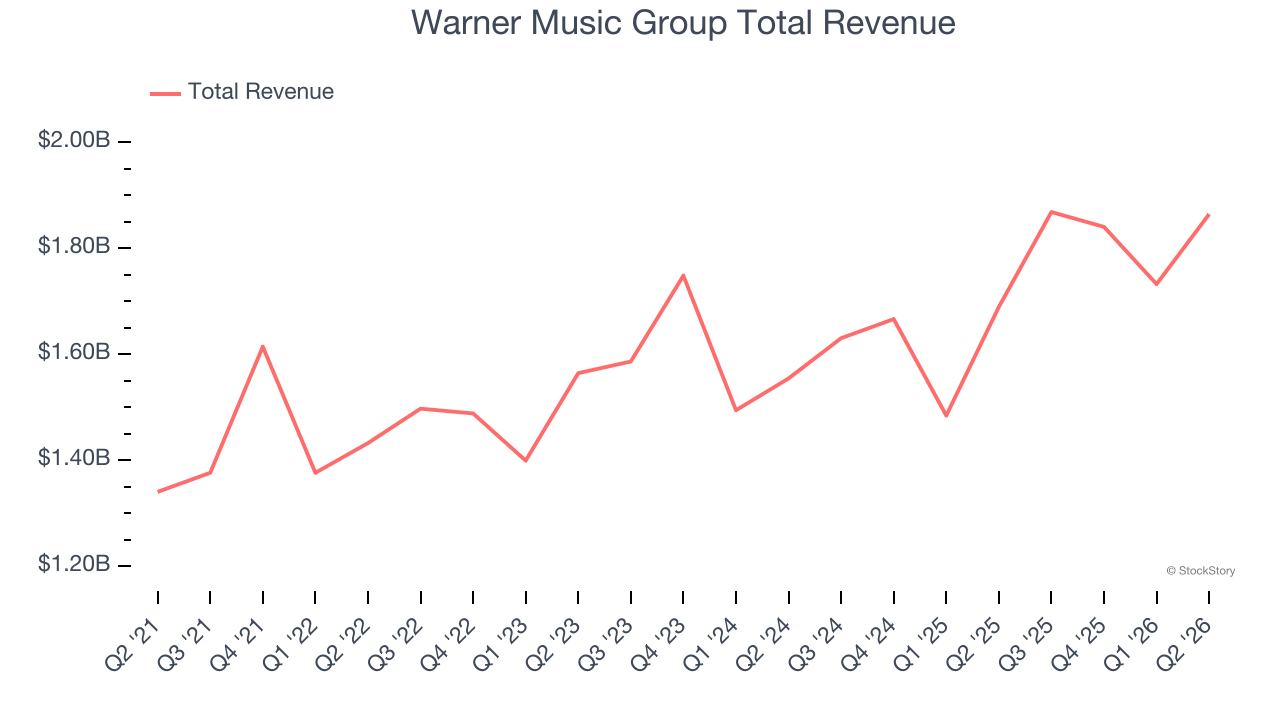
Interestingly, the stock is up 8.5% since reporting and currently trades at $28.22.
Is now the time to buy Warner Music Group? Access our full analysis of the earnings results here, it’s free.
Best Q2: News Corp (NASDAQ: NWSA)
Established in 2013 after a restructuring, News Corp (NASDAQ: NWSA) is a multinational conglomerate known for its news publishing, broadcasting, digital media, and book publishing.
News Corp reported revenues of $2.34 billion, up 10.8% year on year, outperforming analysts’ expectations by 4.1%. The business had an exceptional quarter with a beat of analysts’ EPS estimates and an impressive beat of analysts’ EBITDA estimates.
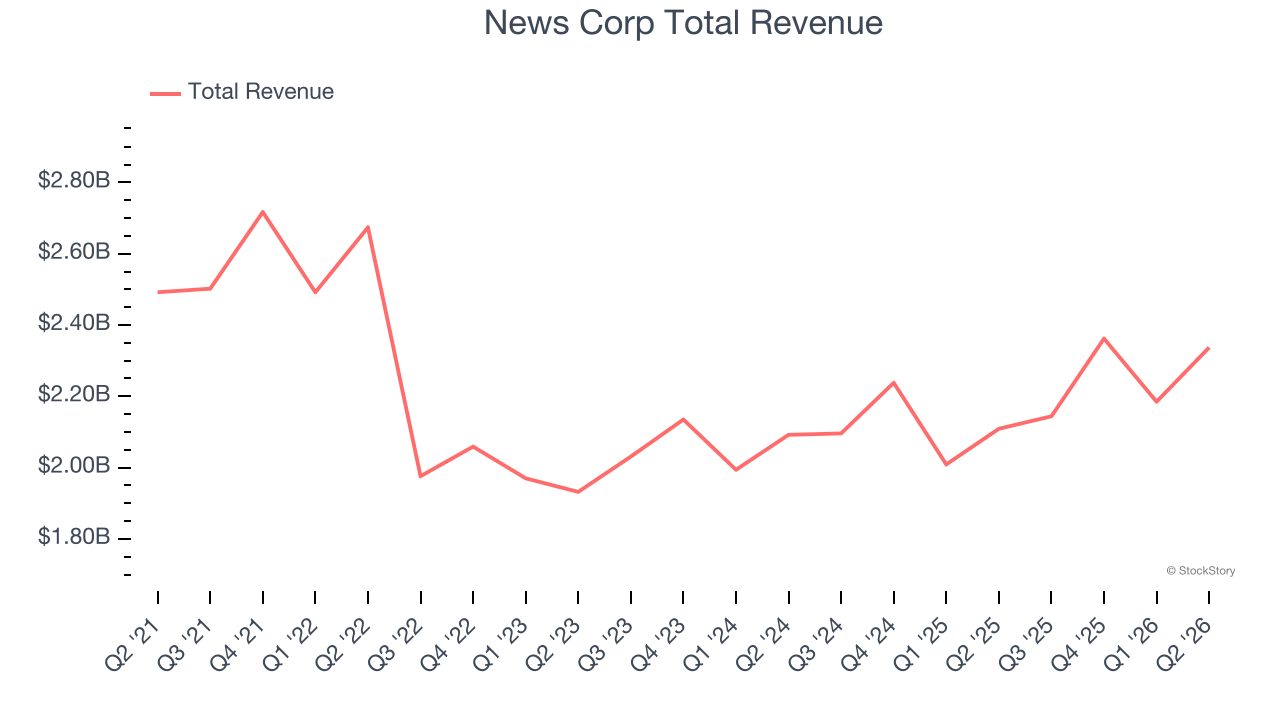
News Corp achieved the biggest analyst estimate beat among its peers. The market seems happy with the results as the stock is up 5.7% since reporting. It currently trades at $30.71.
Is now the time to buy News Corp? Access our full analysis of the earnings results here, it’s free.
Weakest Q2: Scholastic (NASDAQ: SCHL)
Creator of the legendary Scholastic Book Fair, Scholastic (NASDAQ: SCHL) is an international company specializing in children's publishing, education, and media services.
Scholastic reported revenues of $476.1 million, down 6.3% year on year, falling short of analysts’ expectations by 7.9%. It was a softer quarter as it posted full-year EBITDA guidance missing analysts’ expectations significantly.
Scholastic delivered the weakest performance against analyst estimates in the group. As expected, the stock is down 17.3% since the results and currently trades at $38.41.
Read our full analysis of Scholastic’s results here.
Warner Bros. Discovery (NASDAQ: WBD)
Formed from the merger of WarnerMedia and Discovery, Warner Bros. Discovery (NASDAQ: WBD) is a multinational media and entertainment company, offering television networks, streaming services, and film and television production.
Warner Bros. Discovery reported revenues of $8.72 billion, down 11.2% year on year. This number missed analysts’ expectations by 5%. More broadly, it was a mixed quarter as it also logged a beat of analysts’ EPS estimates but a slight miss of analysts’ EBITDA estimates.
Warner Bros. Discovery had the slowest revenue growth of the whole group. The stock is up 9.8% since reporting and currently trades at $28.51.
Read our full, actionable report on Warner Bros. Discovery here, it’s free.
The New York Times (NYSE: NYT)
Founded in 1851, The New York Times (NYSE: NYT) is an American media organization known for its influential newspaper and expansive digital journalism platforms.
The New York Times reported revenues of $762.5 million, up 11.2% year on year. This result surpassed analysts’ expectations by 1.4%. Overall, it was a satisfactory quarter as it also logged a beat of analysts’ EPS estimates.
The stock is down 10.9% since reporting and currently trades at $67.38.
Read our full, actionable report on The New York Times here, it’s free.
Market Update
Over the past year, investors have been forced to repeatedly answer the same question: what is the market’s biggest risk? The answer has changed several times, and each shift has reshaped market leadership.
Late in 2025 and early 2026, artificial intelligence became the market’s primary uncertainty. Investors questioned whether AI would erode software pricing power and weaken competitive moats as AI made it easier to replicate once-differentiated products.
By the spring, technology took a back seat to geopolitics. The U.S. conflict with Iran briefly became the market’s dominant narrative, raising concerns about oil prices, inflation, and global growth. But as energy markets remained orderly and fears of a prolonged supply disruption faded, investors quickly turned their focus back to fundamentals.
Want to invest in winners with rock-solid fundamentals? Check out our 9 Best Market-Beating Stocks and add them to your watchlist. These companies are poised for growth regardless of the political or macroeconomic climate.