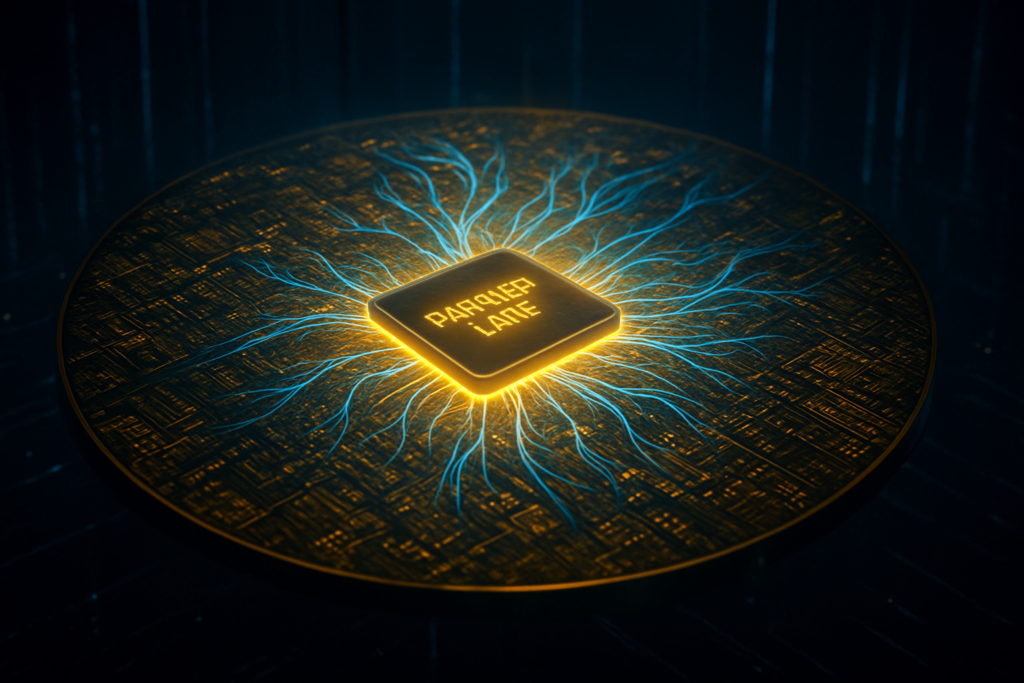
SANTA CLARA, CA — As of January 22, 2026, the global semiconductor landscape has officially shifted. Intel Corporation (NASDAQ: INTC) has confirmed that its long-awaited "Panther Lake" platform, the first consumer processor built on the cutting-edge Intel 18A process node, is now shipping to retail partners worldwide. This milestone marks the formal commencement of the "Angstrom Era," a period defined by sub-2nm manufacturing techniques that promise to redefine the power-to-performance ratio for personal computing. For Intel, the arrival of Panther Lake is not merely a product launch; it is the culmination of CEO Pat Gelsinger’s "five nodes in four years" strategy, signaling the company's return to the forefront of silicon manufacturing leadership.
The immediate significance of this development lies in its marriage of advanced domestic manufacturing with a radical new architecture optimized for local artificial intelligence. By integrating the fourth-generation and beyond Neural Processing Unit (NPU) architecture—including the refined NPU 5 engine—into the 18A process, Intel is positioning the AI PC not as a niche tool for enthusiasts, but as the universal standard for the 2026 computing experience. This transition represents a direct challenge to competitors like Taiwan Semiconductor Manufacturing Co. (NYSE: TSM) and Samsung, as Intel becomes the first company to bring high-volume, backside-power-delivery silicon to the consumer market.
The Silicon Architecture of the Future: RibbonFET, PowerVia, and NPU Scaling
At the heart of Panther Lake is the Intel 18A node, which introduces two foundational technologies that break away from a decade of FinFET dominance: RibbonFET and PowerVia. RibbonFET is Intel’s implementation of a Gate-All-Around (GAA) transistor, which wraps the gate entirely around the channel for superior electrostatic control. This allows for higher drive currents and significantly reduced leakage, enabling the "Cougar Cove" performance cores and "Darkmont" efficiency cores to operate at higher frequencies with lower power draw. Complementing this is PowerVia, the industry's first backside power delivery system. By moving power routing to the reverse side of the wafer, Intel has eliminated the congestion that typically hampers chip density, resulting in a 30% increase in transistor density and a 15-25% improvement in performance-per-watt.
The AI capabilities of Panther Lake are driven by the evolution of the Neural Processing Unit. While the previous generation (Lunar Lake) introduced the NPU 4, which first cleared the 40 TOPS (Trillion Operations Per Second) threshold required for Microsoft (NASDAQ: MSFT) Copilot+ branding, Panther Lake’s silicon refinement pushes the envelope further. The integrated NPU in this 18A platform delivers a staggering 50 TOPS of dedicated AI performance, contributing to a total platform throughput of over 180 TOPS when combined with the CPU and the new Arc "Xe3" integrated graphics. This jump in performance is specifically tuned for "Always-On" AI, where the NPU handles continuous background tasks like real-time translation, generative text assistance, and eye-tracking with minimal impact on battery life.
Initial reactions from the semiconductor research community have been overwhelmingly positive. "Intel has finally closed the gap with TSMC's most advanced nodes," noted one lead analyst at a top-tier tech firm. "The 18A process isn't just a marketing label; the yield improvements we are seeing—reportedly crossing the 65% mark for HVM (High-Volume Manufacturing)—suggest that Intel's foundry model is now a credible threat to the status quo." Experts point out that Panther Lake's ability to maintain high performance in a thin-and-light 15W-25W envelope is exactly what the PC industry needs to combat the rising tide of Arm-based alternatives.
Market Disruption: Reasserting Dominance in the AI PC Arms Race
For Intel, the strategic value of Panther Lake cannot be overstated. By being first to market with the 18A node, Intel is not just selling its own chips; it is showcasing the capabilities of Intel Foundry. Major players like Microsoft and Amazon (NASDAQ: AMZN) have already signed on to use the 18A process for their own custom AI silicon, and the success of Panther Lake serves as the ultimate proof-of-concept. This puts pressure on NVIDIA (NASDAQ: NVDA) and Advanced Micro Devices (NASDAQ: AMD), who have traditionally relied on TSMC’s roadmap. If Intel can maintain its manufacturing lead, it may begin to lure these giants back to "made-in-the-USA" silicon.
In the consumer space, Panther Lake is designed to disrupt the existing AI PC market by making high-end AI capabilities affordable. By achieving a 40% improvement in area efficiency with the NPU 5 on the 18A node, Intel can integrate high-performance AI accelerators across its entire product stack, from ultra-portable laptops to gaming rigs. This moves the goalposts for competitors like Qualcomm (NASDAQ: QCOM), whose Snapdragon X series initially led the transition to AI PCs. Intel’s x86 compatibility, combined with the power efficiency of the 18A node, removes the primary "tax" previously associated with Windows-on-Arm, effectively neutralizing one of the biggest threats to Intel's core business.
The competitive implications extend to the enterprise sector, where "Sovereign AI" is becoming a priority. Governments and large corporations are increasingly wary of concentrated supply chains in East Asia. Intel's ability to produce 18A chips in its Oregon and Arizona facilities provides a strategic advantage that TSMC—which is still scaling its U.S.-based operations—cannot currently match. This geographic moat allows Intel to position itself as the primary partner for secure, government-vetted AI infrastructure, from the edge to the data center.
The Angstrom Era: A Shift Toward Ubiquitous On-Device Intelligence
The broader significance of Panther Lake lies in its role as the catalyst for the "Angstrom Era." For decades, Moore's Law has been measured in nanometers, but as we enter the realm of angstroms (where 10 angstroms equal 1 nanometer), the focus is shifting from raw transistor count to "system-level" efficiency. Panther Lake represents a holistic approach to silicon design where the CPU, GPU, and NPU are co-designed to manage data movement more effectively. This is crucial for the rise of Large Language Models (LLMs) and Small Language Models (SLMs) that run locally. The ability to process complex AI workloads on-device, rather than in the cloud, addresses two of the most significant concerns in the AI era: privacy and latency.
This development mirrors previous milestones like the introduction of the "Centrino" platform, which made Wi-Fi ubiquitous, or the "Ultrabook" era, which redefined laptop portability. Just as those platforms normalized then-radical technologies, Panther Lake is normalizing the NPU. By 2026, the expectation is no longer just "can this computer browse the web," but "can this computer understand my context and assist me autonomously." Intel’s massive scale ensures that the developer ecosystem will optimize for its NPU 4/5 architectures, creating a vicious cycle that reinforces Intel’s hardware dominance.
However, the transition is not without its hurdles. The move to sub-2nm manufacturing involves immense complexity, and any stumble in the 18A ramp-up could be catastrophic for Intel’s financial recovery. Furthermore, there are ongoing debates regarding the environmental impact of such intensive manufacturing. Intel has countered these concerns by highlighting the energy efficiency of the final products—claiming that Panther Lake can deliver up to 27 hours of battery life—which significantly reduces the "carbon footprint per operation" compared to cloud-based AI processing.
Looking Ahead: From 18A to 14A and Beyond
Looking toward the late 2026 and 2027 horizon, Intel’s roadmap is already focused on the "14A" process node. While Panther Lake is the current flagship, the lessons learned from 18A will be applied to "Nova Lake," the expected successor that will push AI TOPS even higher. Near-term, the industry expects a surge in "AI-native" applications that leverage the NPU for everything from dynamic video editing to real-time cybersecurity monitoring. Developers who have been hesitant to build for NPUs due to fragmented hardware standards are now coalescing around Intel’s OpenVINO toolkit, which has been updated to fully exploit the 18A architecture.
The next major challenge for Intel and its partners will be the software layer. While the hardware is now capable of 50+ TOPS, the operating systems and applications must evolve to use that power meaningfully. Experts predict that the next version of Windows will likely be designed "NPU-first," potentially offloading many core OS tasks to the AI engine to free up the CPU for user applications. As Intel addresses these software challenges, the ultimate goal is to move from "AI PCs" to "Intelligent Systems" that anticipate user needs before they are explicitly stated.
Summary and Long-Term Outlook
Intel’s launch of the Panther Lake platform on the 18A process node is a watershed moment for the semiconductor industry. It validates Intel’s aggressive roadmap and marks the first time in nearly a decade that the company has arguably reclaimed the manufacturing lead. By delivering a processor that combines revolutionary RibbonFET and PowerVia technologies with a potent 50-TOPS NPU, Intel has set a new benchmark for the AI PC era.
The long-term impact of this development will be felt across the entire tech ecosystem. It strengthens the "Silicon Heartland" of U.S. manufacturing, provides a powerful alternative to Arm-based chips, and accelerates the transition to local, private AI. In the coming weeks, market watchers should keep a close eye on the first independent benchmarks of Panther Lake laptops, as well as any announcements regarding additional 18A foundry customers. If the early performance claims hold true, 2026 will be remembered as the year Intel truly entered the Angstrom Era and changed the face of personal computing forever.
This content is intended for informational purposes only and represents analysis of current AI developments.
TokenRing AI delivers enterprise-grade solutions for multi-agent AI workflow orchestration, AI-powered development tools, and seamless remote collaboration platforms.
For more information, visit https://www.tokenring.ai/.