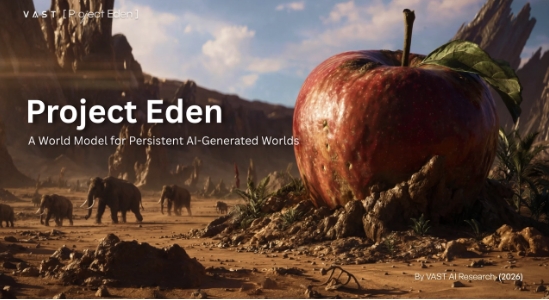
China - July 31, 2026 - VAST AI Research, the research team behind Tripo, announced the research preview of Project Eden, a persistent world model built for multiplayer use and AI agents sharing one consistent world.
Project Eden represents a step beyond conventional video-generation approaches often described as "world models." Instead of predicting the next frame and losing context once objects leave view, Project Eden is designed around an underlying world state that continues to run beneath what the camera sees. This allows the world to remember changes, preserve objects outside the frame, and maintain consistency across different viewpoints.
The research preview marks an important milestone in Tripo's long-term vision for spatial intelligence: AI systems that do not only generate static 3D assets, but can also create, maintain, and reason inside interactive worlds.
From Predicting Pixels to Simulating State
Many current AI systems can generate convincing motion and visual sequences, but they still struggle with long-term memory, causal consistency, and persistent interaction. When the world only exists as a stream of pixels, objects can drift, disappear, or return incorrectly once they leave the camera's view. Static 3D scene generation solves part of the structure problem, but it often lacks physics, events, and change.
Project Eden is built around a different principle: state before rendering. The system separates the underlying world state from the visual output, allowing the environment to exist before and beyond any single camera angle. Rendering becomes a way to observe the world, not the place where the world itself is stored.
This design allows Eden to support persistent environments where changes can last. If a fire is put out, it remains out. If a player looks away from a wall, the wall remains in place. If multiple users enter the same environment, they can interact with one shared reality from different viewpoints.
A Three-Layer Architecture for Persistent Worlds
Project Eden replaces the idea of one video generator doing everything with a three-layer architecture.
The first layer is an evolving structured state, which acts as the compact representation of the world. It tracks coarse geometry, object identity, semantics, and the consequences of user or agent actions.
The second layer is a state-to-observation interface, which converts the world state into camera-conditioned cues such as local geometry, semantics, and recent changes. Because every camera draws from the same underlying state, different viewpoints can remain physically consistent.
The third layer is generative neural rendering, which produces the visible output including lighting, texture, materials, smoke, fire, water, and motion. For creators refining digital environments, AI texturing can help enhance surface details and improve the visual quality of generated 3D assets.
Together, these layers allow Project Eden to support capabilities that pure video generation and static 3D scene generation struggle to combine: persistence, editability, interaction, multiplayer consistency, and agent training.
Built for Creators, Researchers, and Embodied AI
For creators, Project Eden points toward a new engine for interactive content. When generated characters need to become part of interactive experiences, AI rigging can help prepare 3D assets for animation workflows. A creator could generate an environment, define interactions, and invite multiple people into the same persistent space. Worlds can become reusable and editable rather than one-way video outputs.
For researchers, Eden provides a foundation for simulation environments with long-horizon consistency, stable physical rules, editable scenarios, and measurable consequences. These qualities are essential for training and evaluating embodied AI agents, where actions must produce reliable outcomes and the environment should not reset after every visual change.
Project Eden also introduces a foundation for multiplayer AI worlds. Many agents or users can share one compact state while receiving separate rendered views from their own cameras. This opens the door to synchronized racing, shooting-range scenarios, collaborative environments, and other multi-agent simulations where actions occur under the same rules.
Advancing Tripo's Spatial Intelligence Roadmap
Project Eden is a research preview, not a finished general-purpose world model. The team is continuing to develop richer physics, larger environments, wider free-viewpoint exploration, finer object interaction, and stronger State Transition Models that can update worlds based on actions, rules, and feedback.
The project reflects Tripo's broader belief that 3D is becoming a foundational layer for intelligent digital systems. As AI moves beyond text, images, and videos, the ability to understand and operate inside persistent 3D worlds will become increasingly important for creation, simulation, robotics, games, spatial computing, and embodied intelligence.
Project Eden also expands Tripo's long-term research direction beyond asset generation. Through its research initiatives, Tripo is exploring how AI systems can generate, edit, maintain, and reason within spatial environments, supporting the next generation of interactive AI 3D workflows.
About VAST AI Research and Tripo
VAST AI Research builds 3D foundation models and world models focused on advancing spatial intelligence. Its research supports the broader Tripo ecosystem, which brings AI-powered 3D generation, editing, optimization, and workflow tools to creators, developers, studios, and enterprises.
Founded in 2023, Tripo is an AI-driven platform redefining how 3D content is conceived, created, and shared. As an AI 3D model generator, Tripo integrates text-to-3D, Image to 3D Model, AI texturing, model segmentation, smart mesh optimization, auto rigging, stylization, and export tools into an all-in-one AI-native 3D workflow. The platform supports a global creator ecosystem and contributes to the open-source community through foundation models including TripoSR, TripoSG, and TripoSF.
Media Contacts
Maisie
dingjing@vastai3d.com
Tripo
WhatsApp: +65 80675286
Media Contact
Company Name: Tripo
Contact Person: Maisie
Email: Send Email
Country: China
Website: https://www.tripo3d.ai/