In a move that signals the definitive convergence of high-performance computing and biotechnology, NVIDIA Corporation (NASDAQ: NVDA) and Eli Lilly and Company (NYSE: LLY) announced a massive $1 billion "co-innovation" partnership at the J.P. Morgan Healthcare Conference on January 12, 2026. This five-year strategic alliance aims to re-engineer the pharmaceutical landscape by integrating "physical AI" and autonomous laboratories directly into the drug discovery process. The deal marks a pivotal moment for Nvidia, transitioning the company from a provider of specialized hardware to the foundational platform for the next generation of life sciences.
The immediate implications of this partnership are profound, as it seeks to collapse the traditional decade-long drug development timeline into just a few years. By leveraging Nvidia’s latest "Vera Rubin" chip architecture and its BioNeMo generative AI platform, Eli Lilly aims to automate the design and testing of complex molecules for chronic diseases. For the broader market, the deal underscores a shift where the world’s most valuable semiconductor company is now competing for dominance in the $1.5 trillion global pharmaceutical industry, fundamentally changing how investors value "Big Tech" and "Big Pharma" alike.
The $1 Billion Blueprint for Autonomous Science
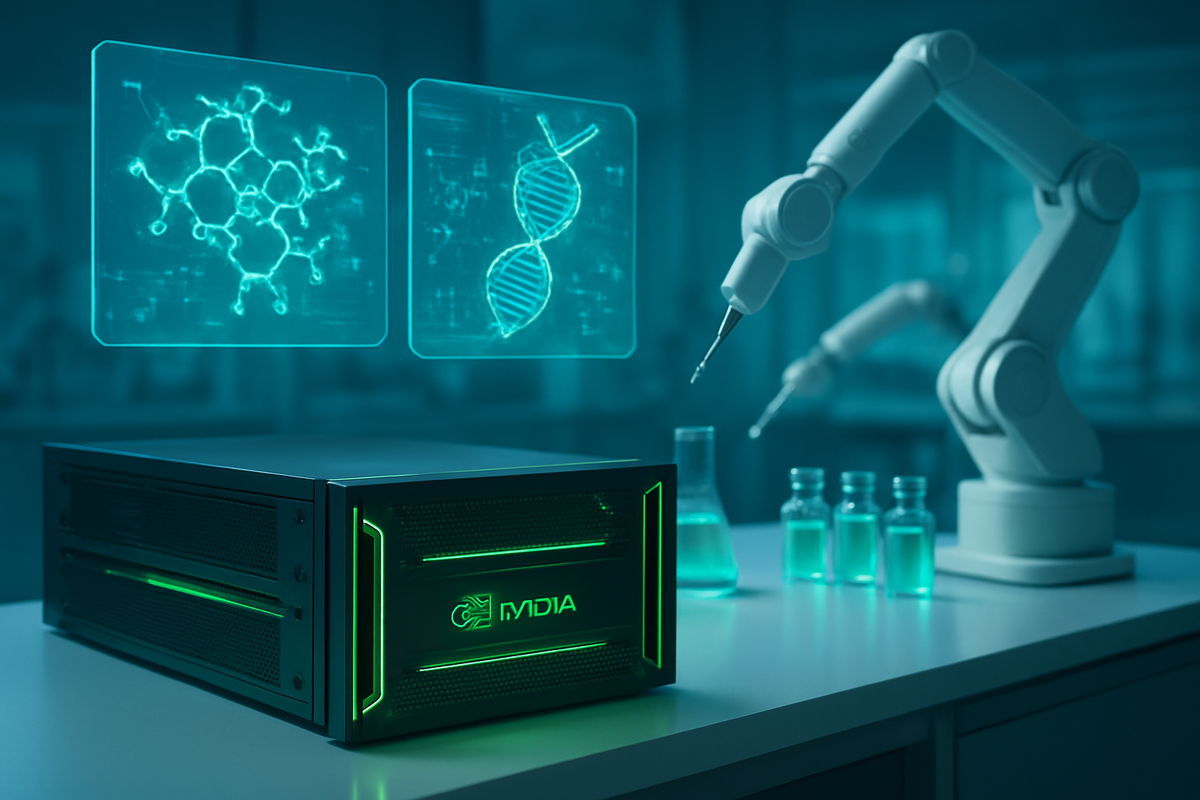
The partnership, unveiled during a joint keynote in San Francisco, centers on the creation of a first-of-its-kind "AI Co-Innovation Lab" in South San Francisco, scheduled to open in late March 2026. This facility will co-locate Lilly’s medicinal chemists with Nvidia’s AI research scientists to pioneer "lab-in-the-loop" discovery. In this model, biological foundation models autonomously design new molecular structures, which are then instantly synthesized and tested by robotic "agentic" wet labs. The resulting data is fed back into the AI in real-time, creating a 24/7 autonomous cycle of experimentation that removes human bottlenecks from early-stage R&D.
This landmark agreement is the culmination of a rapid escalation in collaboration throughout 2025. In October of last year, Eli Lilly deployed the pharmaceutical industry’s most powerful supercomputer, an NVIDIA DGX SuperPOD featuring over 1,000 Blackwell Ultra GPUs, to serve as its primary compute engine. The new 2026 deal expands this infrastructure to include the newly announced Vera Rubin architecture, which provides the massive inference performance required to bridge the gap between digital simulations and real-world laboratory robotics.
Key stakeholders include Nvidia CEO Jensen Huang and Eli Lilly CEO David Ricks, both of whom characterized the partnership as a "structural shift" in how humanity combats disease. The initial market reaction was overwhelmingly positive, with Nvidia shares climbing 4.2% and Eli Lilly shares rising 3.8% in mid-day trading following the announcement. Analysts noted that the deal effectively turns Eli Lilly into a tech-first entity, while securing Nvidia’s position as the "operating system" for the biological century.
Analyzing the Winners and Losers in the AI-Pharma Race
Nvidia (NASDAQ: NVDA) emerges as the clear winner, successfully diversifying its revenue streams away from a heavy reliance on hyperscale cloud providers. By embedding its BioNeMo platform and Omniverse digital twin technology into the core of Eli Lilly’s operations, Nvidia is creating a high-margin, "sticky" ecosystem that other pharmaceutical giants will be forced to adopt to remain competitive. Similarly, Eli Lilly (NYSE: LLY) gains a significant first-mover advantage, potentially slashing billions in R&D costs and accelerating its pipeline for high-demand treatments in obesity, oncology, and Alzheimer’s.
Other potential beneficiaries include specialized biotech firms like Recursion Pharmaceuticals (NASDAQ: RXRX) and Schrödinger, Inc. (NASDAQ: SDGR), which provide the software and data layers that thrive in an Nvidia-standardized environment. Infrastructure providers like Thermo Fisher Scientific (NYSE: TMO) and Illumina (NASDAQ: ILMN) are also positioned to win as they integrate Nvidia’s "intelligent instrument" blueprints into their next generation of lab hardware and genomic sequencers.
Conversely, the "losers" in this new era may be traditional Contract Research Organizations (CROs) and legacy pharmaceutical companies that have been slow to invest in proprietary AI stacks. Firms that rely on manual, labor-intensive clinical trial designs and traditional chemical screening may find themselves unable to compete with the speed and cost-efficiency of the Lilly-Nvidia "AI Factory." Furthermore, smaller biotech companies without the capital to build or lease massive GPU clusters may face a widening "compute divide," struggling to keep pace with the computational power of industry leaders.
Industrializing R&D: A New Standard for Global Health
The significance of this event extends far beyond a single corporate contract; it represents the industrialization of biological research. Historically, drug discovery has been a "bespoke" process, characterized by high failure rates and unpredictable timelines. The Nvidia-Lilly alliance seeks to standardize the "digital blueprint" of a laboratory, using NVIDIA Omniverse to create digital twins of entire manufacturing lines. This allows Lilly to simulate and stress-test the production of complex biologics, like GLP-1 agonists, before a single brick is laid at a new factory.
This trend mirrors the transformation of the automotive and aerospace industries, where digital simulation replaced physical prototypes decades ago. The regulatory implications are also significant. As AI-designed drugs enter the pipeline at an unprecedented rate, the FDA and other global regulators are being forced to adapt. The Nvidia-Lilly partnership includes a commitment to "transparent AI," utilizing NVIDIA FLARE (Federated Learning and Research) to ensure that AI models are verifiable and meet the stringent safety standards required for human therapeutics.
The move also places immense pressure on competitors like Novo Nordisk (NYSE: NVO) and Johnson & Johnson (NYSE: JNJ), both of whom have recently announced their own AI initiatives. However, the depth of the Nvidia-Lilly integration—spanning from chip design to robotic cleanrooms—sets a high bar that may take years for rivals to replicate. This partnership effectively signals that in the 2026 market, a pharmaceutical company’s value is as much about its "compute-per-molecule" as it is about its patent portfolio.
The Road Ahead: Autonomous Labs and Clinical Breakthroughs
In the short term, the industry will be watching the opening of the South San Francisco Co-Innovation Lab in March 2026. This facility will serve as a pilot for the "autonomous lab" concept, and its success or failure in identifying viable drug candidates will be a major market catalyst. Strategic pivots are already underway, with Eli Lilly likely to license its "Lilly TuneLab" platform to smaller biotechs, effectively becoming a platform provider itself, powered by Nvidia’s back-end infrastructure.
Long-term, the focus will shift to clinical trial outcomes. By 2027 and 2028, the first wave of drugs entirely designed and optimized by the Nvidia-Lilly AI stack will likely enter Phase I trials. The ultimate test will be whether these AI-optimized candidates have higher success rates in humans than those discovered through traditional methods. If they do, the pharmaceutical industry will undergo a permanent re-rating, with R&D efficiency becoming the primary metric for investor valuation.
Challenges remain, particularly regarding data privacy and the potential for "AI hallucinations" in molecular design. Nvidia and Lilly must prove that their "lab-in-the-loop" system can catch errors that a human scientist might miss. Furthermore, the geopolitical landscape of semiconductor supply chains remains a risk; any disruption to Nvidia’s Rubin chip production could directly stall the drug pipelines of its major pharmaceutical partners.
Final Thoughts: The Silicon-Science Convergence
The Nvidia-Eli Lilly partnership is a watershed moment that confirms Nvidia’s status as a diversified industrial powerhouse rather than just a "chip maker." By successfully expanding into healthcare and life sciences, Nvidia has secured a foothold in an industry that is largely immune to the cyclical nature of consumer electronics or social media trends. For Eli Lilly, the alliance is a bold bet on a future where the lab of the future is as much a data center as it is a biological facility.
Moving forward, investors should closely monitor the "compute-to-revenue" ratios of major pharmaceutical firms. The ability to harness AI for drug discovery is no longer a luxury; it is a prerequisite for survival in a market where speed-to-market is the ultimate competitive advantage. Watch for further announcements regarding "Physical AI" and the integration of robotics into the drug supply chain, as these will be the next frontiers in the Nvidia-led transformation of global healthcare.
As of January 2026, the message is clear: the most important breakthroughs in medicine are no longer happening just in test tubes, but in the silicon wafers and neural networks that now define the modern laboratory.
This content is intended for informational purposes only and is not financial advice.