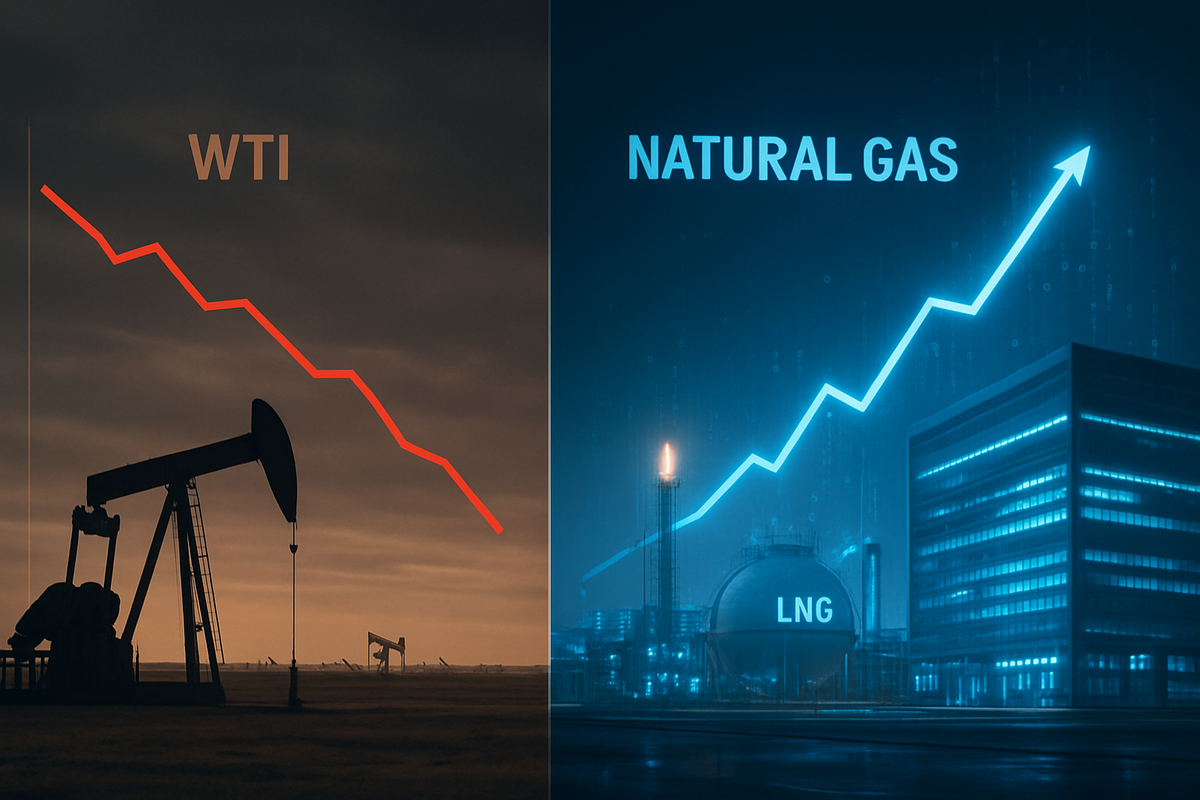
As of January 19, 2026, the global energy landscape is witnessing a rare and stark decoupling of its two most vital commodities. While West Texas Intermediate (WTI) crude oil has slid toward the $59 per barrel mark—a level not seen consistently since the post-pandemic recovery—natural gas prices have surged to a robust $3.11 per MMBtu. This divergence marks a "tale of two markets," where a growing global oil glut is clashing with a structural shift in natural gas demand fueled by a massive expansion in export infrastructure and the insatiable power needs of the artificial intelligence (AI) revolution.
The immediate implications for the market are profound. For consumers, the drop in oil prices offers a significant reprieve at the pump, potentially cooling inflationary pressures that have lingered for years. However, for the energy sector, the "price split" is forcing a radical reallocation of capital. Companies heavily weighted toward liquids are tightening their belts, while those positioned in the natural gas value chain, particularly in the Appalachian and Permian basins, are finding themselves in a surprise mid-winter bull market.
The Great Decoupling: Supply Gluts Meet Infrastructure Squeezes
The slide in crude oil to $59 is the culmination of a strategic pivot by OPEC+ that began in late 2025. After years of maintaining strict production quotas to support prices, the alliance, led by Saudi Arabia and Russia, shifted its focus toward reclaiming market share. This move coincided with record-shattering production from non-OPEC nations. Guyana has emerged as a powerhouse, contributing nearly 1.3 million barrels per day, while Brazil and the United States have continued to defy expectations of a production "plateau." The result is a projected global surplus of nearly 3 million barrels per day, effectively drowning any residual geopolitical risk premiums that previously held oil above $80.
In contrast, the natural gas rally to $3.11 is being driven by a "perfect storm" of demand. The primary catalyst is the operational commencement of several massive Liquefied Natural Gas (LNG) projects. The Golden Pass LNG facility and the second phase of Plaquemines LNG have both entered their ramp-up stages, creating a massive new "sink" for domestic gas. Furthermore, the winter of 2025-2026 has seen the first tangible impact of AI-driven demand. Hyperscale data centers across the U.S. have increasingly turned to natural gas-fired generation to provide the reliable, 24/7 baseload power that renewable sources cannot yet guarantee at scale.
Winners and Losers in a Split-Price Economy
The divergent price paths are creating a clear divide among industry heavyweights. ExxonMobil (NYSE: XOM) has emerged as a resilient leader, benefiting from its long-term strategic pivot toward LNG and its low-cost offshore assets in Guyana, which remain profitable even at $59 oil. Conversely, Chevron (NYSE: CVX) has faced more scrutiny as it balances its capital-intensive projects with a leaner WTI environment, though its diversified portfolio offers some protection against the oil price slump.
The most significant winners are the pure-play natural gas producers and infrastructure giants. EQT Corporation (NYSE: EQT) and Coterra Energy (NYSE: CTRA) have seen their margins expand as Henry Hub prices stabilized above $3.00, a level that provides healthy returns for shale gas extraction. On the infrastructure side, Cheniere Energy (NYSE: LNG) continues to capitalize on its role as the premier U.S. exporter, with long-term contracts insulating it from spot price volatility while it benefits from increased throughput volumes. Meanwhile, oil-heavy producers like Devon Energy (NYSE: DVN) and Diamondback Energy (NASDAQ: FANG) are facing headwinds; with WTI at $59, these firms are expected to scale back exploration and focus on "maintenance mode" to protect their dividends.
Broader Significance and the AI Power Hungry Future
This divergence is more than just a temporary market fluctuation; it represents a fundamental shift in how energy commodities are valued in a transitioning economy. Historically, oil and gas prices moved in relative lockstep, but the current environment shows that natural gas is increasingly decoupling from its "byproduct" status. The "AI power crunch" is a transformative factor, as tech giants seek firm power to support massive server farms. This has turned natural gas into a "strategic tech commodity," bridging the gap between fossil fuels and the green transition.
From a regulatory standpoint, the high natural gas prices are likely to reignite debates over export limits. As domestic prices rise toward $3.11, industrial users in the U.S. may pressure policymakers to slow the pace of new LNG approvals to protect local manufacturing costs. This mirrors historical precedents where domestic price spikes led to political tension between the energy export industry and the domestic industrial base. Furthermore, the oil glut signals a potential period of geopolitical stability—or at least a reduction in the "energy weapon" leverage of major oil exporters—as the world finds itself comfortably oversupplied.
Looking Ahead: The Spring Pivot and OPEC's Next Move
As we move toward the spring of 2026, market participants will be watching for two key factors: the pace of LNG facility ramp-ups and the endurance of the OPEC+ market-share strategy. If the current oil surplus continues to grow, we could see WTI test the $50 floor, a scenario that would likely force a dramatic consolidation among smaller U.S. shale players. Strategic pivots will be necessary; expect to see more "oily" companies attempt to acquire gas-rich assets to balance their portfolios against low crude prices.
On the gas side, the primary challenge will be infrastructure. If pipeline projects like those managed by Kinder Morgan (NYSE: KMI) or the Williams Companies (NYSE: WMB) face further environmental or legal delays, the price of natural gas could become even more volatile as demand outstrips the ability to move the molecule. The emergence of "gas-to-AI" partnerships—where data centers are built directly adjacent to gas processing plants—is a trend that could accelerate in the second half of 2026.
Wrap-Up: Navigating the Energy Rift
The current divergence between $59 WTI and $3.11 Natural Gas underscores a new era of energy complexity. The "abundance" of oil is meeting the "scarcity" of gas infrastructure, creating a bifurcated market that rewards scale and strategic positioning. For investors, the takeaway is clear: the energy sector is no longer a monolith. Value is shifting toward the "gas-export-power" nexus, while the oil production space is entering a period of forced efficiency and capital discipline.
Moving forward, the market will remain sensitive to any shifts in global manufacturing demand and the actualization of AI power projections. If the data center boom lives up to its promise, $3.11 natural gas may be the new floor rather than the ceiling. Investors should keep a close eye on quarterly earnings from the midstream sector and LNG operators, as these "toll-road" businesses are best positioned to capture the upside of the gas rally without the direct exposure to the volatility of the wellhead.
This content is intended for informational purposes only and is not financial advice.