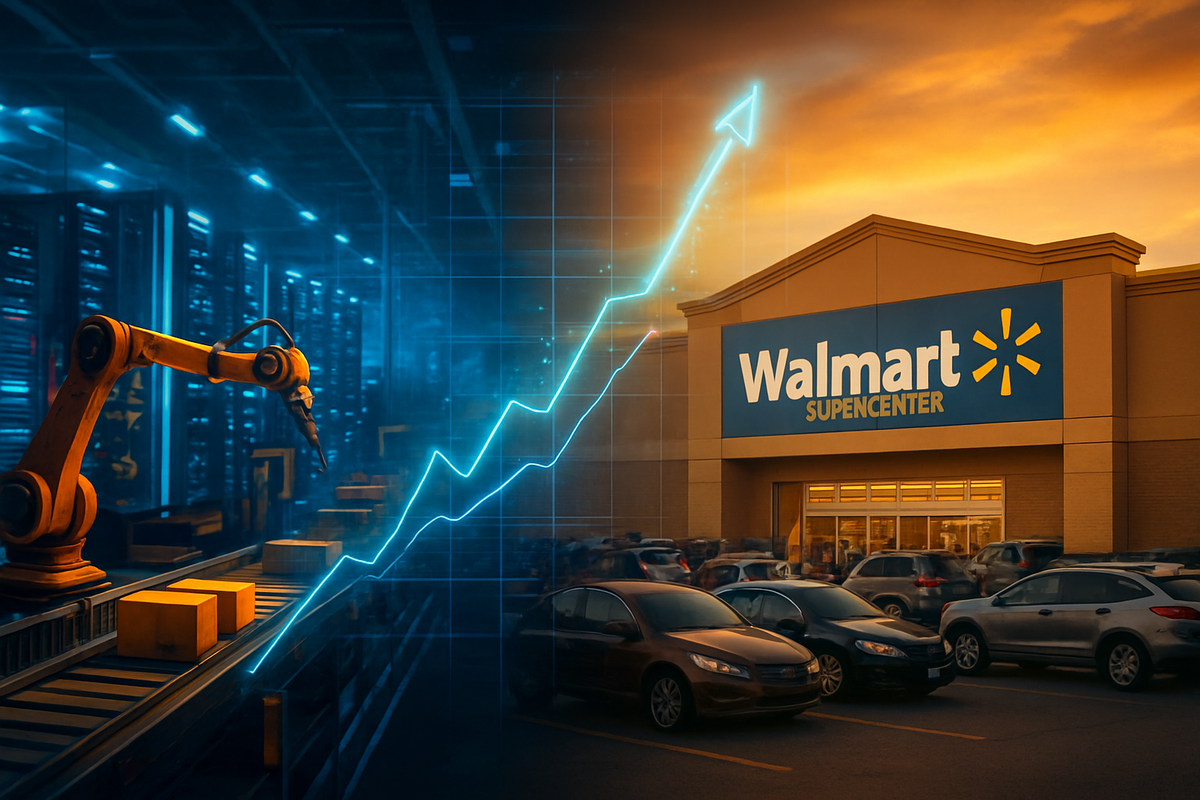
In a watershed moment for the global retail industry, Amazon.com Inc. (NASDAQ: AMZN) has officially surpassed Walmart Inc. (NYSE: WMT) in annual revenue for the first time in history. For decades, Walmart stood as the undisputed titan of commerce, a symbol of brick-and-mortar dominance that once seemed untouchable. However, as of February 2026, the scales have finally tipped. Following the most recent cycle of fiscal reports, Amazon posted a staggering $716.9 billion in total annual revenue, narrowly edging out Walmart’s $713.2 billion.
The immediate implications of this flip are more than just numerical; they signal a definitive shift in the definition of a "retailer." While Walmart remains a powerhouse in physical goods and essential groceries, Amazon’s ascension is fueled by a high-margin "flywheel" of cloud computing, advertising, and logistics services. This milestone marks the end of Walmart’s 13-year streak at the top of the Fortune 500 and ushering in an era where data-driven infrastructure is just as valuable as the products on the shelf.
The Path to $717 Billion: A Data-Driven Victory
The shift was solidified in early February 2026, as both companies closed out their respective fiscal years. Amazon’s report, released on February 5, showed 12% year-over-year growth, driven largely by the explosive demand for artificial intelligence (AI) services within its Amazon Web Services (AWS) division. AWS alone accounted for $128.7 billion of the total revenue, benefiting from a massive surge in corporate AI adoption. Without the high-octane growth of its cloud sector, which saw a 24% increase in the final quarter, Amazon would still trail Walmart in pure retail volume.
Walmart, reporting its results on February 19, 2026, did not go down without a fight. The Arkansas-based giant posted a healthy 4.7% increase in revenue, bolstered by its dominance in the U.S. grocery market. CEO John Furner noted during the earnings call that Walmart had successfully captured a larger share of high-income households, who have increasingly turned to the retailer for "Rollback" pricing amidst persistent, though cooling, food inflation. Despite these gains, Walmart’s reliance on physical foot traffic and a slower-growing digital segment left it vulnerable to Amazon’s rapid-fire logistics expansion.
The timeline leading to this moment has been a decade in the making. Since the mid-2010s, Amazon has aggressively reinvested its profits into a regionalized logistics network that now offers same-day delivery to over 100 million customers. This logistical moat, combined with the profitability of AWS, allowed Amazon to subsidize its retail operations and underprice competitors. Industry analysts had long predicted this "revenue flip" would occur by the mid-2020s, but the acceleration of AI technologies in 2024 and 2025 provided the final push Amazon needed to close the gap.
Winners and Losers in the New Retail Order
The primary winner in this transition is undoubtedly the tech-integrated consumer. Amazon’s rise has forced every major competitor to overhaul their supply chains, leading to faster delivery times and more competitive pricing across the board. Within the market, Amazon’s shareholders have seen their patience rewarded, as the company’s market valuation soared past $2.2 trillion in early 2026. Smaller third-party sellers on Amazon’s platform also stand to gain, as the company’s massive revenue reflects an increasingly diverse marketplace that now accounts for over 60% of total units sold on the site.
Conversely, traditional "middle-of-the-road" retailers are feeling the squeeze. Companies like Target Corporation (NYSE: TGT) and Kohl's Corporation (NYSE: KSS) face an uphill battle as they are caught between Amazon’s convenience and Walmart’s grocery-led value proposition. While Walmart is technically a "loser" in the race for the revenue crown, it remains in its strongest financial shape in years. Its e-commerce sales jumped 24% globally this year, and its advertising arm, Walmart Connect, grew to a record $6.4 billion. However, other big-box retailers that lack Walmart’s scale or Amazon’s tech stack risk becoming obsolete in a market dominated by two behemoths.
The Symbolic Shift: From Storefronts to Servers
This event fits into a broader industry trend where the lines between "technology company" and "retail company" have been permanently blurred. For nearly 60 years, Walmart’s success was built on the efficiency of the physical supply chain—getting pallets of goods to rural and suburban stores. Amazon has rewritten that playbook by turning retail into a service. By monetizing its infrastructure—through AWS, Fulfillment by Amazon (FBA), and its advertising business—Amazon has created a model that is significantly more resilient to the fluctuations of consumer spending than traditional retail.
The ripple effects of this shift will likely be felt in the regulatory sphere. As Amazon cements its lead, calls for antitrust scrutiny regarding its "dual role" as both a marketplace operator and a seller are expected to intensify. Policymakers are already eyeing the $717 billion figure as evidence of a potential monopoly on the digital economy. Historically, this event is being compared to the moment in the early 1990s when Walmart surpassed Sears as the nation’s largest retailer. Just as that shift signaled the end of the department store era, Amazon’s victory signals the end of the physical-first era.
The Next Frontier: AI and the $200 Billion Bet
What comes next for these two giants is a multi-billion dollar arms race in artificial intelligence and automation. During its February 2026 call, Amazon management shocked the market by announcing a $200 billion capital expenditure plan for the coming year. This investment is almost entirely dedicated to building out AI data centers and developing custom silicon chips, such as the Trainium and Graviton series, to maintain its cloud dominance. Amazon is essentially betting that the future of retail is not just online, but autonomous—driven by AI agents that predict and fulfill customer needs before they even search for a product.
Walmart is not sitting idle. The company has authorized its largest-ever $30 billion share repurchase program to return value to shareholders while simultaneously pivoting toward a "digital-first" store model. Investors should expect Walmart to focus heavily on its automated fulfillment centers and the expansion of its "Walmart+" membership program to compete with Amazon Prime. The battleground has shifted from price wars in the aisles to data wars in the cloud, and Walmart’s survival depends on its ability to monetize its 4,700 U.S. stores as micro-fulfillment hubs for a tech-savvy generation.
Closing the Chapter on Traditional Retail
The 2026 revenue milestone is a definitive wrap-up of the "retail wars" that have defined the last two decades. Amazon’s $717 billion total proves that the e-commerce giant has successfully evolved from a bookstore into the backbone of the modern internet and consumer economy. While Walmart’s $713 billion is an impressive feat that keeps it firmly in the top tier of global companies, the momentum is clearly on the side of the "tech-and-services" model.
Moving forward, the market will be watching two key metrics: AWS growth rates and Walmart’s e-commerce margins. For investors, the takeaway is clear: retail is no longer about who sells the most products, but who owns the most data and the fastest delivery route to the customer’s door. As Amazon takes its place at the top of the revenue mountain, the industry enters an uncharted era where the winner is determined by the strength of its algorithms as much as the quality of its goods.
This content is intended for informational purposes only and is not financial advice.