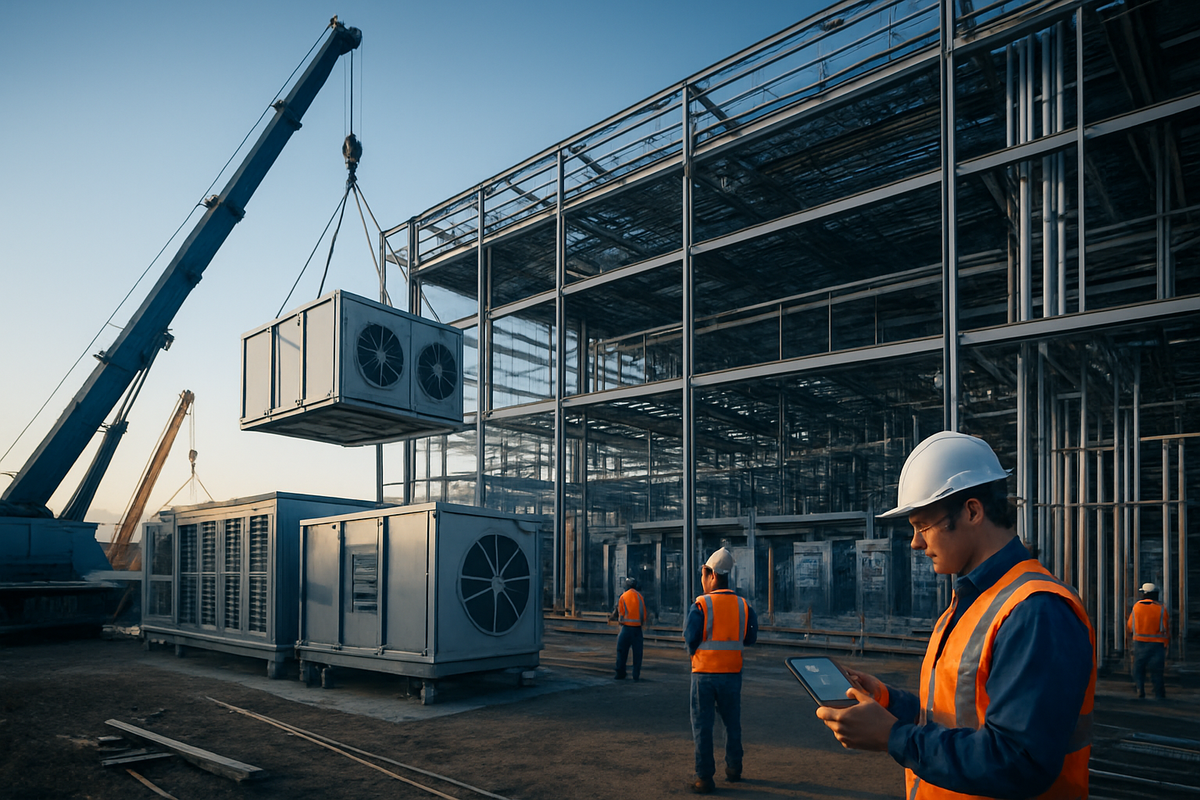
The Industrial Supercycle: Comfort Systems Shatters Records Amid 'Unprecedented' Infrastructure Demand
In a resounding confirmation of the ongoing "Blue-Collar AI" boom, Comfort Systems USA (NYSE: FIX) reported record-breaking financial results for the full year 2025, driven by what management described as "unprecedented demand" for high-end mechanical and electrical services. As of February 20, 2026, the Houston-based contractor has officially joined the elite rank of industrial firms surpassing the $1 billion threshold in both net income and operating cash flow, marking a historic turning point for the company and the broader commercial construction sector.
The implications of these results extend far beyond a single balance sheet. Comfort Systems’ meteoric rise—highlighted by a backlog that nearly doubled to $11.94 billion—serves as a definitive bellwether for the massive capital shift into U.S. infrastructure. From the rapid expansion of artificial intelligence data centers to the federally-funded resurgence of domestic manufacturing, the complex systems required to power and cool the modern economy have become the most valuable assets in the construction landscape.
A Historic Performance Driven by Technological Convergence
On February 19, 2026, Comfort Systems released its fourth-quarter and full-year 2025 earnings, revealing a transformation in the company’s scale. Revenue for the year surged nearly 30% to $9.10 billion, while diluted earnings per share (EPS) grew by a staggering 97.8% year-over-year. The fourth quarter alone saw revenue jump 41.7% compared to the previous year, as the company ramped up operations to meet the specialized needs of hyperscale data center operators and semiconductor giants. During the earnings call on February 20, CEO Brian Lane emphasized that the company is operating in a unique environment where the technical complexity of projects is rising alongside the volume of work.
The timeline leading to this milestone began in late 2024, as the "second wave" of AI investment shifted from silicon chips to the physical facilities required to house them. Throughout 2025, Comfort Systems aggressively expanded its electrical segment through strategic acquisitions, such as Feyen Zylstra, and doubled down on its modular construction capabilities. These off-site manufacturing facilities allow the company to build complex HVAC and electrical skids in controlled environments, bypassing local labor shortages and speeding up project delivery. The market reacted with immediate enthusiasm, as the company’s board approved a 16.7% increase in the quarterly dividend to $0.70 per share, signaling high confidence in the durability of the current project pipeline.
Winners and Losers in the Infrastructure Gold Rush
Comfort Systems is not the only player riding this wave. Peer companies specializing in complex infrastructure, such as Quanta Services (NYSE: PWR) and Emcor Group (NYSE: EME), have also reported record backlogs in early 2026. Quanta Services recently announced a $44 billion backlog, bolstered by the convergence of utility grid modernization and the massive power requirements of "large-load" industries. Similarly, Johnson Controls (NYSE: JCI) has seen its backlog swell to over $18 billion, driven by an "AI cooling cycle" that has made high-density industrial chillers one of the most sought-after products in the global market.
However, the boom is creating a sharp divide between the "haves" and "have-nots" of the construction world. The primary losers in this environment are traditional commercial real estate developers and retail REITs, which continue to struggle with high vacancy rates and a lack of investment as capital migrates toward industrial megaprojects. Furthermore, companies that rely on subcontracted labor rather than "self-performing" their work are finding themselves at a disadvantage. As the industry faces a projected shortage of nearly 500,000 workers in 2026, firms like Comfort Systems, which maintain a large internal workforce, are winning the most lucrative contracts because they can actually guarantee completion dates in a labor-starved market.
The Broader Significance: AI Meets the CHIPS Act
The record performance of Comfort Systems is a direct manifestation of three powerful macro trends: the AI revolution, the CHIPS Act, and the Infrastructure Investment and Jobs Act (IIJA). As of February 2026, the technology sector has become Comfort Systems’ largest market, accounting for 45% of its total backlog. This is no longer just about building warehouses; it is about the "megaproject" era, where single data center campuses or semiconductor "fab" plants require thousands of specialized workers and billions of dollars in mechanical and electrical outfitting.
Historically, construction was a cyclical industry tied to the broader economy, but the current period mimics the industrial build-outs of the post-WWII era or the massive electrification of the early 20th century. The IIJA has hit its peak disbursement phase in 2026, providing a "demand floor" for public works, while the CHIPS Act has triggered a wave of industrial reshoring that is relatively insulated from short-term interest rate fluctuations. This shift represents a fundamental re-rating of the industrial services sector, moving it from a commodity-based business to a high-margin, technology-adjacent powerhouse.
Looking Ahead: The Gating Factors of Growth
While the short-term outlook is exceptionally bright, the next 18 to 24 months will present new strategic challenges. The "labor gating factor" remains the most significant hurdle. For Comfort Systems and its peers, the ability to recruit, train, and retain skilled electricians and pipefitters will dictate their growth ceiling. We may see an even greater pivot toward modularization and robotics on the job site as companies attempt to "manufacture" their way out of the labor shortage.
In the long term, investors should watch for potential bottlenecks in the power grid. In tech hubs like Northern Virginia and Arizona, the sheer demand for electricity from new data centers is outstripping local utility capacity. This could lead to a strategic pivot toward "behind-the-meter" power solutions, where contractors like Comfort Systems are hired to build on-site microgrids and power generation facilities. Additionally, the shift from traditional air cooling to liquid cooling in data centers—required for the latest generation of AI chips—will provide a multi-year tailwind for the company's advanced mechanical division.
A New Era for Industrial Services
The record results from Comfort Systems USA highlight a paradigm shift in the American economy. The industrial sector is no longer the "old economy" lagging behind high-tech; it is the essential backbone that makes the high-tech future possible. With a $12 billion backlog and a presence in the most critical growth sectors of the 21st century, Comfort Systems has demonstrated that the convergence of physical infrastructure and digital innovation is the most potent economic engine of 2026.
Moving forward, the market will transition from a phase of "order-taking" to a phase of "execution." Investors should closely monitor labor costs, project margins, and the pace of federal fund disbursement. While the "unprecedented demand" phase has provided the fuel, the ability of these companies to manage massive, complex megaprojects in a resource-constrained environment will be the true test of their lasting impact. For now, the industrial supercycle shows no signs of slowing down, as the physical world races to catch up with the digital frontier.
This content is intended for informational purposes only and is not financial advice