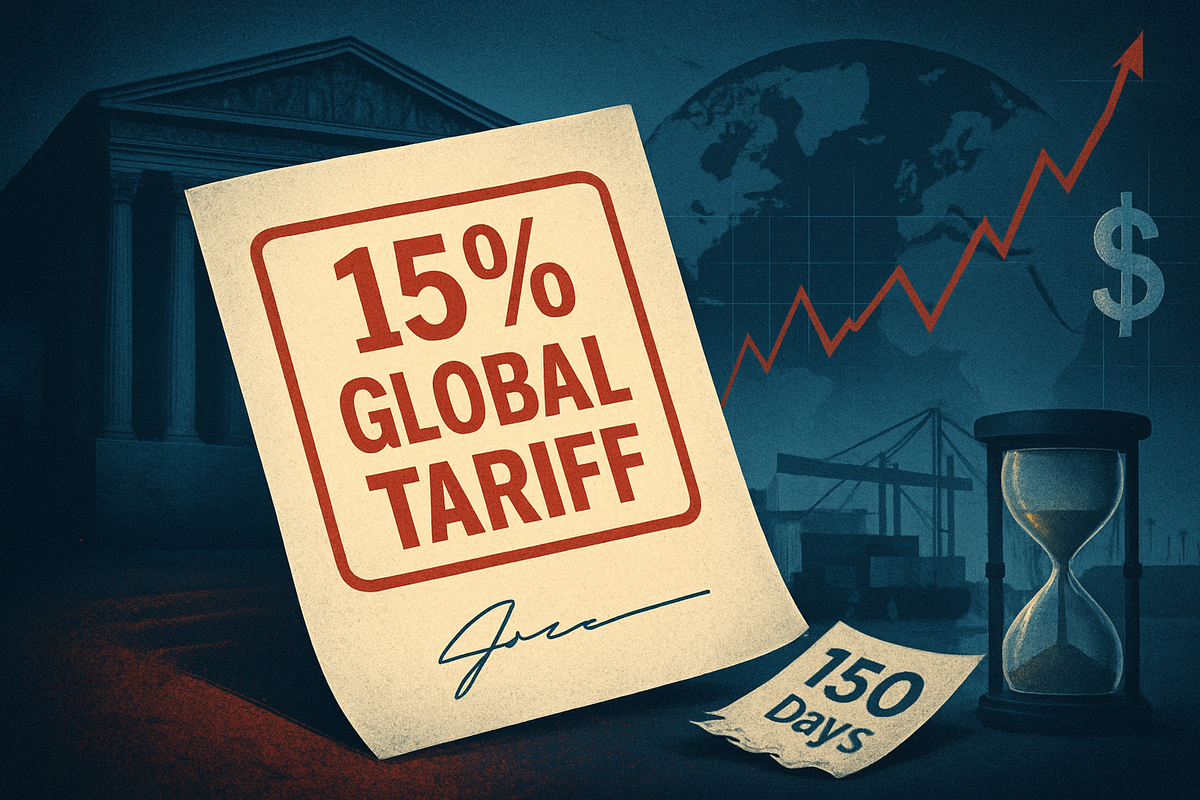
In a weekend that has sent shockwaves through global financial centers, President Donald Trump has signed a sweeping executive order imposing a 15% across-the-board global tariff. This move, announced late Saturday, February 21, 2026, serves as a direct and aggressive counter-maneuver to a landmark Supreme Court ruling issued just one day prior. By invoking the rarely used Section 122 of the Trade Act of 1974, the administration aims to maintain its trade-protectionist agenda while bypassing the judiciary's recent constraints on presidential "emergency" powers.
The immediate implications for the market are profound. As trading opened on Monday, February 23, 2026, the S&P 500 and Nasdaq-100 faced early volatility as investors scrambled to price in a new "tariff bridge." While the Supreme Court’s ruling on Friday initially offered hope for a multi-billion dollar refund of previously collected duties, the President’s swift pivot to a different legal authority suggests that the era of aggressive trade barriers is far from over. Instead, the U.S. is entering a highly regulated 150-day window that sets the stage for a summer showdown between the White House, Congress, and the business community.
The Pivot to Section 122: A Legal Counter-Strike
The catalyst for this weekend’s drama was the Supreme Court’s 6-3 decision in Learning Resources, Inc. v. Trump on Friday, February 20. The Court ruled that the International Emergency Economic Powers Act (IEEPA), which the President had used since 2025 to levy broad "emergency" tariffs, does not grant the executive branch the constitutional authority to impose taxes or duties. This ruling effectively invalidated roughly $134 billion in collected tariffs and threatened to dismantle the administration's primary trade policy.
Refusing to concede, President Trump signed an executive proclamation within hours of the ruling. While he initially signaled a 10% rate on Friday evening, he escalated the levy to 15%—the statutory maximum—via social media on Saturday. To do this, the administration invoked Section 122 of the Trade Act of 1974, also known as the "Balance-of-Payments Authority." This provision allows a president to impose temporary import surcharges to address "large and serious United States balance-of-payments deficits" or to prevent a significant depreciation of the dollar.
The use of Section 122 is a tactical masterstroke designed to exploit a legal loophole. Unlike the IEEPA, which the Supreme Court found too broad for taxation, Section 122 is a trade-specific statute that explicitly mentions a 15% tariff cap. However, the authority comes with a strict "ticking clock": the tariffs expire automatically after 150 days unless Congress intervenes to extend them. For the Trump administration, this 150-day window, ending on July 24, 2026, provides a "bridge" to keep tariffs in place while the U.S. Trade Representative (USTR) launches more permanent investigations under other statutes, such as Section 301 or Section 232.
Market Winners and Losers: Steel Rises as Retail and Tech Retrench
The sudden shift in legal strategy has created a bifurcated market. Domestic commodity producers, particularly in the metals sector, have emerged as the primary "winners." Companies like Cleveland-Cliffs (NYSE: CLF), United States Steel Corp. (NYSE: X), and Steel Dynamics, Inc. (NASDAQ: STLD) saw their shares stabilize or rise in pre-market trading. These firms benefit from a protected domestic market where the 15% surcharge provides a floor against cheaper global imports, ensuring that the supply-side pressure from foreign steel remains muted.
Conversely, the "losers" list is dominated by major importers and high-tech manufacturers. Retail giants such as Walmart Inc. (NYSE: WMT), Target Corp. (NYSE: TGT), and Amazon.com, Inc. (NASDAQ: AMZN) are facing a "double whammy" of uncertainty. While they may eventually receive refunds for the now-invalidated IEEPA tariffs, they must immediately begin paying the new 15% Section 122 surcharge. This creates a massive logistical and accounting headache, complicating inventory planning and pricing strategies for the first half of 2026.
The technology sector, led by heavyweights like Apple Inc. (NASDAQ: AAPL) and Nvidia Corp. (NASDAQ: NVDA), also faces significant headwinds. These companies rely on complex global supply chains that are highly sensitive to "friction costs." The 15% global tariff adds immediate expense to hardware components and finished goods. Additionally, the shipping industry is bracing for impact; carriers like Zim Integrated Shipping Services Ltd. (NYSE: ZIM) and Matson, Inc. (NYSE: MATX) are seeing volume forecasts dip as retailers reconsider the timing of their imports to avoid the current 150-day tariff window.
Wider Significance: A Crisis of Constitutional Authority
This event marks a historic escalation in the tug-of-war between the executive and judicial branches over trade policy. Historically, Section 122 was intended for the "Gold Standard" era of fixed exchange rates, meant to address acute currency crises. By applying it to broad industrial policy in 2026, the Trump administration is testing the boundaries of the law. Critics, including the National Retail Federation and the U.S. Chamber of Commerce, argue that using a "balance-of-payments" justification in a floating exchange rate environment is legally tenuous and potentially fraudulent.
The broader significance lies in the precedent of "authority-hopping." When one legal tool (IEEPA) was struck down by the Supreme Court, the administration immediately reached for another (Section 122). This suggests that the executive branch has become adept at navigating the "administrative state" to achieve policy goals that Congress is unwilling to legislate. It also creates a "regulatory fog" that deters long-term capital investment; if trade rules can change via executive order on a Saturday afternoon, corporations are less likely to commit to multi-year infrastructure projects in the United States.
Furthermore, this move has international ripple effects. By bypassing the Supreme Court's ruling, the U.S. is signaling to trading partners that its trade policy is insulated from domestic judicial oversight. This could prompt retaliatory measures from the European Union and China, who may view the Section 122 tariffs as a violation of World Trade Organization (WTO) principles, even if the U.S. argues they are domestic national security or economic necessity measures.
What Comes Next: The 150-Day Countdown
The financial world is now focused on the July 24, 2026, deadline. Because Section 122 is strictly temporary, the Trump administration must find a more permanent solution before the 150 days expire. Investors should expect the White House to use this period to pressure Congress into codifying the tariffs into law—a tall order given the approaching 2026 midterm elections. If Congress refuses, the administration will likely attempt to transition these duties into Section 301 "unfair trade practice" penalties, which would require a fast-tracked investigation by the USTR.
Short-term, the market will likely see "front-loading" behavior. Importers may attempt to rush goods into the country before the 150-day window ends, fearing that whatever replaces Section 122 could be even more restrictive or higher than 15%. This could lead to a temporary spike in freight rates and port congestion in late Q2 2026. Conversely, some retailers may delay shipments in hopes that legal challenges or a lack of congressional support will lead to a "tariff holiday" in late July.
Long-term, the focus will remain on the $134 billion to $175 billion in potential refunds from the struck-down IEEPA tariffs. While the Supreme Court ruled those tariffs illegal, the administration has signaled it will fight the actual disbursement of refunds in the Court of International Trade. For companies like Nike, Inc. (NYSE: NKE) or Gap Inc. (NYSE: GPS), these potential refunds represent a significant "contingent asset" on their balance sheets, though one that may take years of litigation to realize.
Wrap-Up: Navigating the Policy Fog
The re-imposition of a 15% global tariff via Section 122 represents a definitive statement of intent from the Trump administration: trade protectionism is the cornerstone of their economic policy, and they will utilize every available legal mechanism to defend it. While the Supreme Court's ruling on February 20 was a temporary victory for free-trade advocates, the "Section 122 Bypass" has effectively reset the board, ensuring that the trade war remains the dominant theme for 2026.
Moving forward, the market will likely remain in a state of high alert. The "150-day bridge" is a period of transition rather than a resolution. Investors should watch for three key indicators: the progress of USTR investigations into Section 301, the tone of Congressional leadership regarding a possible extension of the tariffs, and the filing of new lawsuits by trade associations challenging the "balance-of-payments" justification.
Ultimately, the lasting impact of this weekend’s events is the realization that trade policy has moved from the realm of stable legislation into a cycle of executive action and judicial reaction. For the public companies trading in this environment, agility and "regulatory intelligence" are now as important as fundamental earnings. The coming months will be a test of which companies can adapt their supply chains to a world where the rules can be rewritten in 48 hours.
This content is intended for informational purposes only and is not financial advice.