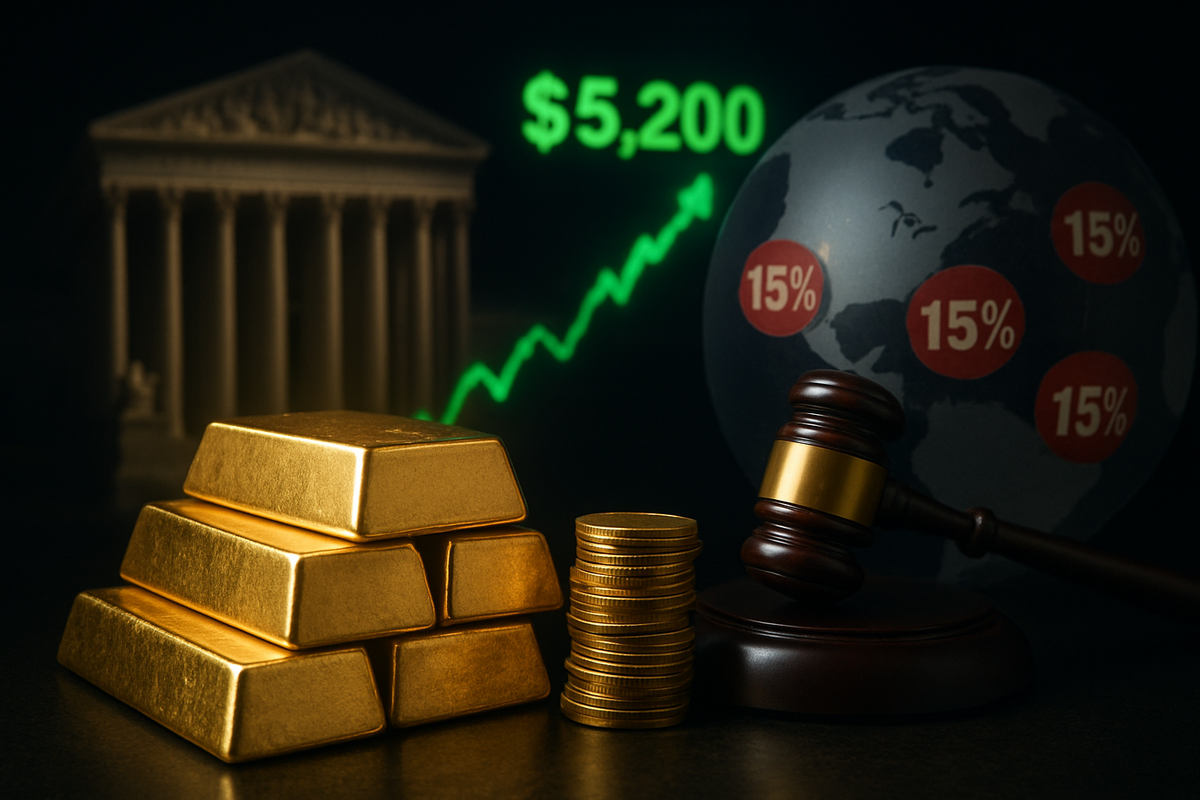
WASHINGTON D.C. — In a day of extraordinary market turbulence, gold prices surged more than 3% on Tuesday, February 24, 2026, breaking past the psychological barrier of $5,200 per ounce. The historic rally comes as investors scramble for safe-haven assets following a high-stakes constitutional showdown between the White House and the judiciary that has sent shockwaves through global trade markets.
The immediate catalyst for the flight to quality was President Donald Trump’s late-night announcement of a 15% global import surcharge. This sweeping executive action was a direct response to a Friday ruling by the Supreme Court that stripped the presidency of its ability to use the International Emergency Economic Powers Act (IEEPA) for tariff imposition. By pivoting to the rarely used Section 122 of the Trade Act of 1974, the administration has reignited fears of a protracted and unpredictable global trade war, leaving markets reeling from the sudden policy pivot.
The 150-Day Surcharge: A Response to Judicial Restraint
The path to today's market chaos began on February 20, 2026, when the Supreme Court issued a landmark 6–3 decision in Learning Resources, Inc. v. Trump. The Court ruled that the IEEPA did not grant the executive branch the unilateral authority to impose revenue-raising tariffs without explicit Congressional approval, citing the "Major Questions Doctrine." This ruling was initially met with a brief market rally as importers anticipated a roll-back of existing duties. However, the optimism was short-lived.
Faced with the prospect of losing his primary economic lever, President Trump invoked Section 122 of the Trade Act of 1974 on Monday evening. This provision allows for a temporary 15% import surcharge for up to 150 days to address "large and serious" balance-of-payments deficits. By applying this surcharge globally, the administration effectively bypassed the Supreme Court's IEEPA restriction, at least temporarily. The "stop-gap" measure hit the wires just before Asian markets opened, sending the U.S. Dollar into a volatile spin and propelling gold from $5,050 to over $5,230 in a matter of hours.
Key stakeholders, including the U.S. Chamber of Commerce and various trade associations, have expressed "profound concern" over the move. While the administration argues the surcharge is a necessary defense of the U.S. economy, legal scholars are already questioning whether Section 122 can be applied so broadly. For now, the "policy whiplash"—moving from a judicial victory for free trade to an executive expansion of protectionism—has created a vacuum of certainty that only gold seems capable of filling.
Winners and Losers: Mining Giants vs. Global Supply Chains
The immediate beneficiaries of the volatility are the world's largest gold producers. Newmont (NYSE: NEM) and Barrick Gold (NYSE: GOLD) both saw their share prices climb more than 5% in early trading, as the rising spot price of gold directly bolsters their bottom lines. Analysts at major firms have already begun revising earnings estimates for Kinross Gold (NYSE: KGC), noting that the company’s high sensitivity to gold price fluctuations makes it a prime candidate for outperformance in this "new era of uncertainty."
Conversely, the 15% surcharge represents a massive new tax on American companies with deep international roots. Apple (NASDAQ: AAPL) saw its shares tumble 4% as investors priced in the increased cost of importing hardware components and the likelihood of retaliatory measures from China and the EU. Similarly, Walmart (NYSE: WMT), a massive importer of consumer goods, faces a direct threat to its low-margin business model. The retail giant may be forced to choose between passing those costs on to an already inflation-weary consumer or absorbing the hit to its earnings.
Even tech stalwarts like IBM (NYSE: IBM) were caught in the crossfire. As the company leans more into global AI consulting, the friction of international trade and the potential for digital service taxes in retaliation for the 15% surcharge have dampened growth prospects. The divergence between "safe-haven" miners and "global-exposure" multinationals has rarely been more pronounced.
A Return to the "Gold Standard" of Fear
The events of February 2026 fit into a broader trend of deglobalization that has been accelerating for years. This latest escalation represents a "Trade War 2.0," where the battle is fought not just with tariffs, but through legal and constitutional maneuvers. Historically, gold has acted as the ultimate barometer of geopolitical stress. The 3% move today mirrors the safe-haven flows seen during the 2008 financial crisis and the 2020 pandemic, but with a new twist: it is now being driven by a fundamental breakdown in the predictability of U.S. trade policy.
Furthermore, the 15% surcharge is expected to have significant inflationary ripple effects. If the surcharge remains for the full 150 days, the cost of imported raw materials and finished goods will spike, potentially forcing the Federal Reserve to reconsider its interest rate path. This "stagflationary" shadow—slowing growth due to trade friction combined with rising prices—is the ideal environment for gold. Central banks, particularly in emerging markets, have already been accumulating gold at record rates, and today's policy shift is likely to accelerate that trend as they seek to diversify away from the dollar.
The 150-Day Countdown: What Lies Ahead
The market is now staring down a 150-day clock. Under Section 122, the 15% surcharge will expire in late July 2026 unless the administration can find a new legal justification or Congress intervenes. In the short term, expect a flurry of new "Section 301" investigations into "unfair trade practices," which the administration likely hopes will provide a more permanent legal footing for the duties before the 150-day window closes.
Strategic pivots will be required for any firm with a global footprint. Supply chain managers are expected to accelerate "near-shoring" or "friend-shoring" efforts to move production away from areas most likely to be targeted by retaliatory tariffs. However, such shifts take years, not months. In the interim, market volatility will remain the "new normal." If the constitutional crisis deepens—perhaps with a fresh challenge to Section 122—gold could easily test the $6,000 mark as the "ultimate insurance policy."
Market Wrap-Up and Investor Outlook
The 3% breakout in gold is more than just a price movement; it is a vote of no confidence in the current stability of global trade rules. The Supreme Court's attempt to limit executive power has, ironically, led to a more aggressive and broad-based trade barrier, leaving investors to grapple with a landscape where "legal certainty" is a moving target.
Moving forward, the market will be hyper-focused on two fronts: the technical support levels for gold, which now sit firmly at $5,100, and the legislative response from Capitol Hill. Investors should watch for any signs of a bipartisan effort to reclaim trade authority or, conversely, signs that other nations are preparing to hit back with their own 15% levies. For the next 150 days, the "Gold breakout" isn't just a headline—it's the primary strategy for a market in defensive mode.
This content is intended for informational purposes only and is not financial advice.