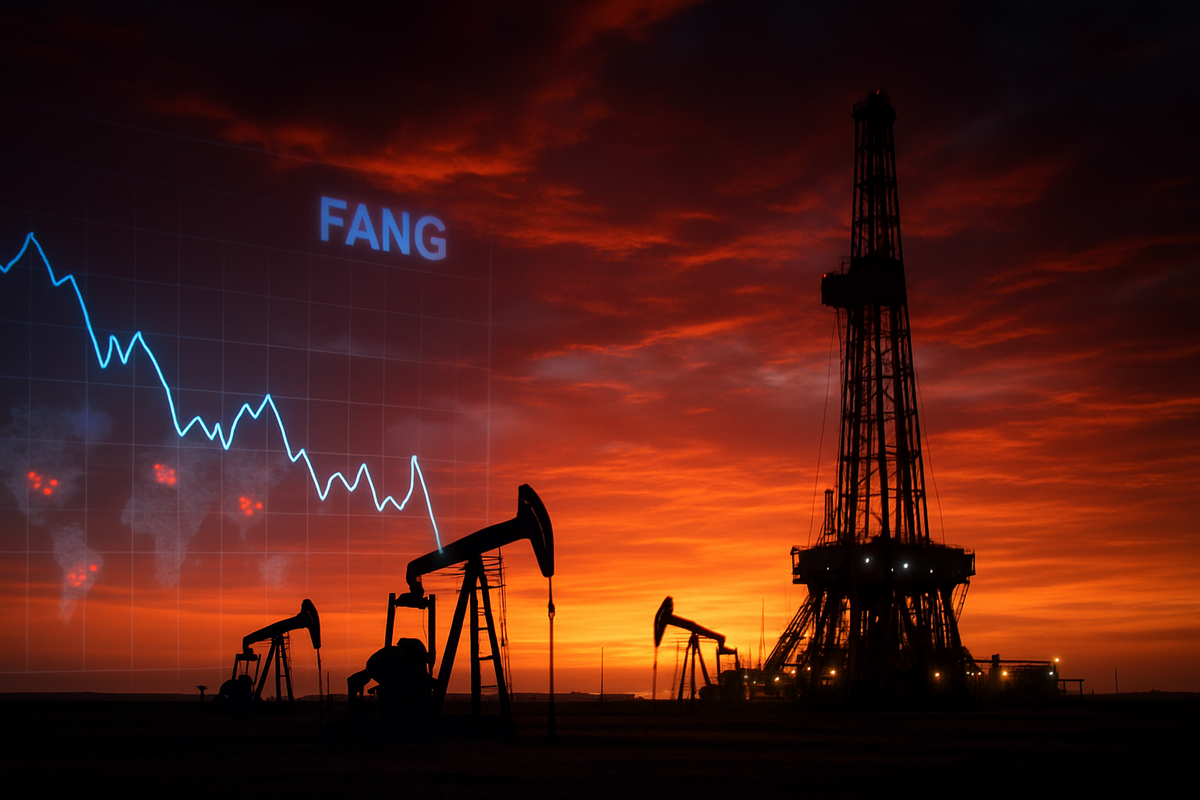
MIDLAND, Texas — Diamondback Energy (NASDAQ: FANG) reported its fourth-quarter and full-year 2025 financial results on February 24, 2026, posting an earnings per share (EPS) of $1.74. The figure fell short of the $1.88 consensus estimate previously established by Wall Street analysts. Despite the earnings miss, the company’s revenue of $3.38 billion managed to slightly exceed expectations, highlighting a complex operational environment where record-breaking production volumes are being offset by a persistent downward trend in global commodity prices.
The immediate market reaction was one of cautious reassessment. As of the opening bell on February 24, shares of Diamondback Energy saw a modest decline as investors weighed the $3.7 billion non-cash impairment charge—driven by lower year-end oil prices—against the company's aggressive debt-reduction strategy. The report underscores a pivotal moment for the U.S. shale industry, as the largest independent producer in the Permian Basin navigates a "Yellow Light" operational phase, balancing fiscal discipline against a backdrop of historic geopolitical instability in South America and the Middle East.
The $1.74 EPS reported today is the culmination of a volatile fiscal year 2025, during which Diamondback Energy finalized the integration of Endeavor Energy Resources. This merger solidified Diamondback’s position as the dominant force in the Permian Basin, with production metrics hitting a staggering average of 512.8 thousand barrels of oil per day (MBO/d) in the final quarter. However, the financial tailwinds provided by this massive scale were blunted by a cooling global market. Throughout late 2025, West Texas Intermediate (WTI) prices hovered in the mid-$50s, a far cry from the highs seen earlier in the decade, leading to the significant impairment charges that dragged down the bottom line.
The timeline leading up to today's report was marked by Diamondback’s strategic pivot to a "maintenance mode." Following the Endeavor acquisition, management shifted its focus from aggressive growth to capital efficiency and shareholder returns. In today’s earnings call, executives reiterated their commitment to a $4.20 per share annual base dividend, even as they face a global surplus of crude. This "Yellow Light" strategy—keeping production flat while waiting for price stability—was designed to protect the balance sheet against the very price dips that occurred in the fourth quarter.
Key stakeholders, including institutional investors and major Permian service providers, have been closely watching Diamondback’s ability to deleverage. The company reported it has reduced its consolidated net debt to $14.6 billion, with a stated goal of reaching $10 billion by the end of 2026. While the earnings miss is a headline setback, the company’s ability to generate significant free cash flow at lower price points remains its primary defense mechanism against a "lower-for-longer" price environment.
In the wake of this earnings report, the energy sector is seeing a clear divergence between "low-cost champions" and "high-cost laggards." Diamondback Energy (NASDAQ: FANG) emerges as a potential long-term winner due to its rock-bottom breakeven costs; the company noted today that its operations remain economical even if WTI drops to $50 per barrel, with its base dividend sustainable down to $37 per barrel. Other Permian heavyweights with similar scale, such as ExxonMobil (NYSE: XOM) and Chevron (NYSE: CVX), are likely to benefit from the same "Permian resilience" as they leverage high-efficiency multi-well pads to weather the current price slump.
Conversely, the losers in this environment are the higher-cost marginal producers and those heavily exposed to the infrastructure-starved regions of South America. Despite the recent political upheaval in Venezuela, the "uninvestable" nature of its aging oil infrastructure means that traditional oil majors are unlikely to see a return on investment there for years. Companies that banked on a rapid Venezuelan recovery following the deposition of the Maduro regime in early 2026 are finding that "regime change" does not instantly translate into "production surge."
Furthermore, oil field service providers like Halliburton (NYSE: HAL) and SLB (NYSE: SLB) may face headwinds as Diamondback and its peers maintain their "Yellow Light" stance. With production targets held flat for 2026, the demand for new drilling rigs and hydraulic fracturing fleets is expected to stagnate. Investors in the service sector should be wary of the decreased bargaining power these companies hold when the largest shale producers are focused more on cost-cutting than expansion.
The broader significance of Diamondback’s earnings miss is inextricably linked to the geopolitical "risk floor" currently holding oil prices above $50. In January 2026, the capture of Venezuelan President Nicolás Maduro by U.S.-backed forces sent shockwaves through the market, initially spiking prices on fears of supply disruptions. However, as the dust settled, the reality of Venezuela’s crippled infrastructure became apparent, capping production at roughly 1 million barrels per day. This situation has created a "bearish overhang," where the potential for future Venezuelan supply keeps a lid on long-term price spikes while near-term chaos provides a temporary floor.
Simultaneously, the "Maximum Pressure" campaign against Iran has returned to the forefront. In early 2026, Iranian exports dropped from 2 million to 1.5 million barrels per day due to a combination of domestic strikes and tighter U.S. sanctions enforcement. The threat of a closure of the Strait of Hormuz—a vital artery for 30% of global seaborne oil—remains a "black swan" event that analysts suggest could spike Brent prices by nearly 100%. For Diamondback, these tensions act as a counterweight to the massive 1-to-3 million barrel-per-day global surplus forecasted for the first half of 2026.
This event fits into a wider industry trend of "Defensive Shale," where American producers no longer chase production records but instead act as the world’s most efficient "swing producers." The historical precedent here is the 2014-2016 oil crash, but with a key difference: today’s Permian leaders have much stronger balance sheets and more advanced technology. This resilience makes the U.S. energy sector a critical geopolitical tool, as domestic production provides a buffer against the supply shocks emanating from the Middle East and South America.
Looking ahead, the next six months will be a test of Diamondback’s strategic flexibility. The company has signaled that it is prepared to shift to a "Red Light" phase—cutting activity and production—if WTI prices descend into the $40s. Conversely, should the tensions in Iran lead to a physical supply disruption at the Strait of Hormuz, Diamondback is uniquely positioned to "Green Light" its massive inventory of drilled-but-uncompleted wells (DUCs) to capture higher prices. This agility is the cornerstone of their 2026 outlook.
In the short term, investors should expect Diamondback to prioritize the repayment of debt over any further large-scale M&A. The goal of reaching $10 billion in net debt by the end of 2026 is ambitious but necessary to insulate the company from a prolonged global oversupply driven by non-OPEC growth in Brazil and Guyana. Market opportunities may emerge in the form of "bolt-on" acquisitions—smaller, high-quality acreage that fits into Diamondback’s existing Permian footprint—as smaller, distressed producers struggle with the $55 price environment.
To wrap up, Diamondback Energy's February 24, 2026, earnings report is a masterclass in the "new normal" of the energy sector. The $1.74 EPS miss is a reminder that even the most efficient producers are not immune to global price erosion and non-cash impairments. However, the underlying strength of the company’s Permian operations and its disciplined capital allocation provide a blueprint for how shale companies can survive and eventually thrive in a volatile 2026.
The market moving forward will be a tug-of-war between the bearish reality of a global supply glut and the bullish fear of geopolitical collapse in Iran and Venezuela. For investors, the takeaway is clear: focus on companies with low breakeven points and strong balance sheets. Diamondback Energy remains a bellwether for the industry, and its ability to maintain a high dividend while aggressively paying down debt will be the key metric to watch in the coming quarters.
As we move into the spring of 2026, the "geopolitical floor" remains shaky. Investors should keep a close eye on U.S. naval activity in the Persian Gulf and the speed of infrastructure stabilization in Venezuela, as these factors will ultimately dictate whether Diamondback’s "Yellow Light" turns green or red by the end of the year.
This content is intended for informational purposes only and is not financial advice.