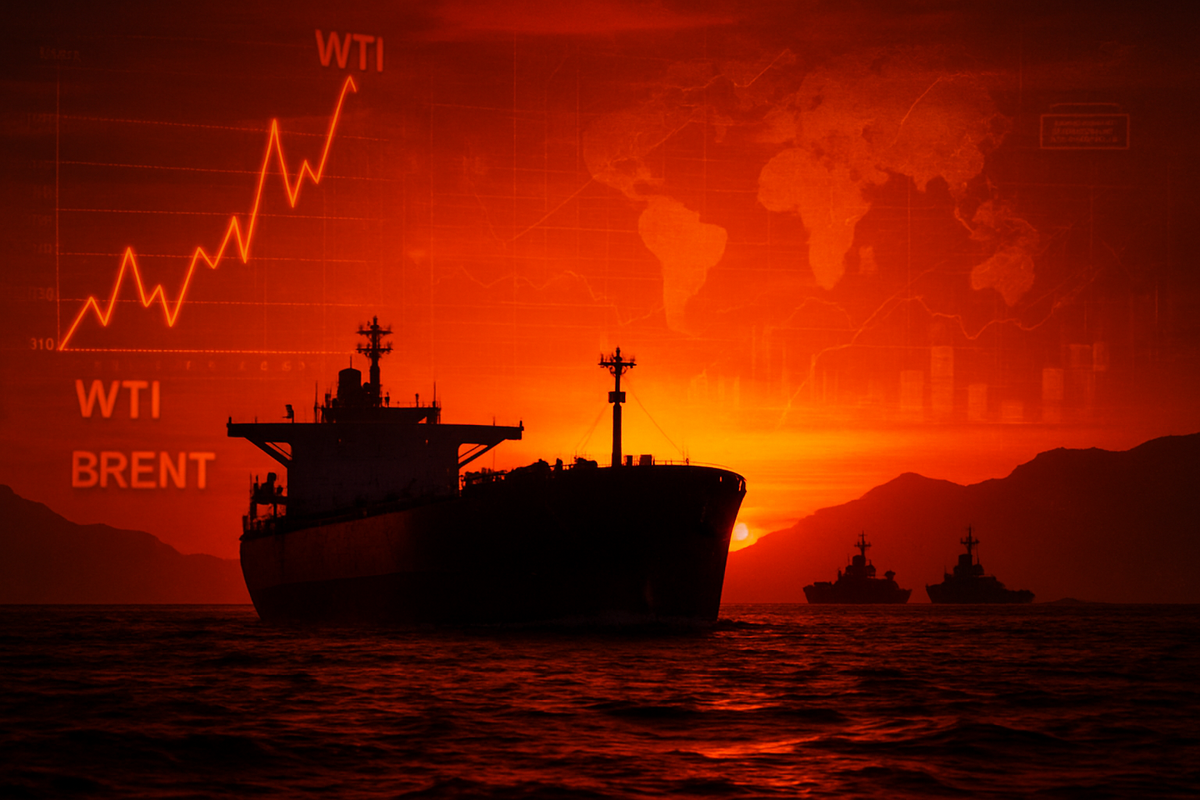
As of February 24, 2026, the global energy market is locked in a high-stakes tug-of-war between escalating geopolitical risks and cooling economic demand. Crude oil prices have surged to six-month highs this week, driven by a "geopolitical risk premium" as the United States and Iran teeter on the edge of a direct confrontation in the Persian Gulf. This "Iran-related supply anxiety" is currently centered on the Strait of Hormuz, a critical maritime chokepoint through which nearly 20% of the world’s daily oil consumption passes.
However, the rally in West Texas Intermediate (WTI) and Brent crude is facing a significant counter-force: the specter of "demand destruction." Traders are increasingly wary that newly implemented 10% to 15% global tariffs under Section 122 of the Trade Act could stifle international commerce and manufacturing. This dual-pressure environment has created a volatile "ceiling and floor" dynamic, leaving investors to weigh the immediate threat of a supply shock against the long-term reality of a slowing global economy.
The current "2026 Crisis" began in late 2025, following a series of nationwide anti-government protests in Iran that were met with a severe crackdown. By January 2026, the situation transitioned from domestic unrest to international crisis as the U.S. began a massive naval and air buildup in the Persian Gulf, reaching levels of military presence not seen in the region for over two decades. The tension reached a boiling point on February 3, 2026, when several IRGC Navy gunboats reportedly attempted to seize a U.S.-linked tanker in the Strait of Hormuz.
Market volatility spiked again on February 16, 2026, when Iran conducted large-scale naval drills, including temporary closures of shipping lanes. These maneuvers triggered an immediate 7% jump in oil prices over a 48-hour period. As of today, February 24, Brent crude is trading near $71.70 per barrel, while WTI sits at approximately $66.50. High-level, indirect diplomacy is currently underway in Geneva and Muscat, with U.S. envoys Steve Witkoff and Jared Kushner reportedly negotiating a "win-win" deal that would exchange strict nuclear enrichment limits for sanctions relief. Until a breakthrough is reached, analysts at Goldman Sachs and Barclays suggest an "Iran premium" of $7 to $10 remains baked into current prices.
The primary beneficiaries of this geopolitical friction are the major domestic energy producers and defense contractors. ExxonMobil (NYSE: XOM) and Chevron (NYSE: CVX) have seen their stock prices buoyed by higher crude realizations and their roles as diversified global majors. Pure-play exploration and production firms like ConocoPhillips (NYSE: COP) and Permian Basin leader Devon Energy (NYSE: DVN) are also gaining, as they provide investors with direct exposure to rising WTI prices without the same level of Middle Eastern operational risk.
Conversely, the defense sector is seeing a resurgence in procurement expectations. Lockheed Martin (NYSE: LMT), Northrop Grumman (NYSE: NOC), and RTX Corp (NYSE: RTX) have all outperformed the broader market in February as the U.S. bolsters its regional surveillance and missile defense capabilities. These companies are viewed as "geopolitical hedges," providing stability in portfolios during periods of international instability.
On the losing side of the ledger are sectors highly sensitive to fuel and feedstock costs. The airline industry has been hit particularly hard; American Airlines (NASDAQ: AAL), Delta Air Lines (NYSE: DAL), and United Airlines (NASDAQ: UAL) have seen their shares retreat 5-6% this month as rising jet fuel prices threaten to erase projected profit margins. Similarly, logistics giants like FedEx (NYSE: FDX) and UPS (NYSE: UPS) are facing higher operational "burn rates," while chemical manufacturers such as Dow Inc. (NYSE: DOW) and LyondellBasell (NYSE: LYB) struggle with the rising cost of petroleum-derived feedstocks like naphtha.
The current scenario mirrors historical precedents like the "Tanker War" of the 1980s and the 2019 Gulf of Oman attacks, where "war risk premiums" for shipping insurance skyrocketed. However, the 2026 market is fundamentally different due to the "shale buffer." Because the U.S. is now a dominant global energy producer, the threat of a total supply collapse—similar to the 1973 oil embargo—is less likely. Instead, the market is bracing for "asymmetric harassment," where drones, mines, or temporary blockades create persistent uncertainty rather than a permanent outage.
Furthermore, this event is occurring against a backdrop of shifting trade policy. The new 10-15% global tariffs have introduced a "ceiling" on how high oil can climb. While supply fears push prices up, the tariffs act as a drag on global growth, potentially reducing 2026 demand growth to just 850,000 barrels per day. This creates a "pincer movement" for the global economy: high energy costs combined with higher costs of goods due to trade barriers, a recipe for the stagflationary pressures that economists haven't seen in decades.
Looking ahead, the direction of the market hinges on the outcome of the Geneva talks. If a diplomatic breakthrough occurs by March, the "fear premium" could evaporate overnight, potentially sending Brent back toward the mid-$60s. However, if negotiations stall and the U.S. increases its naval "freedom of navigation" operations, a military miscalculation in the Strait of Hormuz could send prices toward $85 or higher, regardless of the demand-side pressure from tariffs.
Strategically, companies in the transport and manufacturing sectors will likely accelerate their pivot toward energy-efficient technologies and alternative fuels to hedge against future price shocks. Investors should also watch for a potential "strategic pivot" from OPEC+, which may be forced to increase production if Iranian exports are permanently sidelined, or conversely, cut production if global tariffs trigger a sharper-than-expected economic slowdown.
In summary, the oil market in early 2026 is a microcosm of the broader geopolitical landscape: a volatile mix of military brinkmanship and protectionist economic policy. The "supply anxiety" regarding Iran is real and historically grounded, but it is being checked by the sobering reality of "demand destruction" from global trade tensions. For the market to find a sustainable path forward, either a diplomatic solution in the Middle East or a cooling of trade hostilities will be necessary.
For investors, the coming months will require a high degree of agility. Watch for updates on the Geneva summit and any shifts in the Trump administration's Section 122 tariff implementation. While energy and defense stocks offer a short-term refuge, the broader health of the market depends on whether the global economy can withstand the dual shocks of expensive energy and restricted trade. The "Hormuz Bottleneck" is not just a geographical challenge; it is currently the primary bottleneck for global economic recovery in 2026.
This content is intended for informational purposes only and is not financial advice.