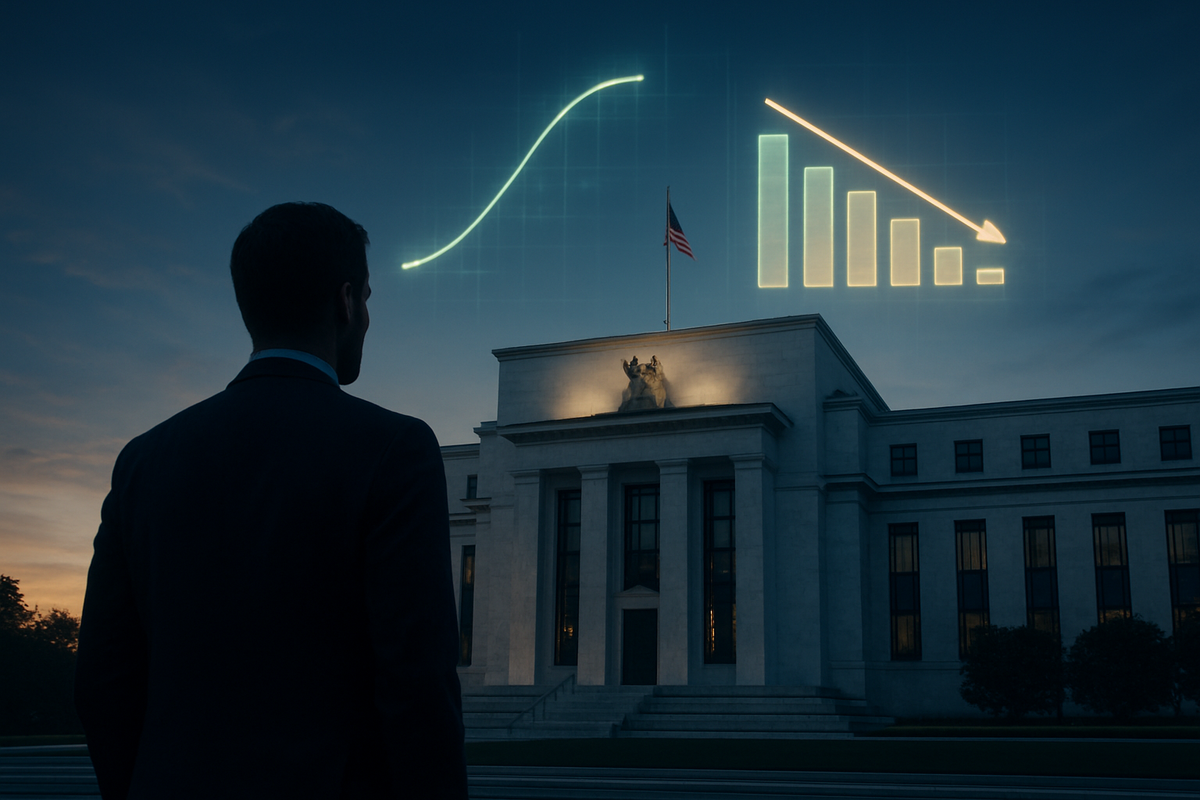
As the sun begins to set on Jerome Powell’s tenure at the helm of the world’s most powerful central bank, the financial world is bracing for a tectonic shift in economic governance. The nomination of Kevin Warsh to succeed Powell as Chairman of the Federal Reserve in May 2026 has sent a "Warsh Shock" through global markets, signaling an end to the "forward guidance" era and the beginning of a more discretionary, market-attuned regime. With the current date of February 24, 2026, marking the peak of pre-confirmation tension, investors are recalibrating portfolios for a leader who promises to marry aggressive interest rate cuts with a ruthless reduction of the Fed’s $6.6 trillion balance sheet.
The transition, slated for May 15, 2026, represents more than a change in leadership; it is a fundamental pivot toward what Warsh describes as "monetary discipline." While Powell’s legacy is defined by a data-dependent approach that relied heavily on transparency and consensus, Warsh is expected to introduce a "productivity hawk" framework. This doctrine suggests that the deflationary power of artificial intelligence and technological advancement allows for a lower "neutral" interest rate without reigniting the inflationary fires that plagued the early 2020s. However, this flexibility comes with a caveat: Warsh intends to dismantle the Fed's "buyer of last resort" status, potentially creating a more volatile environment for long-term debt.
A High-Stakes Handover Amid Senate Friction
President Trump officially tapped Warsh for the role on January 30, 2026, characterizing the former Fed Governor as a "central casting" choice capable of restoring the Fed’s focus to its core mandate. Warsh, a 55-year-old veteran of both Morgan Stanley and the George W. Bush administration, has a long-standing reputation for "flexibility." During the Great Financial Crisis, he was a key lieutenant to Ben Bernanke, often voting for unconventional easing (QE2) despite personal philosophical objections, demonstrating a pragmatic willingness to prioritize financial stability over ideological purity. This history suggests a leader who will not be boxed in by rigid models or "dot plots," which he is rumored to be considering abolishing.
The path to confirmation, however, is not without its hurdles. In the weeks leading up to today, February 24, 2026, the nomination has encountered a "wild card" in the form of Senator Thom Tillis (R-NC). Tillis has vowed to withhold his support in the Senate Banking Committee—where Republicans hold a narrow 13-11 lead—until a Department of Justice probe into Chairman Powell’s $4 billion headquarters renovation project is resolved. This political brinkmanship has created a window of uncertainty, though most Wall Street analysts expect a resolution before the May deadline. Market participants are watching the scheduled March confirmation hearings with bated breath, as any sign of a stalled nomination could trigger a sharp reversal in current market pricing.
Initial market reactions have been a study in "bear steepening." While short-term interest rate futures have rallied on the expectation that Warsh will deliver two to three rate cuts by the end of 2026, long-term bond yields have climbed. This phenomenon reflects the "Warsh Doctrine" of "QT-for-Cuts": a strategic trade-off where the Fed lowers the cost of short-term borrowing but accelerates the sale of its massive $2 trillion Mortgage-Backed Securities (MBS) portfolio. By returning to a "Treasury-only" balance sheet, Warsh intends to force private markets back into the driver’s seat of price discovery, a move that has already caused ripples across the housing and corporate credit sectors.
Winners and Losers in the "Warsh Shock"
The banking sector has emerged as the clear winner of the "Warsh Shock," buoyed by the prospect of a steeper yield curve. Financial institutions like Bank of America (NYSE: BAC), KeyCorp (NYSE: KEY), and Huntington Bancshares (NASDAQ: HBAN) have seen their valuations jump as investors anticipate expanded Net Interest Margins (NIM). Under a steeper curve, these lenders can borrow at lower short-term rates while lending at higher long-term rates—a fundamental boost to their core profitability. Life insurers, including MetLife (NYSE: MET) and Prudential Financial (NYSE: PRU), are also finding favor, as higher long-term yields allow them to reinvest premium income into more lucrative fixed-income assets.
Conversely, the real estate sector and highly leveraged tech companies are facing a "valuation nightmare." Real Estate Investment Trusts (REITs) like Prologis (NYSE: PLD) and Vornado Realty Trust (NYSE: VNO) have seen their share prices pressured by the rise in 10-year yields, which currently hover near 4.5%. For these firms, the "maturity wall" of 2026—when billions in debt must be refinanced—has suddenly become significantly more expensive. In the tech world, growth-heavy giants like Microsoft (NASDAQ: MSFT), Alphabet (NASDAQ: GOOGL), and Meta Platforms (NASDAQ: META) have experienced volatility. While their cash-rich balances offer some protection, their valuations are sensitive to the rising discount rates associated with higher long-term yields.
However, a subset of the tech sector could thrive under Warsh’s "productivity thesis." Companies at the forefront of the AI revolution, such as NVIDIA (NASDAQ: NVDA), Qualcomm (NASDAQ: QCOM), and Tesla (NASDAQ: TSLA), are being viewed through a different lens. Warsh’s belief that AI-driven efficiency gains justify lower interest rates effectively frames these companies not just as growth plays, but as the very engines of the Fed’s new policy framework. For investors, this creates a stark bifurcation in the market: betting on the "old economy" real estate vs. the "new economy" productivity titans.
Redefining the Fed’s Footprint
The shift from Powell to Warsh marks the most significant change in Fed philosophy since the Volcker-to-Greenspan transition. Powell’s tenure was characterized by "monetary dominance," where the Fed used its balance sheet as a primary tool to manage financial conditions. Warsh is expected to pivot toward "monetary discipline," advocating for a smaller Fed footprint and a retreat from "mission creep." This includes a likely roll-back of the Fed’s involvement in climate-related financial risk assessments and social equity initiatives, focusing the institution strictly on price stability and maximum employment through the lens of market signals rather than theoretical models.
Historically, this transition mirrors the 1980s shift away from the stagflation era. By emphasizing "price discovery" and "sound money," Warsh is attempting to decouple the Fed from its role as the market's constant safety net. This "regime change" carries significant risks; the withdrawal of Fed liquidity from the MBS market could lead to a liquidity crunch in mortgage lending, potentially cooling the housing market more aggressively than intended. Furthermore, by moving away from "forward guidance"—the practice of telling markets exactly what the Fed will do months in advance—Warsh intends to restore the element of surprise to central banking, which he argues prevents markets from becoming "lazy" and overly reliant on the Fed.
The ripple effects extend to the digital and commodity markets. Bitcoin, which had traded as a hedge against "easy money," plummeted 25% following the nomination announcement, as investors repriced the end of the zero-interest-rate fever dream. Gold also suffered a sharp correction, dropping 18% as the U.S. dollar strengthened on the back of higher long-term yields. The "Warsh Doctrine" essentially challenges the narrative of persistent debasement, betting that a leaner, more disciplined Fed will restore the dollar’s status as a stable store of value, even as short-term rates are cut to support economic growth.
The Road Ahead: June and Beyond
As we move toward the May 15 handover, the short-term outlook remains dominated by the confirmation process and the June FOMC meeting. Markets have already priced in a 25-basis-point cut for June 2026, which would serve as Warsh’s opening salvo. The long-term challenge will be the "active" reduction of the balance sheet. Unlike the "passive runoff" employed by the Powell Fed—where maturing bonds were simply not replaced—Warsh is expected to initiate the active sale of assets. This could create a "volatility tax" on bond markets throughout late 2026 and 2027 as the private sector absorbs trillions in supply.
Strategic pivots will be required for corporate treasurers and institutional investors alike. The "easy money" playbook of the last decade is being rewritten. Companies with "maturity walls" in late 2026 may look to front-run the transition by issuing debt now, before the full force of Warsh’s MBS sales hits the market. For the retail investor, the opportunity lies in the "productivity" narrative; if Warsh is correct and AI allows for a higher growth/lower rate environment, the mid-2026 period could represent a generational entry point for tech and automation stocks that can prove their efficiency gains.
Final Assessment for the Modern Investor
The nomination of Kevin Warsh represents a calculated gamble on a "productivity-led" economy. By the time he takes the gavel in May 2026, the transition from Powell’s consensus-driven model to Warsh’s discretionary, market-first approach will be well underway. The key takeaways for the market are clear: expect a steeper yield curve, a more volatile bond market, and a Fed that is less interested in being the market's "best friend" and more interested in being its "strict supervisor."
Moving forward, the market will be a tale of two halves. The "short end" of the curve will likely fall, providing relief to consumers and small businesses, while the "long end" will remain elevated, challenging the real estate and long-duration growth sectors. Investors should watch the 10-year Treasury yield and the spread between it and the 2-year yield as the ultimate barometers of the "Warsh Doctrine’s" success. As we head into the summer of 2026, the era of the "Fed Put" is being replaced by the era of "Price Discovery," and those who adapt to this new discipline will be the ones who thrive in the post-Powell landscape.
This content is intended for informational purposes only and is not financial advice