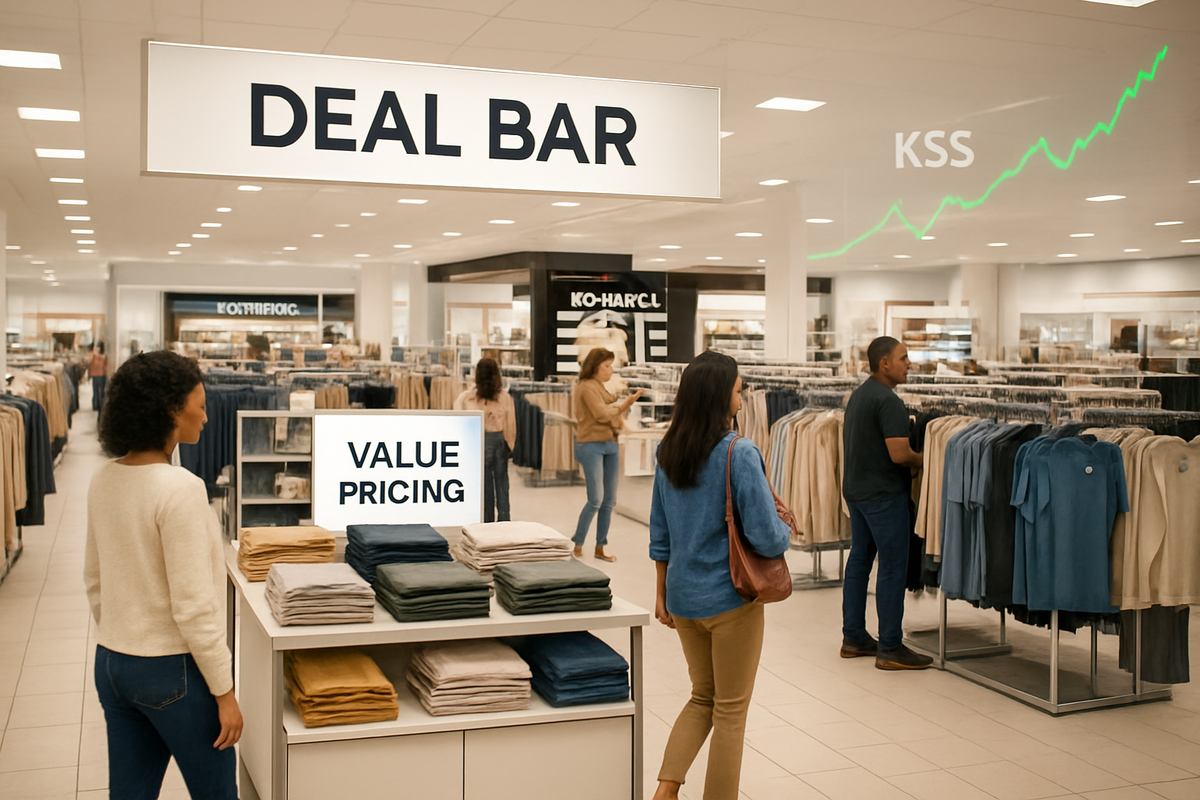
In a high-stakes bid to reverse years of declining foot traffic and identity crisis, Kohl’s Corporation (NYSE: KSS) CEO Michael J. Bender officially unveiled a comprehensive strategic revamp during the company’s March 2026 earnings presentation. The plan, which management is calling the "Customer-Led Strategy," focuses on reclaiming the value-conscious middle-market shopper by re-emphasizing proprietary brands and introducing aggressive new value-pricing tiers. The announcement comes at a critical juncture for the Wisconsin-based retailer, as it battles a volatile stock price and a retail landscape increasingly dominated by off-price giants and premium department stores.
The immediate market reaction to the "2026 Strategic Vision" was a study in contrasts. Shares of Kohl's initially surged over 14% in pre-market trading following a rare fourth-quarter earnings beat, only to see those gains evaporate by the closing bell on March 25, 2026. Investors remain deeply divided on whether Bender—who took the helm as permanent CEO in November 2025 following a period of leadership instability—can successfully pivot the 1,150-store chain toward sustainable growth or if the company is simply managing a slow decline in a shrinking mid-market segment.
A New Vision: The 2026 Strategic Pillars
The centerpiece of the new strategy is a return to Kohl’s historical roots while doubling down on its most successful recent partnership. CEO Michael Bender highlighted four primary pillars during the March 25 investor call. First is the launch of the "By Kohl’s" marketing campaign, a deliberate shift away from high-cost national brands back toward the company's high-margin proprietary labels like Sonoma Goods for Life, Croft & Barrow, and Tek Gear. This includes the introduction of new private-label lines such as FLX Golf and a teen-focused brand called Sea + Sky, aimed at capturing younger demographics who have largely migrated to fast-fashion competitors.
The most visible change for shoppers will be the nationwide rollout of "The Deal Bar." Located at the front of every store, this new section features impulse items and essentials priced at $10 or less, a move designed to directly compete with the "treasure hunt" experience offered by off-price retailers like Ross Stores, Inc. (NASDAQ: ROST). Simultaneously, Kohl’s is leaning into its "Sephora at Kohl's" partnership, which surpassed $2 billion in annual sales in late 2025. The 2026 plan includes bringing prestige brands like MAC Cosmetics and Charlotte Tilbury to over 850 locations, hoping to leverage the Sephora "halo effect" to drive cross-shopping in other departments.
This revamp follows a tumultuous period for the retailer. Since 2023, Kohl’s has seen a revolving door in the executive suite, with former CEO Tom Kingsbury focusing on inventory discipline before his exit in early 2025, and a brief, six-month tenure by Ashley Buchanan. Bender, formerly the Board Chairman, has spent the last five months dismantling "failed experiments," such as the reduction of fine jewelry and petite sections, which he admitted had alienated the core Kohl’s customer. "We stopped listening to our best customers for a while," Bender told analysts. "Today, we start earning them back."
Market Displacement: Winners and Losers in the Retail Shuffle
The Kohl's turnaround strategy creates a ripple effect across the retail sector, with several key players standing to gain or lose market share based on its execution. Target Corporation (NYSE: TGT) and Macy’s, Inc. (NYSE: M) are perhaps the most directly impacted. Target, which saw its stock jump 22% in early 2026 on its own recovery story, currently holds the "cheap-chic" crown that Kohl’s is trying to reclaim. If Kohl's "Deal Bar" and private-label push succeed, it could siphon off value-seeking suburban shoppers who have migrated to Target for their basics.
Conversely, Macy’s, Inc. (NYSE: M) appears to be pulling ahead in the department store race by leaning into luxury via its Bloomingdale’s brand and its "Bold New Chapter" strategy under CEO Tony Spring. While Kohl's retreats into the value segment, Macy's is successfully capturing the higher-end consumer. The "loser" in this scenario may continue to be the Kohl’s investor if the company cannot fix its thin profit margins, which currently hover near 1.2%. High inventory velocity is helping, but stagnant foot traffic remains a secular headwind that Kohl's has yet to overcome compared to the robust growth seen at Nordstrom, Inc. (NYSE: JWN) and its thriving off-price Rack division.
The beauty industry remains a clear winner. The continued expansion of Sephora within Kohl's stores is a major boon for LVMH Moët Hennessy Louis Vuitton (OTC: LVMUY), Sephora’s parent company. By using Kohl’s as a suburban distribution vehicle, Sephora is effectively locking out competitors like Ulta Beauty, Inc. (NASDAQ: ULTA) from prime middle-market real estate, even as Kohl’s itself struggles to maintain its overall store profitability.
The Broader Retail Context: Survival of the Mid-Market
The Kohl's overhaul is a bellwether for the broader "squeezed middle" of American retail. For the past decade, the market has bifurcated into high-end luxury and low-end discount. Kohl's, situated squarely in the middle, has suffered as consumers either traded up for status or down for survival. The 2026 "Back-to-Basics" plan is a strategic admission that the mid-market can no longer exist as a generalist; it must provide a specific value proposition—in this case, "The Deal Bar" and exclusive beauty brands—to survive.
Historically, retail turnarounds of this magnitude are difficult to pull off without significant store closures. While Kohl’s shuttered 27 underperforming locations in 2025, Bender’s commitment to keep the remaining 1,150 stores open is a risky bet on the "Small Format" store concept. By testing 35,000-square-foot locations in urban centers, Kohl’s is attempting to mirror the success of smaller, localized footprints seen in the grocery and pharmacy sectors. This trend reflects a wider industry shift away from the sprawling 100,000-square-foot mall anchors of the 1990s.
The Road Ahead: Short-Term Pain vs. Long-Term Gain
Looking toward the remainder of 2026, Kohl's faces a narrow path to success. The company’s guidance for the fiscal year remains conservative, projecting net sales to be flat to down 2%. Short-term profitability will likely be pressured by the marketing spend required for the "By Kohl’s" campaign and the capital expenditures needed to install "The Deal Bars" across the fleet. Investors will be watching closely for the Q2 and Q3 results to see if the Sephora expansion can finally drive enough traffic to lift the lagging apparel and home categories.
A potential strategic pivot may still be on the table if these efforts don't yield a 1% to 2% lift in comparable-store sales by year-end. Analysts have long speculated that Kohl's could be a target for private equity or a merger with a real estate investment trust (REIT) interested in its off-mall locations. For now, the "Bender Plan" is the only roadmap available, and its success hinges on whether the American suburban shopper still values the "Kohl's Cash" and "Deal Bar" experience in an era of 15-minute delivery and ultra-fast fashion.
Final Assessment for Investors
The March 2026 revamp is arguably the most honest assessment of Kohl’s position in years. By acknowledging its loss of core customers and leaning into its partnership with Sephora, the company is finally playing to its remaining strengths. However, the market’s skeptical reaction to the earnings beat—selling off the gains almost immediately—suggests that "honest assessment" is not the same as "guaranteed recovery."
For investors, the key metrics to watch in the coming months will be inventory turnover and the performance of the "By Kohl's" private labels. If these brands can achieve the high-margin status management expects, the stock’s current valuation of $12–$15 per share could look like a bargain. But if foot traffic continues to bleed toward Ross Stores, Inc. (NASDAQ: ROST) and Target Corporation (NYSE: TGT), the 2026 revamp may go down as a well-executed but ultimately too-late attempt to save a retail icon.
This content is intended for informational purposes only and is not financial advice.