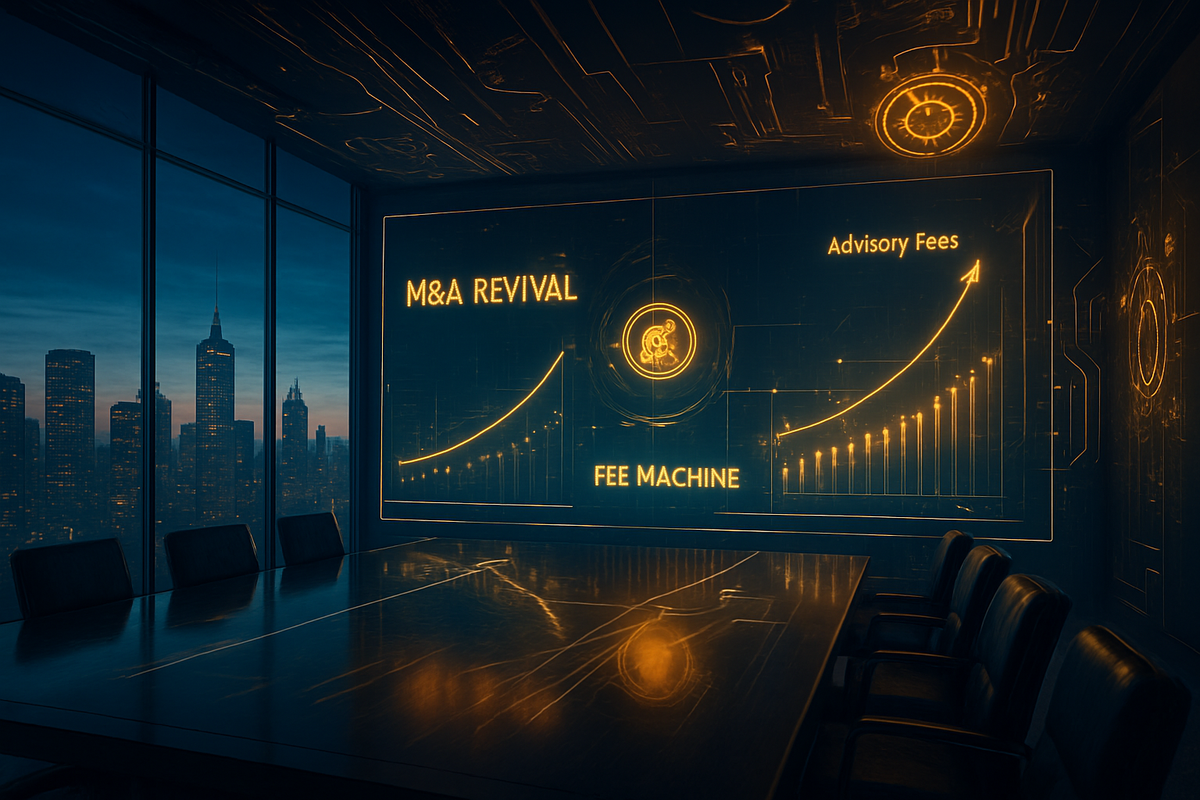
As the curtains rise on the first-quarter earnings season of 2026, the financial world is bracing for a definitive shift in the banking sector’s profitability engine. Scheduled to report on April 13 and 14, industry titans are expected to pivot away from the interest-rate-driven "windfall era" of the previous two years. Instead, the spotlight has turned toward a burgeoning "Fee Machine" model, powered by a significant revival in Mergers and Acquisitions (M&A) that has characterized the opening months of the year.
The transition comes at a critical juncture for the market. With the current date of April 9, 2026, investors are looking to JPMorgan Chase & Co. (NYSE: JPM) and The Goldman Sachs Group, Inc. (NYSE: GS) to confirm whether the "Innovation Supercycle"—a wave of dealmaking fueled by artificial intelligence infrastructure and private equity deployment—can offset the plateauing of net interest income (NII). While the macro environment remains clouded by geopolitical tensions in the Middle East, the return of high-margin advisory fees is poised to redefine the winners and losers of this cycle.
The Breaking of the Liquidity Logjam
The anticipated reports from April 13 (Goldman Sachs) and April 14 (JPMorgan Chase) mark the end of a multi-year "M&A drought" that persisted through much of 2022 to 2024. During that period, aggressive interest rate hikes and regulatory uncertainty left deal-making at a virtual standstill. However, the timeline shifted in late 2025 as global deal values began a dramatic 40% surge, culminating in a Q1 2026 that analysts are calling the "breaking of the liquidity logjam."
Central to this revival has been the massive accumulation of "dry powder" by private equity firms, which entered 2026 with a record $3 trillion in unspent capital. As interest rates stabilized in a neutral corridor of 3.50% to 3.75% earlier this year, the cost of financing became predictable enough for these firms to finally pull the trigger on major acquisitions. Furthermore, a surge in "megadeals" (transactions exceeding $10 billion) in the semiconductor and data center sectors has provided a lucrative stream of advisory work for Wall Street’s elite.
Initial market reactions to preliminary Q1 data have been cautiously optimistic. Trading desks have seen a spike in activity, not just from M&A, but from the volatility sparked by the U.S.-Iran conflict that began in late February. This conflict led to a "March Oil Shock," with Brent crude spiking above $120 per barrel, forcing institutional clients to engage in heavy hedging—a secondary but vital component of the "fee machine" that benefits the largest banks.
Winners and Losers in the New Regime
The primary beneficiaries of this shift are the Global Systemically Important Banks (G-SIBs), specifically those with deep investment banking roots. The Goldman Sachs Group, Inc. (NYSE: GS) stands as the most exposed to this upside; with investment banking revenue now accounting for nearly 20% of its total revenue, its performance is a direct proxy for the health of global capital markets. Goldman enters this earnings season with an announced M&A pipeline estimated at $1.6 trillion, and the market’s primary question is how effectively the firm has converted that backlog into realized fees during the first quarter.
JPMorgan Chase & Co. (NYSE: JPM), while more diversified, is also leaning heavily into its fee-generating capacity. While the bank has guided for a plateauing NII of approximately $104.5 billion for 2026, its investment banking fees are expected to jump by as much as 18% year-over-year. By integrating its massive consumer reach with high-level advisory, JPM is insulating itself against the "interest rate squeeze" that is currently battering smaller competitors.
Conversely, the losers in this environment are likely the regional and mid-cap banks. Lacking the sophisticated investment banking arms of their larger peers, these institutions remain heavily dependent on traditional lending spreads. With the Federal Reserve signaling a possible pause in rate cuts due to "sticky" energy-driven inflation, regional banks face a dual threat: stagnant loan growth and an inability to participate in the high-margin M&A fee pool. This productivity gap is expected to widen significantly as the results are tallied next week.
A Fundamental Shift in the Banking Landscape
The emergence of the "Fee Machine" model is more than a quarterly trend; it represents a fundamental recalibration of how big banks operate in a post-inflationary world. Historically, banks have toggled between being "spread businesses" (earning on interest) and "fee businesses" (earning on services). The 2026 revival suggests that the industry is entering a phase where "active" profit—earned through execution, advisory, and complex market making—is more sustainable than the "passive" income generated by the interest rate hikes of 2023.
This trend fits into the broader industry theme of technological consolidation. The current "Innovation Supercycle" is being driven by the realization that AI is not just a software play but a physical infrastructure challenge. This has triggered a wave of strategic acquisitions that regulators, previously hawkish, are now beginning to allow under a more "transaction-friendly" administrative stance. The ripple effects are being felt across the tech sector, as companies like NVIDIA Corporation (NASDAQ: NVDA) and Microsoft Corp (NASDAQ: MSFT) navigate a landscape of "buy-or-be-left-behind."
However, there is a historical precedent for caution. The 2000 and 2007 cycles both saw periods where intense fee-driven growth masked underlying structural risks. While today’s banks are far better capitalized, the reliance on high-velocity dealmaking makes them sensitive to sudden geopolitical shocks. The ongoing U.S.-Iran war serves as a reminder that a major escalation could quickly freeze the very markets that the "Fee Machine" relies upon.
The Road Ahead: Conversion and Resilience
Looking ahead, the next six months will determine whether the M&A revival is a long-term shift or a temporary release of pent-up demand. If the April 13-14 reports show that deal "conversion" rates are high, it will likely trigger a further re-rating of bank stocks, as investors move capital toward firms with high non-interest income. Banks may also need to pivot their strategies toward more aggressive wealth management and fintech integration to diversify their fee streams even further.
In the short term, the market will be hyper-focused on any commentary regarding "deal longevity." If JPMorgan and Goldman Sachs indicate that their pipelines are continuing to grow despite the oil price shocks, it would suggest that the AI-driven investment cycle is powerful enough to override traditional macroeconomic headwinds. However, if the banks announce an increase in loan-loss reserves—perhaps due to the inflationary pressures of the conflict—it could signal that the "Fee Machine" is merely a bright spot in an otherwise darkening economic sky.
Summary and Outlook for Investors
The upcoming earnings season for JPMorgan Chase and Goldman Sachs is a litmus test for the new financial order of 2026. The key takeaway for investors is the divergence in the banking sector: the giants are leveraging their scale to dominate the high-margin advisory landscape, while smaller institutions struggle with the limitations of a traditional lending model. The shift to a "fee machine" represents a strategic evolution aimed at securing growth in a world where interest rates are no longer a reliable tailwind.
As we move into next week, the market will be watching for three specific things: the rate of M&A backlog conversion, the impact of energy prices on consumer credit quality, and any shifts in capital allocation strategy. For now, Wall Street remains hopeful that the "Innovation Supercycle" is strong enough to keep the deal machines humming, regardless of the geopolitical volatility on the horizon. The era of the interest rate windfall is over; the era of the high-stakes fee has begun.
This content is intended for informational purposes only and is not financial advice.