Technology giant Microsoft (NASDAQ: MSFT) reported calendar Q3 2026 (fiscal Q1 2027) results topping the market’s revenue expectations, with revenue up 18.8% year on year to $92.28 billion. Its non-GAAP profit of $4.92 per share was 4.3% above analysts’ consensus estimates.
For more on Microsoft, read our free full research report.
Microsoft (MSFT) Q3 CY2026 highlights:
- Revenue $92.28 billion vs S&P analysts’ consensus estimates of $90.64 billion (1.8% beat)
- Azure cloud revenue grew 48% year over year (beat)
- EPS (GAAP) $4.92 vs analysts’ consensus estimates of $4.72 (4.3% beat)
- Gross margin 67.8%, down from 69% in the same quarter last year
- Operating margin 49.8%, in line with the same quarter last year
- Free cash flow margin 20.2%, down from 33% in the same quarter last year
- Market capitalization $3.95 trillion
Revenue growth
Microsoft shows that fast growth and large scale can coexist despite conventional wisdom. The company’s revenue base of $176.3 billion five years ago has nearly doubled to $346.4 billion in the last year, translating into a strong 14.5% annualized growth rate.
Over the same period, Microsoft’s big tech peers Amazon, Alphabet and Apple posted annualized growth rates of 11.4%, 14.5% and 5.2%, respectively. Comparing the four is relevant because investors often value them relative to one another. With these benchmarks in mind, Microsoft’s price looks attractive.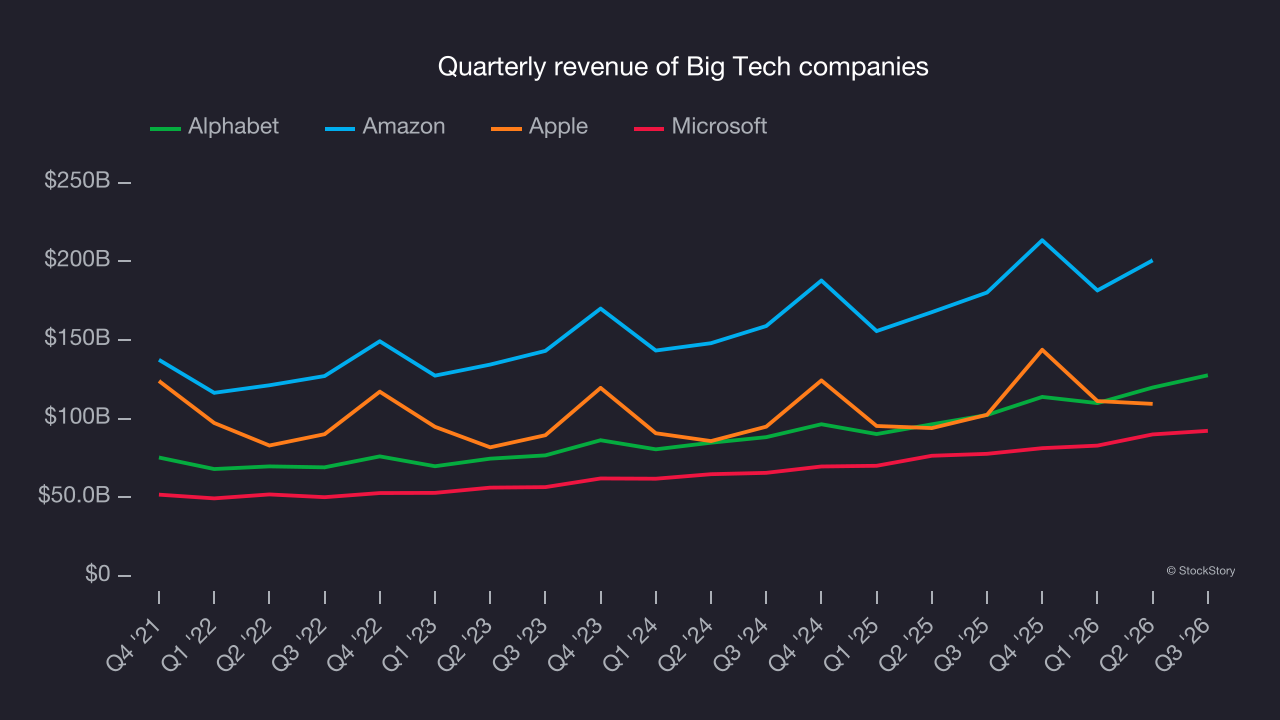
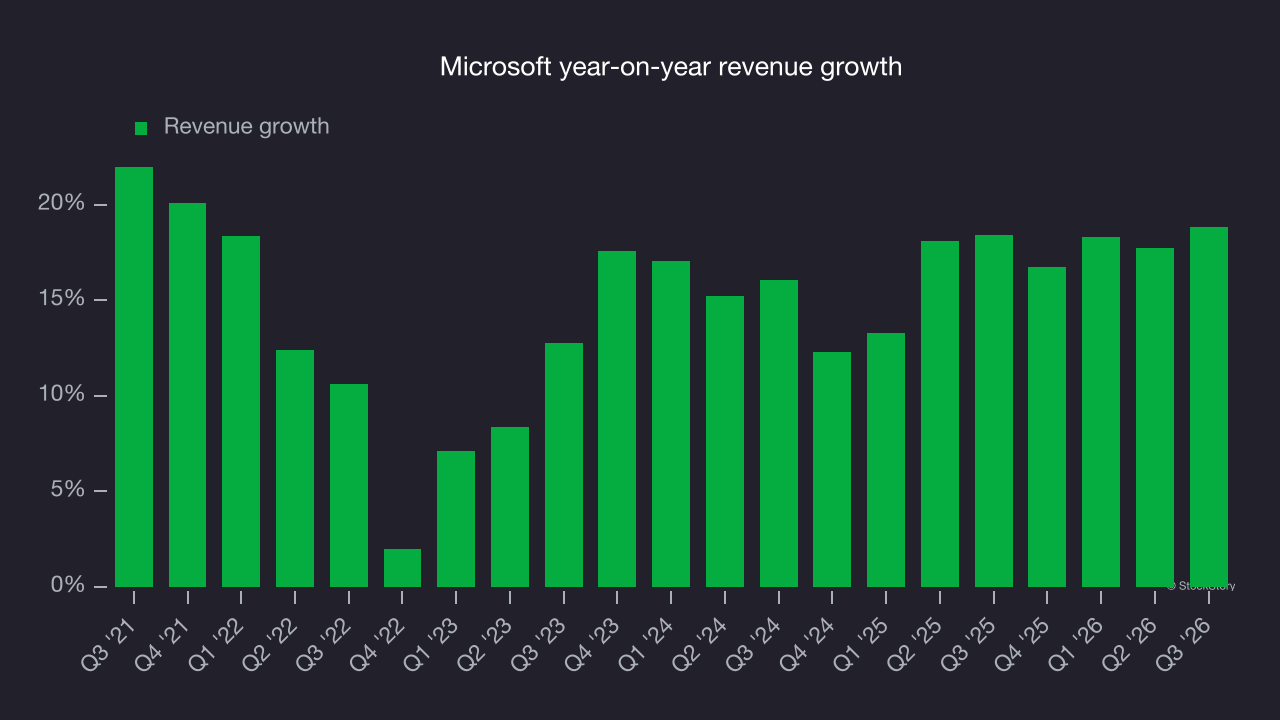
We enjoyed seeing Microsoft beat analysts’ revenue expectations this quarter, and all-important Azure growth exceeded estimates as well. We were also happy its EPS outperformed Wall Street’s estimates. Overall, we think this was a decent quarter with some key metrics above expectations. The stock traded up 3.4% to $548.50 immediately following the results.
Key takeaways from Microsoft’s Q3 results
Microsoft’s revenue and EPS both topped Wall Street’s consensus estimates, making for a solid quarter with key metrics above expectations. Shares rose 3.6% to $549.34 immediately after the results.
Microsoft may have had a good quarter, but an investment decision requires a broader view. Consider its valuation and business quality as well as the latest earnings. For more on Microsoft, read our full research report here (it’s free).