Solar energy systems company Shoals (NASDAQ: SHLS) reported Q3 2026 results exceeding the market’s revenue expectations, with revenue up 43.8% year on year to $195.3 million. Next quarter’s revenue guidance ($175 million at the midpoint) was surprisingly strong, coming in 7% above analysts’ consensus estimates. Its non-GAAP profit of $0.14 per share was 14.9% above analysts’ consensus estimates.
For more on Shoals, read our free full research report.
Shoals (SHLS) Q3 2026 highlights:
- Revenue $195.3 million vs S&P analysts’ consensus estimates of $162.3 million (43.8% year-on-year growth, 20.3% beat)
- Adjusted EPS $0.14 vs S&P analysts’ consensus estimates of $0.12 (14.9% beat)
- Adjusted EBITDA $39.81 million vs analysts’ consensus estimates of $35.11 million (20.4% margin, 13.4% beat)
- Revenue guidance $175 million at the midpoint for Q4 2026, above analysts’ consensus estimates of $163.6 million
- EBITDA guidance $131 million at the midpoint for the full year, above analysts’ consensus estimates of $124.9 million
- Operating margin 14.8%, up from 13.7% in the same quarter last year
- Free cash flow margin 13.3%, up from 6.6% in the same quarter last year
- Backlog $791.7 million at quarter end, up 9.8% year on year
- Market capitalization $1.43 billion
“We’re very pleased with our strong results in the period, as productivity improvements drove both quarterly revenue and Adjusted EBITDA above our expected range. We remain focused on making meaningful operational improvements as we finish 2026 on a strong note. The long-term health of the market remains robust and we’re well positioned to continue the momentum into 2027 and beyond,” said Brandon Moss, CEO of Shoals.
Revenue growth
A company’s long-term revenue performance can indicate its overall quality. Any business can put up a good quarter or two, but many enduring ones grow for years. Over the last five years, Shoals grew its revenue at a strong 26% compounded annual growth rate. Its growth beat the average industrials company and shows its offerings resonate with customers.
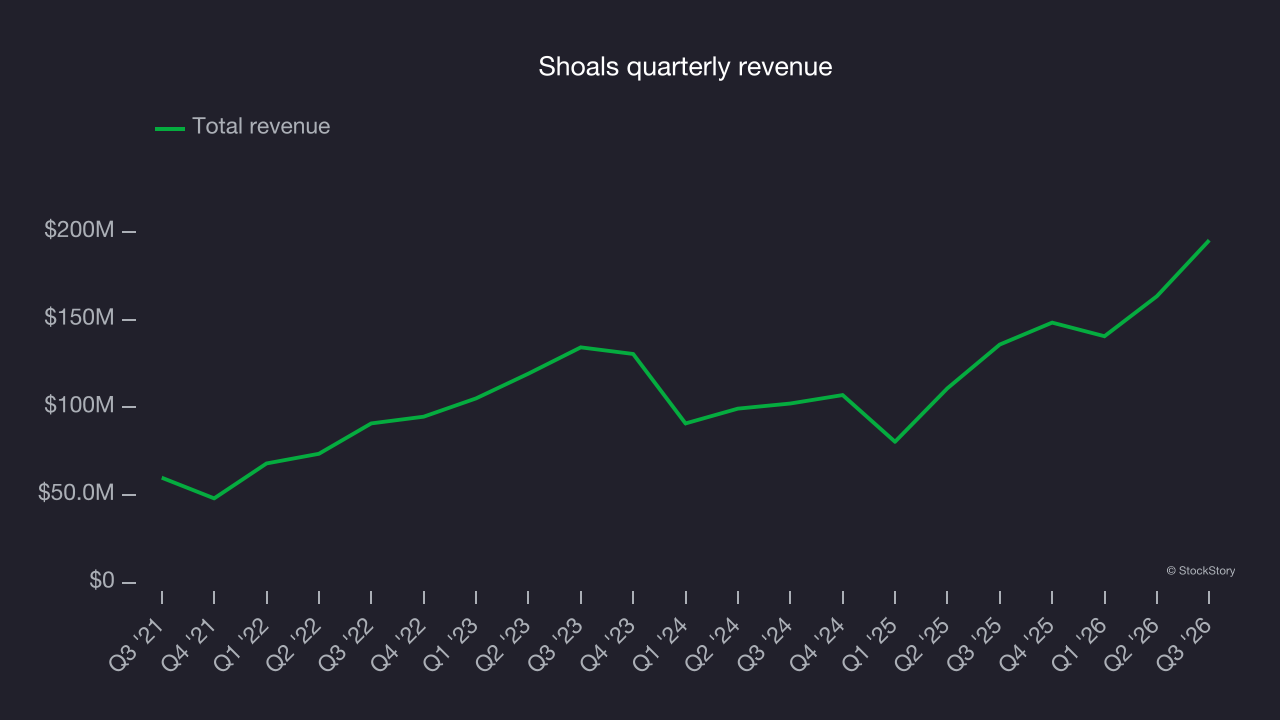
Long-term growth matters the most, but within industrials, a half-decade historical view may miss cycles, industry trends or a company capitalizing on catalysts such as a new contract win or a successful product line. Shoals’s annualized revenue growth of 23.8% over the last two years is below its five-year trend, but the results still suggest healthy demand. 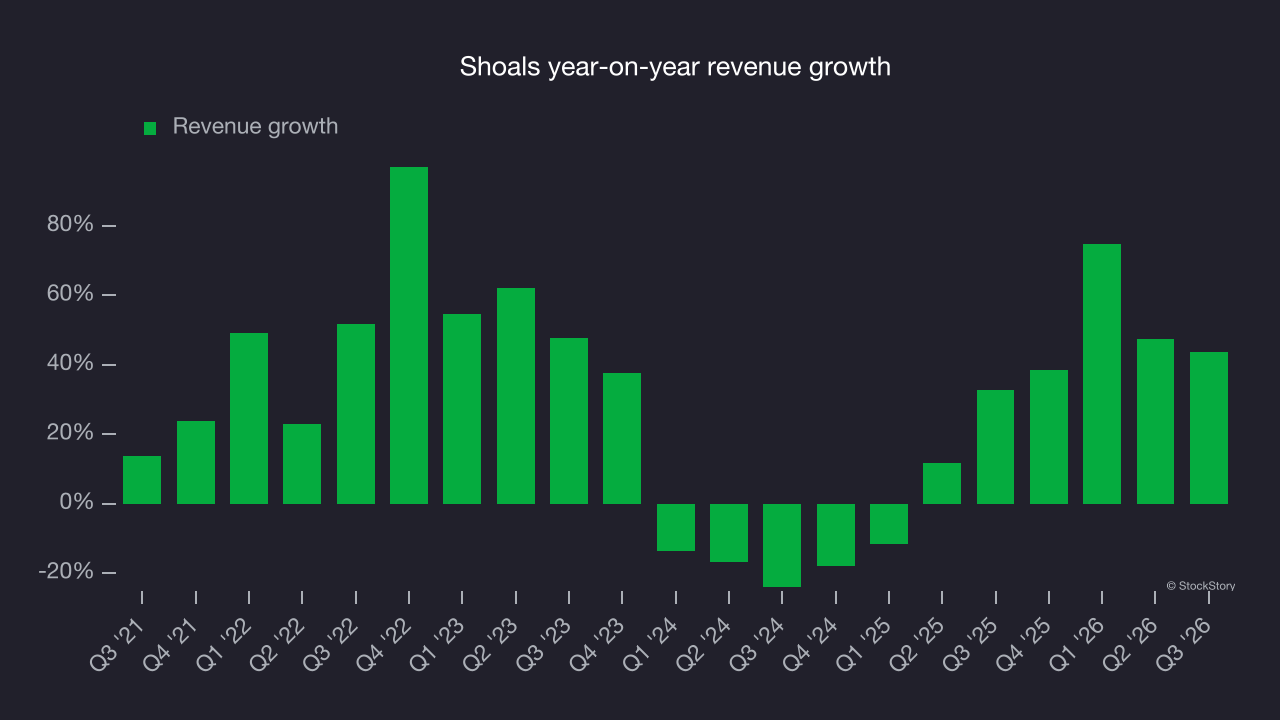
Shoals also reports its backlog, or the value of its outstanding orders that have not yet been executed or delivered. Shoals’s backlog reached $791.7 million in the latest quarter and averaged 11.9% year-on-year growth over the last two years. Revenue growth outpaced backlog growth, indicating that the company fulfilled orders faster than it added new orders to the backlog. This implies Shoals was operating efficiently but raises questions about the health of its revenue pipeline. 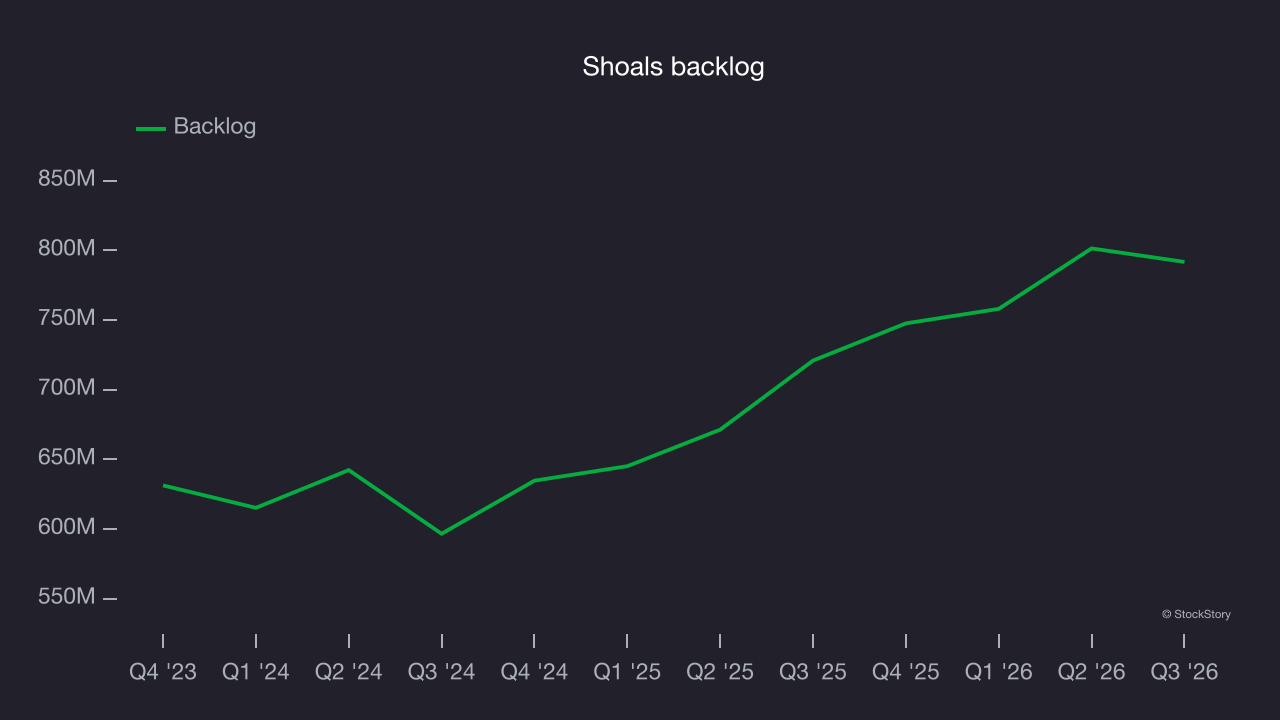
This quarter, Shoals reported strong year-on-year revenue growth of 43.8%, and its $195.3 million of revenue beat Wall Street’s consensus estimates by 20.3%. Management is guiding for an 18% year-on-year increase in revenue next quarter.
Looking further ahead, sell-side analysts expect revenue to grow 5.2% over the next 12 months, according to S&P, a deceleration versus the last two years. This projection is underwhelming and implies its products and services will face some demand challenges.
Operating margin
Operating margin is a key measure of profitability. Think of it as net income, or the bottom line, excluding the impact of taxes and interest on debt, which are less connected to business fundamentals.
Shoals has been an efficient company over the last five years. It was one of the more profitable businesses in the industrials sector, with an average operating margin of 13.9%. That outcome is unsurprising given its favorable gross margin baseline.
Analyzing the trend in its profitability, Shoals’s operating margin decreased by 5 percentage points over the last five years. This raises questions about the company’s expense base because its revenue growth should have given it leverage on its fixed costs, resulting in better economies of scale and profitability.
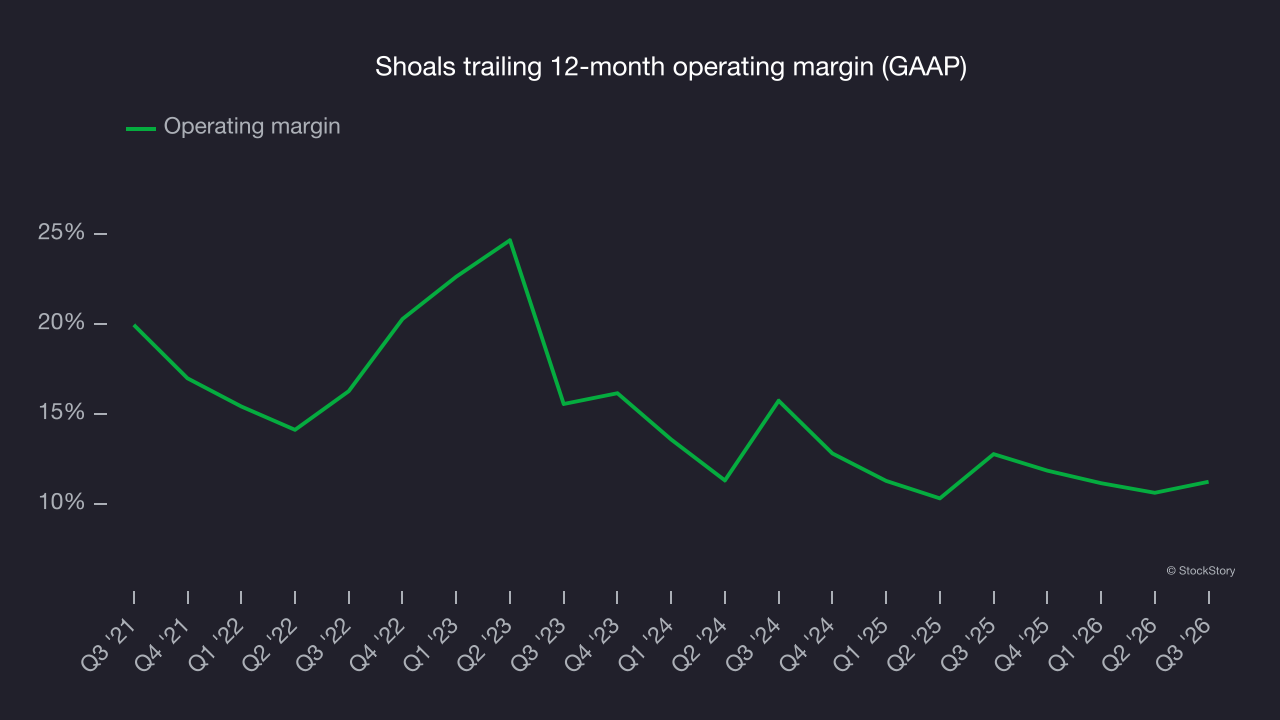
In Q3, Shoals generated an operating margin of 14.8%, up 1.1 percentage points year on year. The increase was encouraging and, given that its gross margin decreased, suggests greater efficiency as operating expenses such as marketing, research and development and administrative overhead grew more slowly than revenue.
Earnings per share
Long-term changes in earnings per share, or EPS, matter for the same reason as long-term revenue growth. Compared to revenue, however, EPS highlights whether a company’s growth is profitable.
Shoals’s EPS grew at a decent 9% compounded annual growth rate over the last five years. However, this performance trailed its 26% annualized revenue growth, indicating the company became less profitable on a per-share basis as it expanded.
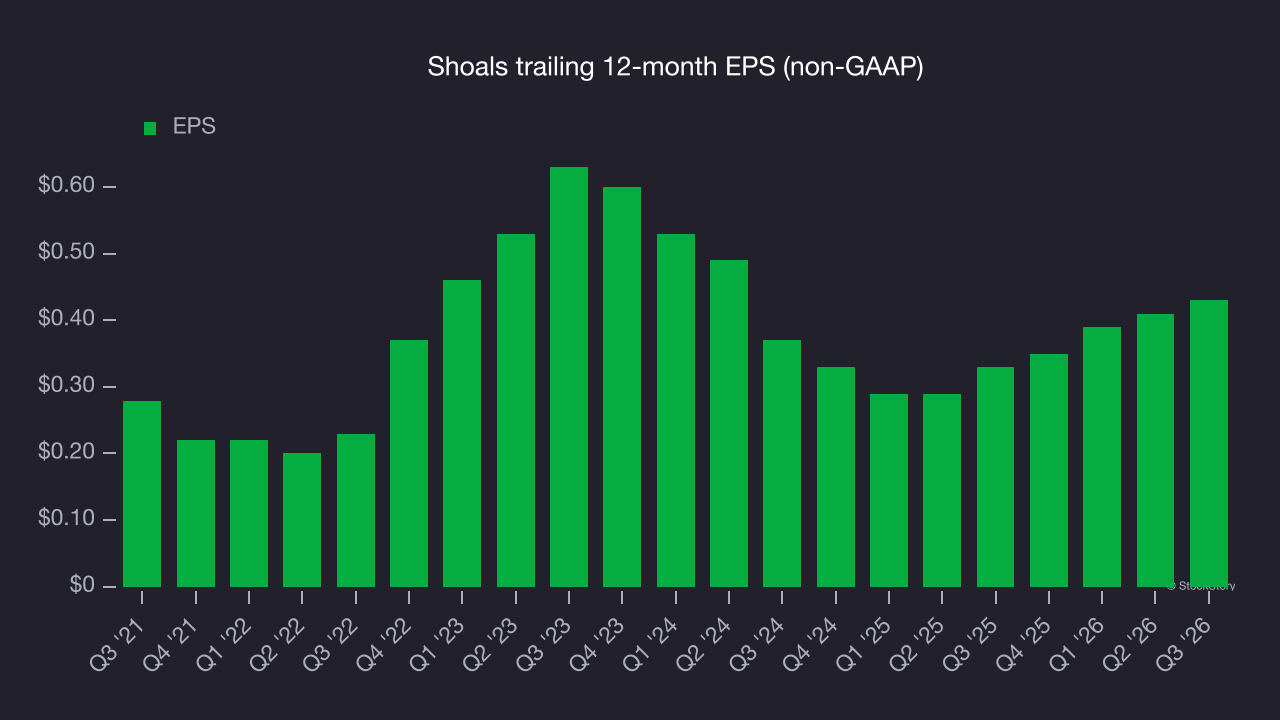
A closer look at Shoals’s earnings helps explain its performance. As mentioned earlier, Shoals’s operating margin expanded this quarter but declined by 5 percentage points over the last five years. Its share count also grew by 66.4%, meaning the company not only became less efficient with its operating expenses but also diluted its shareholders. 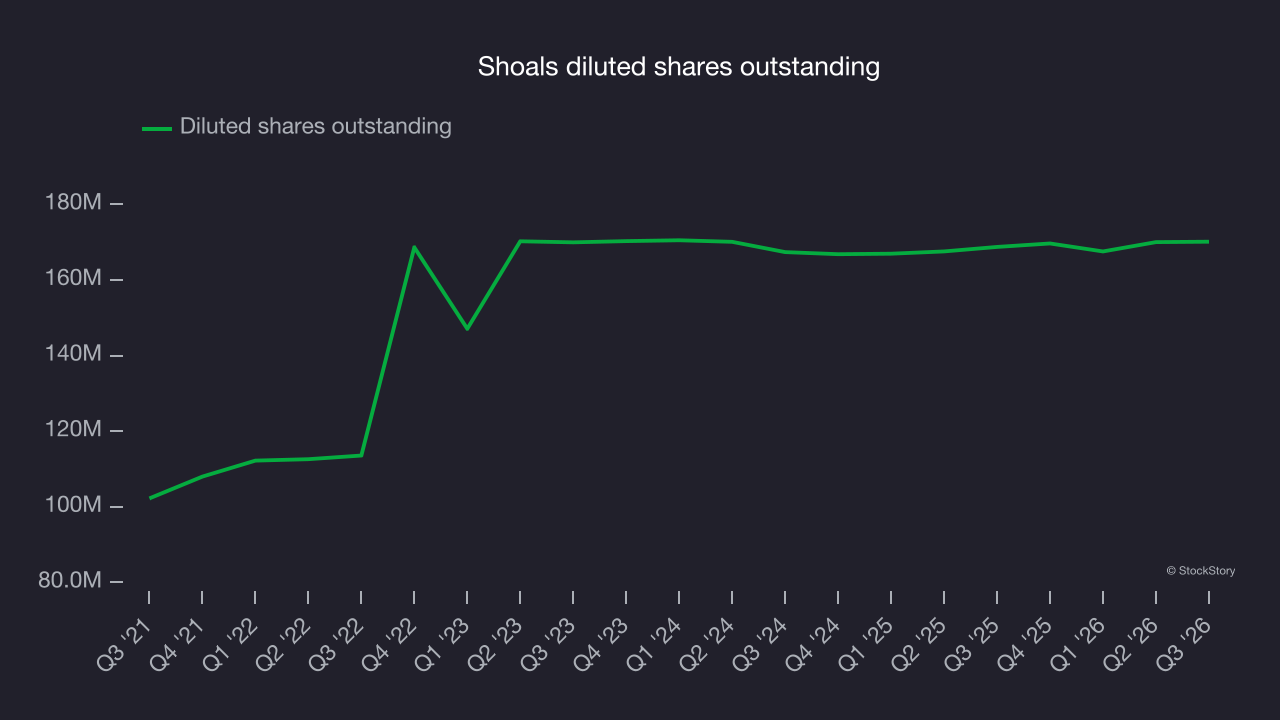
As with revenue, EPS trends over a more recent period can provide insight into an emerging theme or development for the business.
For Shoals, its two-year annual EPS growth of 7.8% was lower than its five-year trend.
In Q3, Shoals reported adjusted EPS of $0.14, up from $0.12 in the same quarter last year. Adjusted EPS comfortably beat analysts’ consensus estimates, a positive result for shareholders. Over the next 12 months, Wall Street expects Shoals’s full-year EPS to grow 29.5% from $0.43 to $0.56, according to S&P.
Key takeaways from Shoals’s Q3 results
Shoals delivered sizable beats on both EBITDA and revenue relative to analysts’ consensus estimates, giving its Q3 results some clear positives. Shares rose 4.5% to $8.85 immediately after the results.
Shoals may have had a good quarter, but does that make the stock a buy? The latest quarter matters, but not nearly as much as longer-term fundamentals and valuation when making that decision. For more on Shoals, read our full research report here (it’s free).