Regional banking company United Community Banks (NYSE: UCB) reported Q1 CY2026 results beating Wall Street’s revenue expectations, with sales up 11.2% year on year to $276.5 million. Its non-GAAP profit of $0.70 per share was in line with analysts’ consensus estimates.
Is now the time to buy United Community Banks? Find out by accessing our full research report, it’s free.
United Community Banks (UCB) Q1 CY2026 Highlights:
- Net Interest Income: $232.8 million vs analyst estimates of $235.9 million (30.6% year-on-year decline, 1.3% miss)
- Net Interest Margin: 3.7% vs analyst estimates of 3.6% (in line)
- Revenue: $276.5 million vs analyst estimates of $274.5 million (11.2% year-on-year growth, 0.7% beat)
- Efficiency Ratio: 56.7% vs analyst estimates of 55% (168.7 basis point miss)
- Adjusted EPS: $0.70 vs analyst estimates of $0.70 (in line)
- Tangible Book Value per Share: $22.56 vs analyst estimates of $22.56 (9.6% year-on-year growth, in line)
- Market Capitalization: $4.11 billion
Chairman and CEO Lynn Harton stated, “Our first quarter results mark the start of what we expect to be a great year for United. We continue to improve our earning asset mix by growing loans, funded by maturing investment securities and growth in customer deposits. This shift in earning asset composition and our strategic focus on deposit pricing helped to widen our net interest margin by three basis points in the first quarter. In fact, our net interest margin is up 29 basis points when compared to the first quarter of 2025. We entered the year with a small wholesale funding position, but deposit growth allowed that to be completely repaid by the end of the quarter. We took advantage of our strong capital position and repurchased 1.09 million shares of our common stock at an average price of $33.97 per share during the quarter. All our key performance metrics show significant improvement when compared to the first quarter of 2025. With strong capital and liquidity, we notified holders of our remaining $100 million in subordinated debentures of our intent to redeem those securities in the second quarter.
Company Overview
Starting as a small community bank in 1950 and expanding through strategic acquisitions across the Southeast, United Community Banks (NYSE: UCB) is a regional bank holding company that provides financial services including loans, deposits, wealth management, and merchant services across the southeastern United States.
Sales Growth
Two primary revenue streams drive bank earnings. While net interest income, which is earned by charging higher rates on loans than paid on deposits, forms the foundation, fee-based services across banking, credit, wealth management, and trading operations provide additional income. Regrettably, United Community Banks’s revenue grew at a mediocre 9.6% compounded annual growth rate over the last five years. This fell short of our benchmark for the banking sector and is a rough starting point for our analysis.
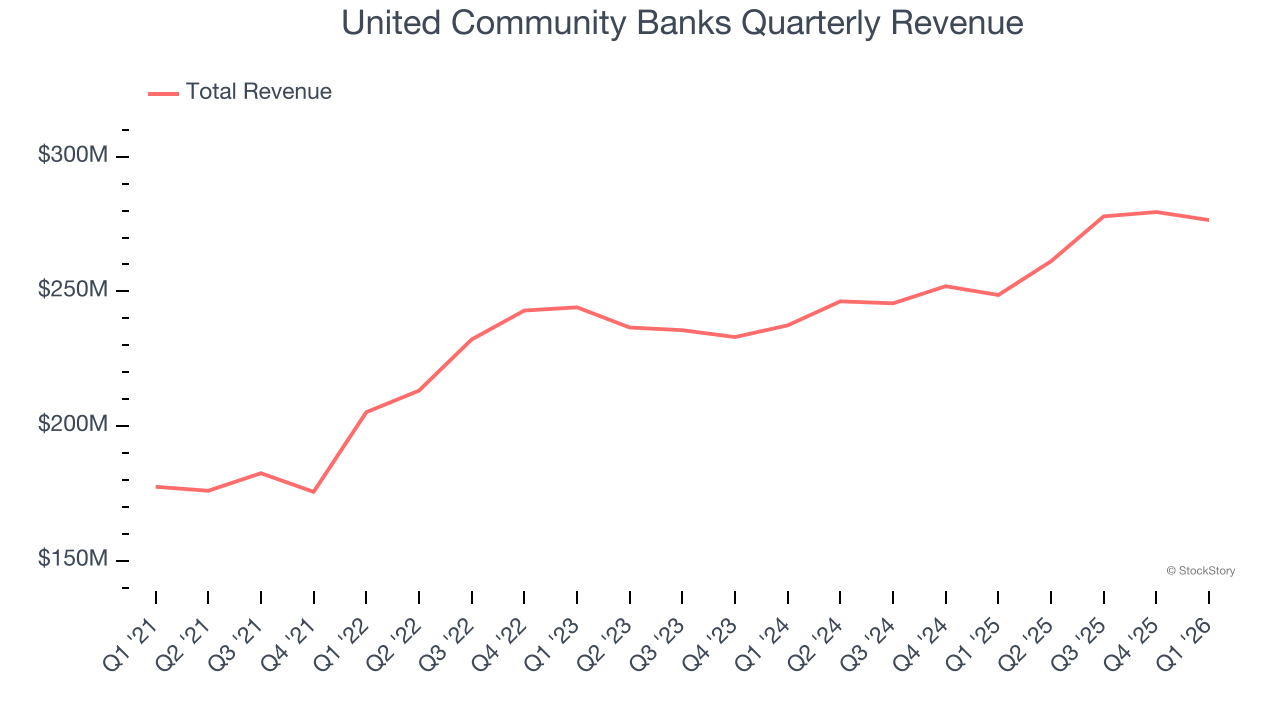
We at StockStory place the most emphasis on long-term growth, but within financials, a half-decade historical view may miss recent interest rate changes, market returns, and industry trends. United Community Banks’s recent performance shows its demand has slowed as its annualized revenue growth of 7.8% over the last two years was below its five-year trend. We’re wary when companies in the sector see decelerations in revenue growth, as it could signal changing consumer tastes aided by low switching costs. 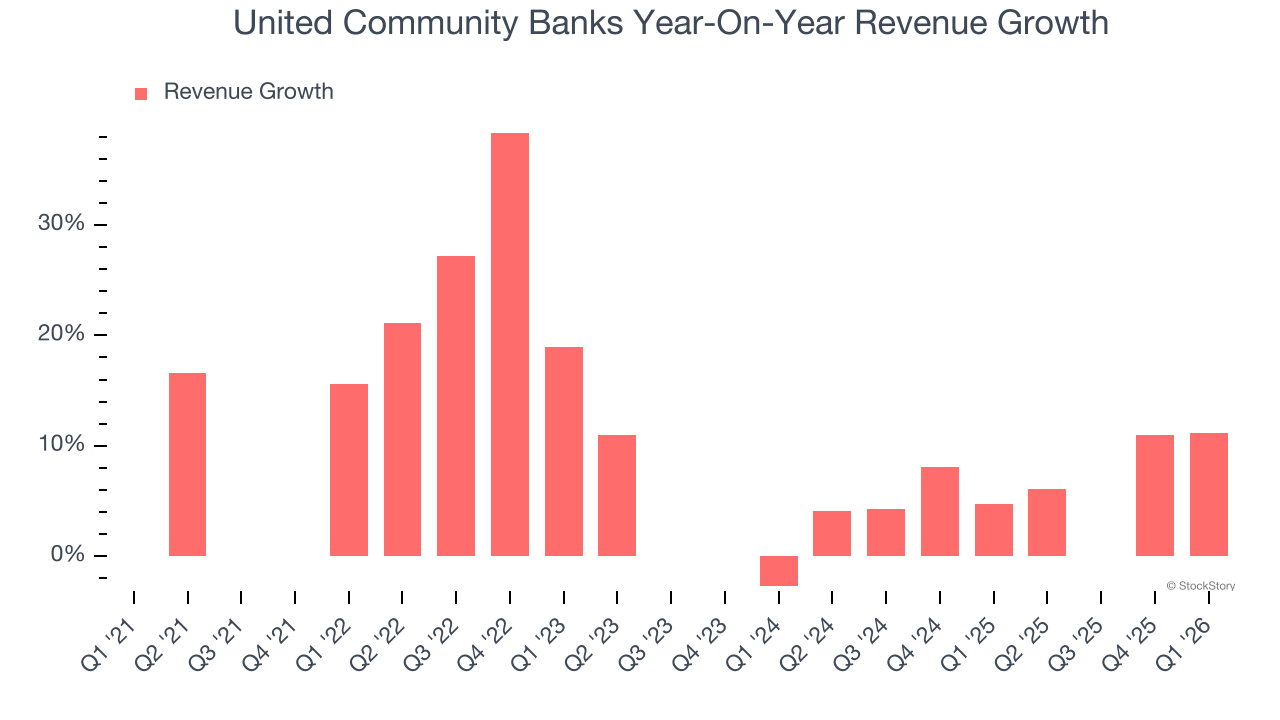 Note: Quarters not shown were determined to be outliers, impacted by outsized investment gains/losses that are not indicative of the recurring fundamentals of the business.
This quarter, United Community Banks reported year-on-year revenue growth of 11.2%, and its $276.5 million of revenue exceeded Wall Street’s estimates by 0.7%.
Net interest income made up 86.3% of the company’s total revenue during the last five years, meaning United Community Banks barely relies on non-interest income to drive its overall growth.
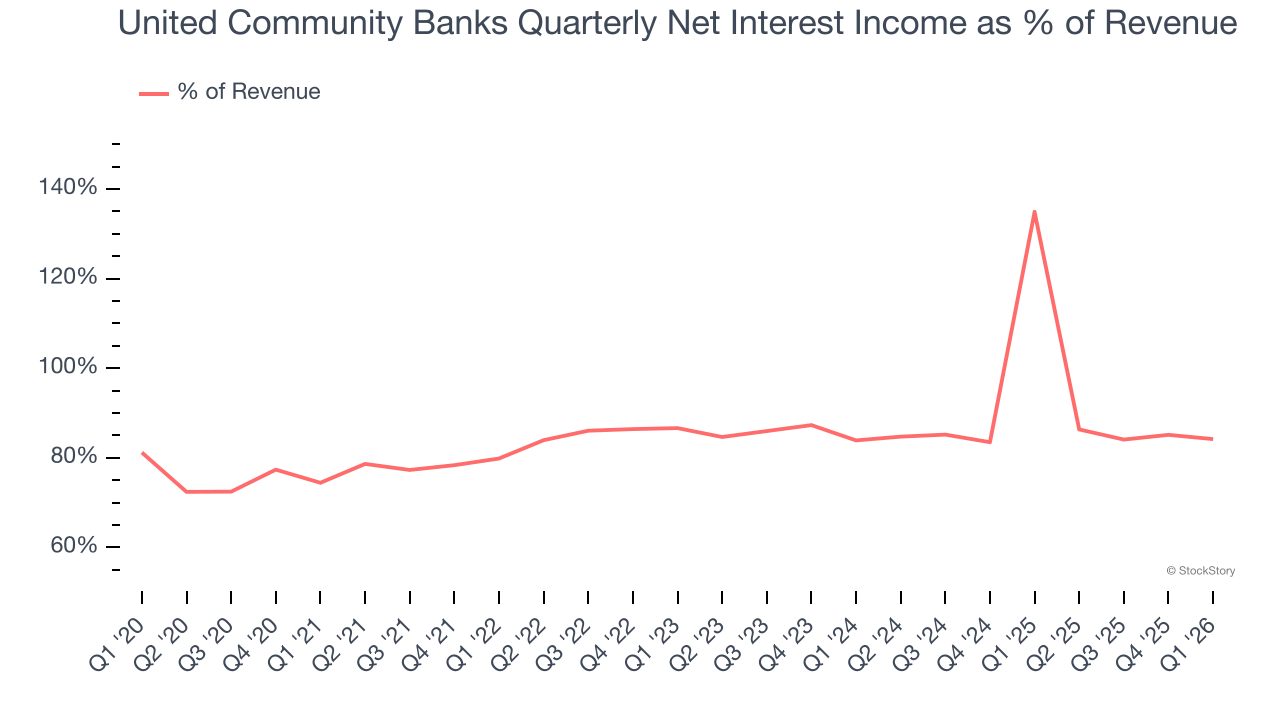
Markets consistently prioritize net interest income growth over fee-based revenue, recognizing its superior quality and recurring nature compared to the more unpredictable non-interest income streams.
ALSO WORTH WATCHING: Nvidia’s Quiet Partner. Nvidia’s chips cost a hundred grand. The connectors that make them work cost even more. One company makes them all.
Every AI server needs specialized infrastructure the chip companies don’t make. High-speed cables. Power connectors. Thermal sensors. This 90-year-old company built a monopoly on it. The AI boom just started. This stock is still flying under the radar. Claim The Stock Ticker Here for FREE.
Tangible Book Value Per Share (TBVPS)
Banks are balance sheet-driven businesses because they generate earnings primarily through borrowing and lending. They’re also valued based on their balance sheet strength and ability to compound book value (another name for shareholders’ equity) over time.
This is why we consider tangible book value per share (TBVPS) the most important metric to track for banks. TBVPS represents the real, liquid net worth per share of a bank, excluding intangible assets that have debatable value upon liquidation. EPS can become murky due to acquisition impacts or accounting flexibility around loan provisions, and TBVPS resists financial engineering manipulation.
United Community Banks’s TBVPS grew at a mediocre 4.7% annual clip over the last five years. However, TBVPS growth has accelerated recently, growing by 9.9% annually over the last two years from $18.67 to $22.56 per share.
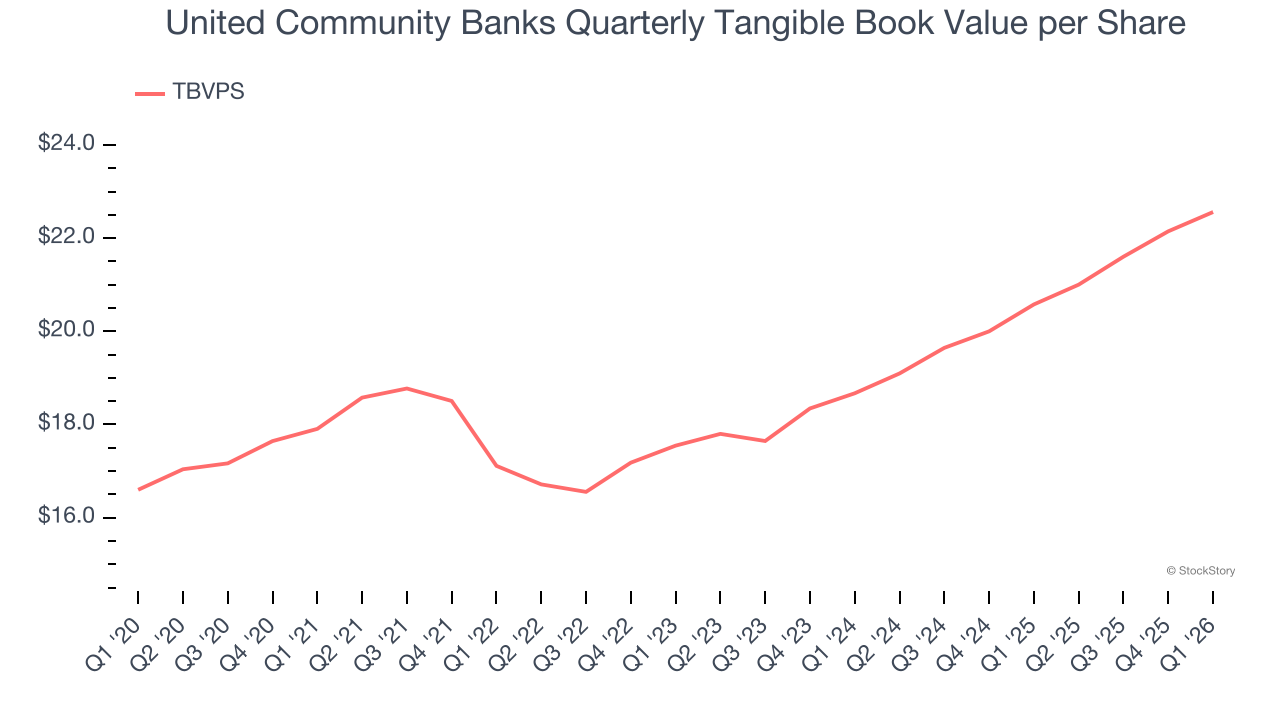
Over the next 12 months, Consensus estimates call for United Community Banks’s TBVPS to grow by 9.3% to $24.67, paltry growth rate.
Key Takeaways from United Community Banks’s Q1 Results
It was good to see United Community Banks narrowly top analysts’ revenue expectations this quarter. EPS and TBVPS were both in line. On the other hand, its net interest income slightly missed. Overall, this was a mixed quarter. The stock remained flat at $34.30 immediately after reporting.
United Community Banks underperformed this quarter, but does that create an opportunity to invest right now? If you’re making that decision, you should consider the bigger picture of valuation, business qualities, as well as the latest earnings. We cover that in our actionable full research report which you can read here (it’s free).