
Local television broadcasting and media company Gray Television (NYSE: GTN) met Wall Street’s revenue expectations in Q1 CY2026, but sales fell by 1.8% year on year to $768 million. On the other hand, next quarter’s revenue guidance of $790 million was less impressive, coming in 1.5% below analysts’ estimates. Its GAAP loss of $0.34 per share was 23.6% below analysts’ consensus estimates.
Is now the time to buy Gray Television? Find out by accessing our full research report, it’s free.
Gray Television (GTN) Q1 CY2026 Highlights:
- Revenue: $768 million vs analyst estimates of $769.3 million (1.8% year-on-year decline, in line)
- EPS (GAAP): -$0.34 vs analyst expectations of -$0.28 (23.6% miss)
- Adjusted EBITDA: $154 million vs analyst estimates of $164.6 million (20.1% margin, 6.4% miss)
- Revenue Guidance for Q2 CY2026 is $790 million at the midpoint, below analyst estimates of $802.1 million
- Operating Margin: 10.5%, down from 11.8% in the same quarter last year
- Free Cash Flow was -$18 million, down from $15 million in the same quarter last year
- Market Capitalization: $624.3 million
Hilton Howell, Jr., Executive Chairman and CEO, commented, “Our first quarter 2026 results were solid, with Core Advertising exceeding our guidance and Political revenue at the high end of our guidance range. A recently resolved dispute with a distribution partner impacted our Net Retransmission Revenue for the quarter. With all scheduled 2026 retransmission negotiations now complete and the improvement in underlying MVPD subscriber trends, we now have visibility on our growth in Net Retransmission Revenue for full year 2026. While we are seeing some softness in core advertising in Q2, we are optimistic that, as the largest owner of top-rated local television stations and a footprint covering most of the competitive races, we will again capitalize on a strong mid-term political cycle.
Company Overview
Specializing in local media coverage, Gray Television (NYSE: GTN) is a broadcast company supplying digital media to various markets in the United States.
Revenue Growth
Examining a company’s long-term performance can provide clues about its quality. Any business can have short-term success, but a top-tier one grows for years. Regrettably, Gray Television’s sales grew at a weak 5.2% compounded annual growth rate over the last five years. This fell short of our benchmark for the consumer discretionary sector and is a poor baseline for our analysis.
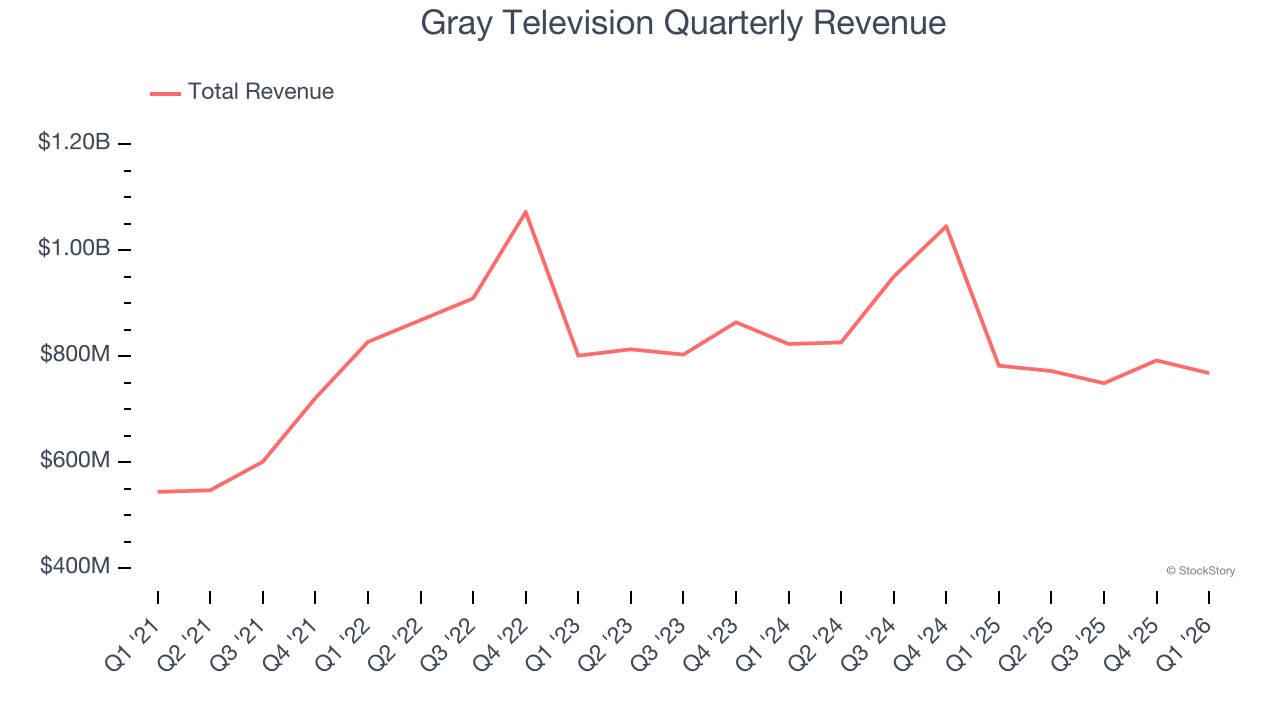
Long-term growth is the most important, but within consumer discretionary, product cycles are short and revenue can be hit-driven due to rapidly changing trends and consumer preferences. Gray Television’s performance shows it grew in the past but relinquished its gains over the last two years, as its revenue fell by 3.4% annually. 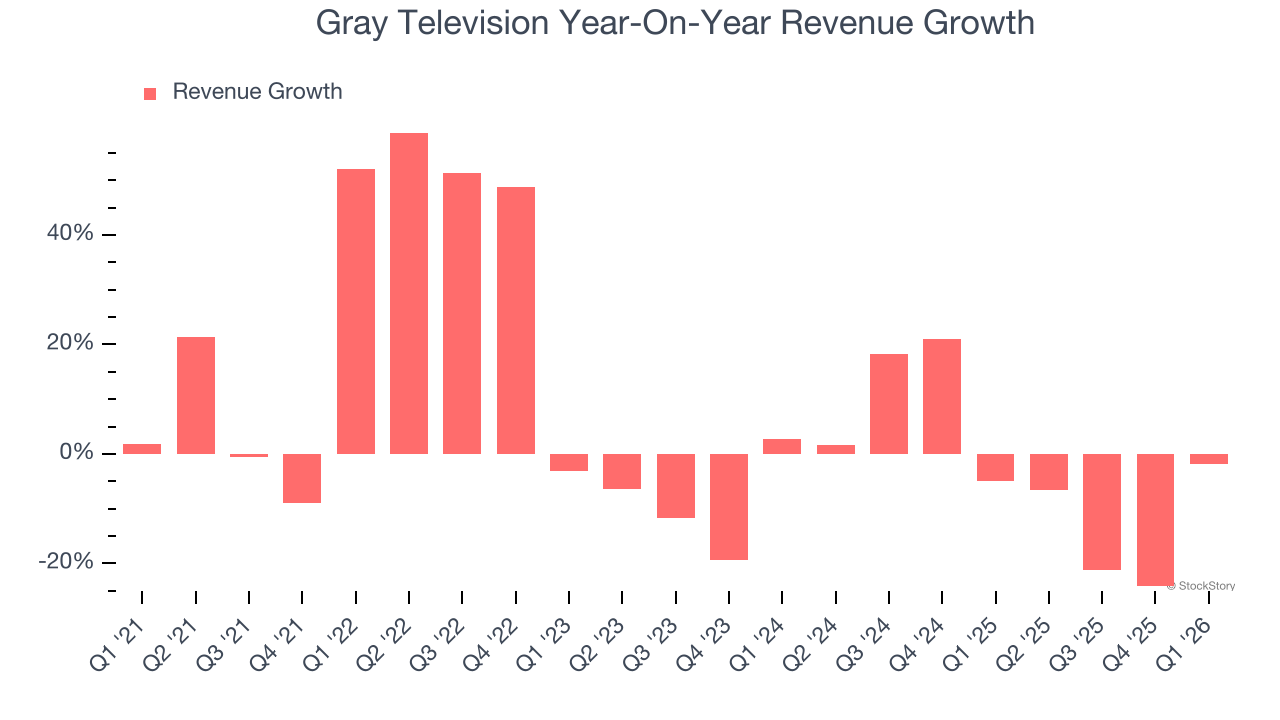
We can better understand the company’s revenue dynamics by analyzing its most important segments, Retransmission and Advertising, which are 45.8% and 44.1% of revenue. Over the last two years, Gray Television’s Retransmission revenue (affiliate and licensing fees) averaged 1.4% year-on-year declines while its Advertising revenue (marketing services) averaged 5.3% declines. 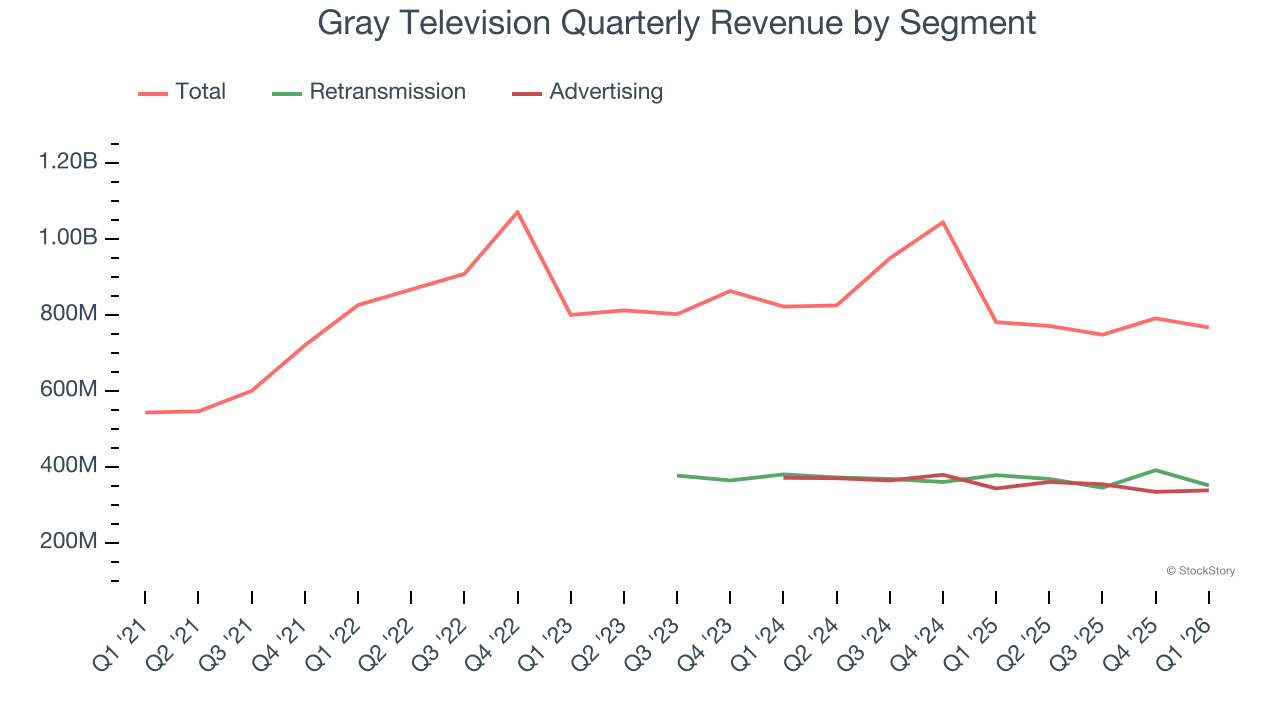
This quarter, Gray Television reported a rather uninspiring 1.8% year-on-year revenue decline to $768 million of revenue, in line with Wall Street’s estimates. Company management is currently guiding for a 2.3% year-on-year increase in sales next quarter.
Looking further ahead, sell-side analysts expect revenue to grow 13% over the next 12 months, an improvement versus the last two years. This projection is above the sector average and suggests its newer products and services will catalyze better top-line performance.
WHILE YOU’RE HERE: The Next Palantir? One satellite company captures images of every point on Earth. Every single day. The Pentagon wants it. Hedge funds are using it to beat earnings. You’ve probably never heard of it.
This is what the early days of Palantir looked like before it became a $437 billion giant. Same playbook. Different technology. If you missed Palantir, you need to see this. Claim The Stock Ticker for Free HERE.
Operating Margin
Gray Television’s operating margin has shrunk over the last 12 months and averaged 18% over the last two years. The company’s profitability was mediocre for a consumer discretionary business and shows it couldn’t pass its higher operating expenses onto its customers.
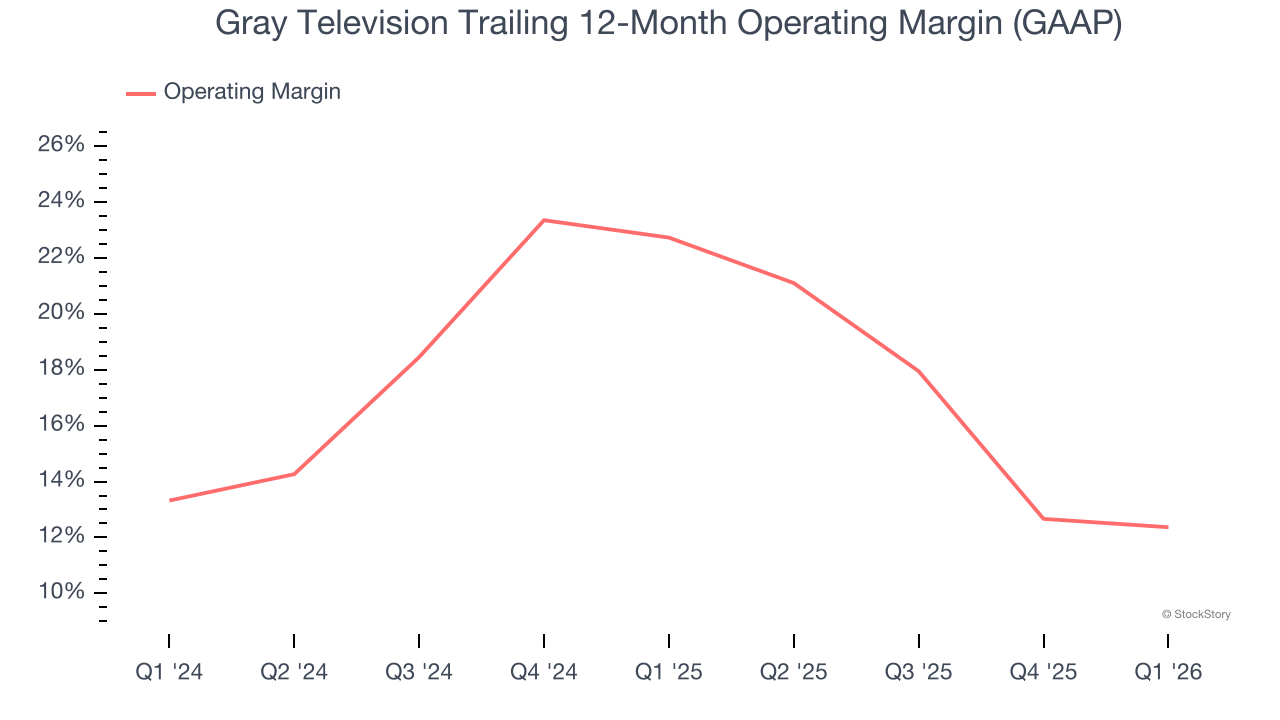
In Q1, Gray Television generated an operating margin profit margin of 10.5%, down 1.2 percentage points year on year. This reduction is quite minuscule and indicates the company’s overall cost structure has been relatively stable.
Earnings Per Share
We track the long-term change in earnings per share (EPS) for the same reason as long-term revenue growth. Compared to revenue, however, EPS highlights whether a company’s growth is profitable.
Sadly for Gray Television, its EPS declined by 19.4% annually over the last five years while its revenue grew by 5.2%. This tells us the company became less profitable on a per-share basis as it expanded.
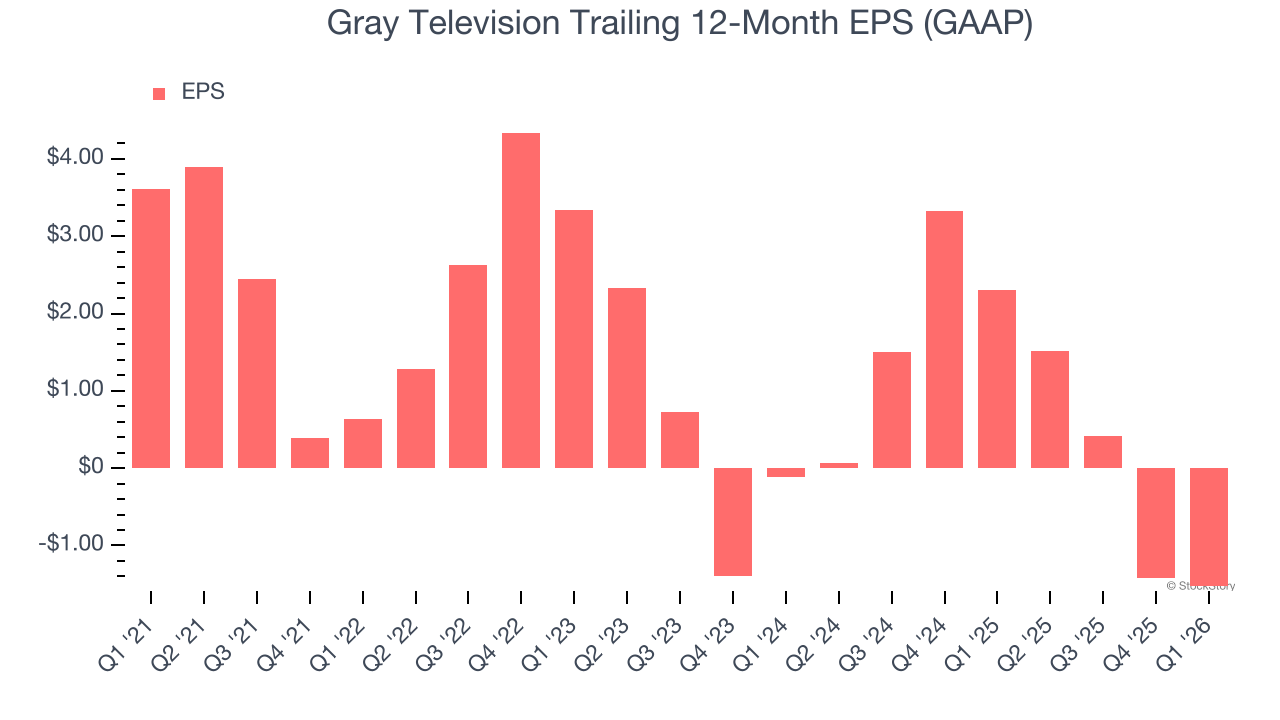
In Q1, Gray Television reported EPS of negative $0.34, down from negative $0.23 in the same quarter last year. This print missed analysts’ estimates. We also like to analyze expected EPS growth based on Wall Street analysts’ consensus projections, but there is insufficient data.
Key Takeaways from Gray Television’s Q1 Results
We struggled to find many positives in these results. Its EPS missed and its adjusted operating income fell short of Wall Street’s estimates. Overall, this was a softer quarter. The stock traded down 6.4% to $5.18 immediately after reporting.
The latest quarter from Gray Television’s wasn’t that good. One earnings report doesn’t define a company’s quality, though, so let’s explore whether the stock is a buy at the current price. If you’re making that decision, you should consider the bigger picture of valuation, business qualities, as well as the latest earnings. We cover that in our actionable full research report which you can read here (it’s free).