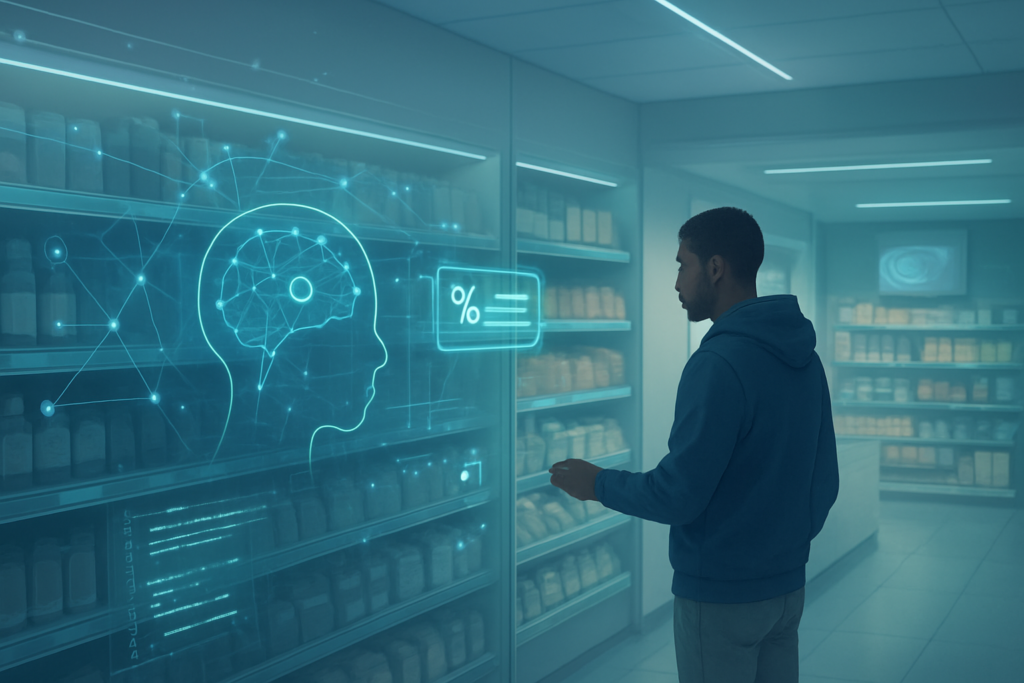
Artificial intelligence is fundamentally reshaping customer loyalty programs within the convenience store sector, moving beyond rudimentary point systems to deliver hyper-personalized offers and insights. This paradigm shift, driven by advanced data analysis and predictive capabilities, promises to redefine customer engagement, boost retention, and significantly enhance the overall shopping experience. The immediate significance lies in enabling convenience retailers to compete more effectively with larger chains by fostering deeper, individualized connections with their patrons, thereby driving increased revenue and operational efficiencies.
This transformation is not merely an incremental improvement but a wholesale re-imagination of how loyalty programs function. By leveraging AI, convenience stores can now dissect vast quantities of customer data—from purchase history and product preferences to browsing behavior and real-time interactions—to construct incredibly detailed individual profiles. This granular understanding allows for the creation of rewards and promotions that are not just relevant but precisely tailored to each customer's unique needs and likely future desires, a stark contrast to the generic, one-size-for-all approaches of the past.
The Algorithmic Edge: Technical Deep Dive into Personalized Loyalty
The technical core of this revolution lies in sophisticated machine learning algorithms, particularly those driving predictive analytics and recommendation engines. These AI models are capable of processing immense volumes of transactional data, real-time sales figures, and digital interaction logs at speeds and scales previously unattainable by human analysis. For instance, AI systems can identify subtle buying patterns, predict when a customer might need a specific item again, or suggest complementary products with remarkable accuracy. This goes beyond simple association rules; it involves complex neural networks learning intricate relationships within customer journeys and purchasing behaviors.
A key technical capability is the AI's ability to recognize "look-alike" customers across different stores and regions, enabling highly targeted marketing campaigns that transcend geographical boundaries and traditional segmentation methods. Furthermore, AI determines not just what to offer, but when and how to deliver it, ensuring personalized offers are presented at the most opportune moments to maximize effectiveness. This might involve dynamic pricing adjustments, real-time promotions based on current inventory, or personalized challenges integrated into gamified loyalty programs, such as those pioneered by Tesco's (LSE: TSCO) Clubcard Challenges. These dynamic, context-aware offers represent a significant departure from static coupon books or fixed discount tiers.
Compared to previous approaches, which often relied on manual data analysis, basic demographic segmentation, and reactive campaign management, AI-driven loyalty programs are proactive, predictive, and highly automated. Legacy systems struggled with scalability for true one-to-one personalization, often leading to generic offers that diluted customer engagement. AI, however, generates offers instantaneously and precisely, optimizing for individual customer context and business goals. Initial reactions from the retail tech community and early adopters highlight the transformative potential, praising the ability to achieve scalable personalization and unlock previously hidden insights into customer behavior. Experts note that this shift marks a move from merely collecting data to intelligently acting on it in real-time.
Corporate Chessboard: AI's Impact on Tech Giants and Retailers
The integration of AI into convenience store loyalty programs presents a significant competitive advantage and reshuffles the corporate landscape for both technology providers and retailers. Companies specializing in AI and data analytics platforms stand to benefit immensely. Firms like SessionM (acquired by Mastercard (NYSE: MA)), Antavo, and Eagle Eye (AIM: EYE) are already at the forefront, offering scalable AI-powered solutions that enable retailers to implement these advanced loyalty strategies. Tech giants like Google (NASDAQ: GOOGL), Amazon (NASDAQ: AMZN), and Microsoft (NASDAQ: MSFT), with their robust cloud AI services (Google Cloud AI, AWS AI/ML, Azure AI), are also poised to capture a substantial market share by providing the underlying infrastructure and specialized AI tools necessary for processing and analyzing vast datasets.
For convenience store chains, the adoption of AI-enhanced loyalty programs is becoming less of a luxury and more of a necessity to remain competitive. Early adopters gain a strategic edge by fostering stronger customer relationships, increasing customer lifetime value, and optimizing inventory management through predictive demand forecasting. This development puts pressure on smaller, independent convenience stores that may lack the resources to invest in sophisticated AI solutions, potentially leading to consolidation or partnerships with AI service providers. The competitive implications extend to traditional loyalty program vendors, who must now rapidly integrate advanced AI capabilities into their offerings or risk obsolescence.
Potential disruption to existing products and services includes the diminishing relevance of generic marketing campaigns and traditional, segment-based loyalty initiatives. AI's ability to deliver hyper-personalized, real-time offers makes mass-market promotions less effective by comparison. This also creates a new market for AI startups focused on niche applications within retail, such as behavioral economics-driven personalization or AI-powered gamification engines specifically designed for high-frequency, low-basket-size environments like convenience stores. Companies that can offer accessible, cost-effective AI solutions for small to medium-sized retailers will find a significant market opportunity, challenging the dominance of larger enterprise solutions.
Broader Implications: AI's Role in the Evolving Retail Landscape
The integration of AI into convenience store loyalty programs is a microcosm of a much broader trend within the AI landscape: the shift towards truly individualized customer experiences across all retail sectors. This development aligns perfectly with the growing consumer expectation for personalization, where generic interactions are increasingly viewed as irrelevant or even intrusive. It underscores AI's profound impact on understanding and influencing human behavior at scale, moving beyond simple automation to intelligent, adaptive systems.
The impacts are wide-ranging. For consumers, it promises a more rewarding and frictionless shopping experience, with offers that genuinely resonate and simplify decision-making. For businesses, it translates into enhanced customer lifetime value, reduced churn, and more efficient marketing spend. However, this advancement also brings potential concerns, particularly regarding data privacy and ethical AI use. The collection and analysis of extensive personal data, even for benevolent purposes, raise questions about transparency, data security, and the potential for algorithmic bias. Retailers adopting these technologies must navigate these ethical considerations carefully, ensuring compliance with regulations like GDPR and CCPA, and building trust with their customer base.
This milestone can be compared to previous AI breakthroughs in e-commerce recommendation engines (e.g., Amazon's product suggestions) or streaming service personalization (e.g., Netflix's content recommendations). The key difference here is the application to a high-frequency, often impulse-driven, physical retail environment, which presents unique challenges in data capture and real-time interaction. It signifies AI's maturation from primarily digital applications to pervasive integration within brick-and-mortar operations, blurring the lines between online and offline customer experiences and setting a new standard for retail engagement.
The Road Ahead: Future Developments and Emerging Horizons
Looking ahead, the evolution of AI in convenience store loyalty programs is expected to accelerate, driven by advancements in real-time data processing, edge AI, and multimodal AI. In the near term, we can anticipate more sophisticated predictive models that not only anticipate purchases but also predict customer churn with higher accuracy, allowing for proactive retention strategies. The integration of generative AI could lead to dynamically generated, highly creative personalized marketing messages and even custom product recommendations that feel uniquely crafted for each individual.
Potential applications on the horizon include the seamless integration of loyalty programs with in-store smart infrastructure. Imagine AI-powered cameras analyzing anonymized foot traffic patterns to dynamically adjust personalized offers displayed on digital screens as a customer walks through an aisle. Edge AI, processing data directly on devices within the store, could enable even faster and more localized personalization without constant reliance on cloud connectivity. Furthermore, multimodal AI, combining insights from various data types like voice, image, and text, could lead to richer customer profiles and more nuanced interactions, such as AI-powered chatbots that understand emotional cues during customer service interactions.
Challenges that need to be addressed include ensuring data interoperability across disparate systems, mitigating algorithmic bias to ensure fair and equitable offer distribution, and building robust cybersecurity measures to protect sensitive customer data. Additionally, the cost of implementing and maintaining advanced AI systems remains a barrier for some smaller retailers. Experts predict that the next phase will involve greater democratization of these AI tools, with more accessible, plug-and-play solutions becoming available, allowing a broader range of convenience stores to leverage these powerful capabilities. The focus will shift towards creating truly symbiotic relationships between AI systems and human store managers, where AI provides insights and automation, while humans provide strategic oversight and empathy.
A New Era of Customer-Centric Retail: The AI-Powered Loyalty Revolution
The advent of AI-enhanced customer loyalty programs in the convenience store sector marks a pivotal moment in retail history, signifying a profound shift towards a truly customer-centric model. The key takeaway is that AI is moving beyond simple automation to enable hyper-personalization at scale, transforming generic interactions into deeply engaging, individualized experiences. This development's significance in AI history lies in its demonstration of AI's capability to drive tangible business value in high-volume, low-margin environments, proving its versatility beyond traditional e-commerce applications.
This evolution is not merely about better discounts; it's about fundamentally understanding and anticipating customer needs, fostering genuine loyalty, and creating a more intelligent, responsive retail ecosystem. The long-term impact will be a retail landscape where personalization is the norm, customer data is an invaluable asset, and AI acts as the central nervous system connecting customer behavior with business strategy. We are witnessing the birth of a new era where convenience stores, often seen as traditional, are becoming pioneers in adopting cutting-edge AI to redefine the customer relationship.
In the coming weeks and months, watch for increased adoption rates among regional convenience store chains, new partnerships between AI solution providers and retail groups, and further innovations in real-time personalization and predictive analytics. Expect continued discourse around data privacy and ethical AI, as the industry grapples with the responsibilities that come with such powerful data-driven capabilities. The AI-powered loyalty revolution is here, and it's poised to reshape how we shop, how we're valued, and how convenience stores thrive in the competitive retail arena.
This content is intended for informational purposes only and represents analysis of current AI developments.
TokenRing AI delivers enterprise-grade solutions for multi-agent AI workflow orchestration, AI-powered development tools, and seamless remote collaboration platforms.
For more information, visit https://www.tokenring.ai/.