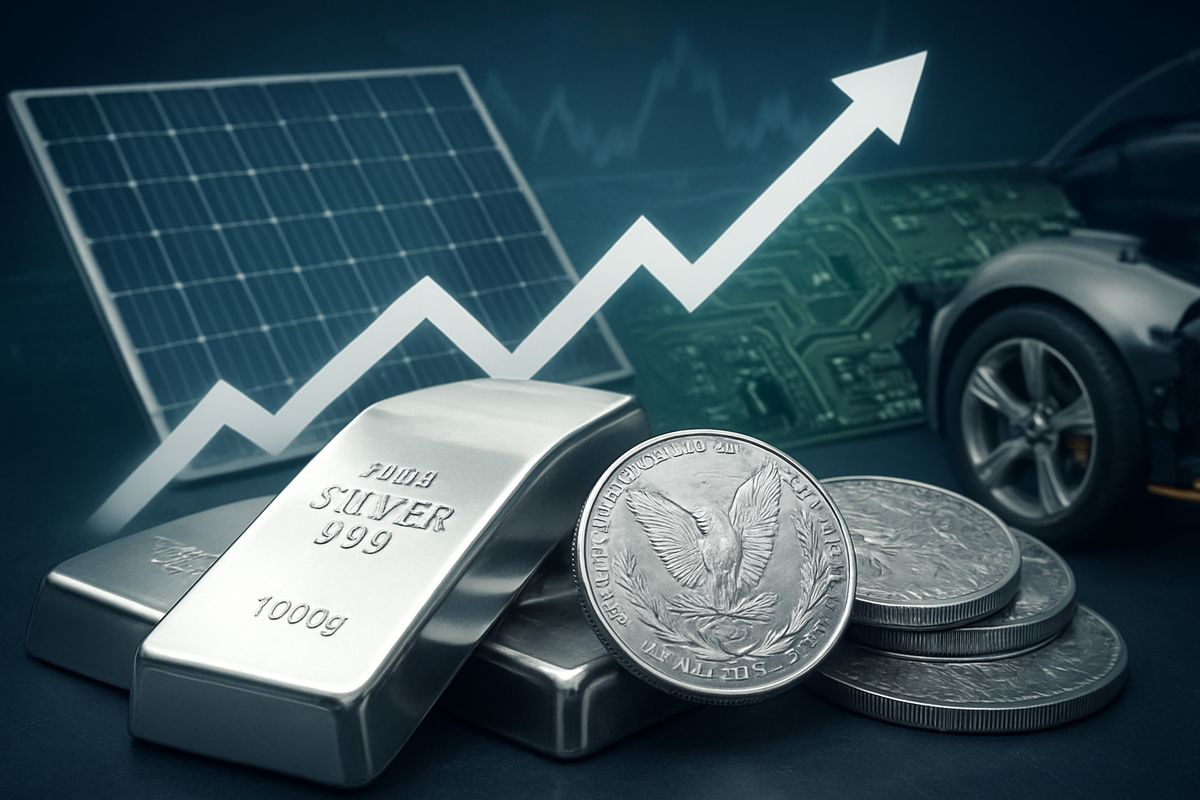
Silver has recently shattered historical price records, surging past $66 per troy ounce in mid-December 2025, a dramatic ascent that has more than doubled its value year-to-date. This monumental rally is not merely a fleeting market anomaly but rather a powerful indicator of deep-seated structural shifts in global supply and demand dynamics, poised to send significant ripple effects across the financial markets and key industrial sectors.
The immediate implications are profound, highlighting a persistent supply deficit exacerbated by escalating industrial demand from green technologies and a robust resurgence of investor interest seeking safe-haven assets amidst macroeconomic uncertainties. This unprecedented surge positions silver as a critical commodity to watch, with its trajectory set to redefine cost structures for numerous industries and potentially reshape investment strategies for years to come.
A Historic Ascent: Unpacking Silver's Record-Breaking Rally
Silver's journey to unprecedented heights in 2025 has been nothing short of spectacular, culminating in a series of record-breaking milestones in December. The metal first eclipsed its long-standing all-time high of US$49.95 (set in January 1980) on October 9, 2025, signaling a new era for the precious and industrial metal. The momentum accelerated sharply in the final quarter, with December proving to be a particularly pivotal month.
On December 9, spot silver breached the US$60 per troy ounce mark, a psychological and technical barrier. Just two days later, on December 11, it hit a new historical intraday high of $64.2062. The peak of this initial surge came on December 12, reaching US$64.65, propelled by the US Federal Reserve's announcement of a 25 basis point interest rate cut, which historically tends to favor non-yielding assets like precious metals. The ascent continued unabated, with silver prices surging past $66 per ounce on December 17, 2025, reaching $66.31 for spot silver and futures climbing to $66.43, establishing a new all-time high of $66.50. This global trend was mirrored in India, where silver rates crossed the ₹2 lakh mark per kilogram, soaring to a record high of ₹2,05,800 per kg, with futures contracts hitting ₹2,06,111 per kg on the same day.
The primary drivers behind this historic rally are multifaceted. Fundamentally, the market is grappling with its fifth consecutive year of a structural supply deficit, where global demand consistently outstrips mined production. Mine output has remained largely flat or even declined, and with critical Chinese strategic reserves reportedly at decade-low levels, the physical availability of silver has become acutely tight, reflected in elevated borrowing rates for the metal. This persistent imbalance forms the bedrock of the price surge.
Key players and stakeholders involved in this scenario include the major silver mining companies, industrial consumers (particularly in the solar and electronics sectors), institutional investors, and central banks whose monetary policies directly influence the attractiveness of precious metals. The initial market reaction has been one of bullish anticipation, with analysts revising price targets upwards and investors flocking to silver as both an industrial commodity and a robust safe-haven asset. The "backwardation" in the market, where current prices exceed future prices, further underscores the immediate tightness in physical supply and reinforces the bullish sentiment.
Corporate Fortunes Diverge: Winners and Losers in the Silver Rush
The unprecedented surge in silver prices is creating a stark divergence in fortunes across various public companies, enriching those at the source of supply while imposing significant cost pressures on industries heavily reliant on the precious metal.
The Beneficiaries: Silver Miners and Streaming Companies
Silver mining companies stand as the most direct beneficiaries of the current price rally. With spot silver prices more than doubling year-to-date, their revenues are soaring, and profit margins are expanding, assuming relatively stable production costs. Major players in this sector are experiencing a significant uplift. For instance, Pan American Silver Corp. (NASDAQ: PAAS / TSX: PAAS), one of the world's leading silver producers, is seeing a direct boost to its top and bottom lines from its extensive operations across the Americas. Similarly, First Majestic Silver Corp. (NYSE: AG / TSX: AG), with its primary focus on Mexican silver mines, has already reported a remarkable 96% year-over-year revenue increase, underscoring its high sensitivity to silver price movements. Other significant mining companies like Hecla Mining Company (NYSE: HL), Endeavour Silver Corp. (NYSE: EXK / TSX: EDR), Coeur Mining, Inc. (NYSE: CDE), and Silvercorp Metals Inc. (NYSEMKT: SVM / TSX: SVM) are also poised for substantial gains. In India, Hindustan Zinc Ltd (NSE: HINDZINC), a subsidiary of Vedanta and the world's third-largest silver producer, saw silver contribute 40% to its profitability in the September quarter of 2025, highlighting its significant exposure and benefit from the price hike.
Precious metals streaming companies also emerge as significant winners. These firms provide upfront financing to miners in exchange for the right to purchase future production at a fixed, often much lower, price. This business model allows them to capitalize on rising spot prices with minimal operational risk. Wheaton Precious Metals Corp. (NYSE: WPM), one of the largest in this space, is particularly well-positioned, as its agreements to acquire silver at an average price of $5.75 per ounce through 2029 translate into massive profit margins at current record-high prices.
The Challengers: Industrial Consumers and Jewelry Sector
Conversely, industries that heavily consume silver as a critical input are facing mounting cost pressures, threatening to squeeze profit margins, necessitate price increases, or even force a pivot to alternative, albeit often less efficient, materials.
Solar panel manufacturers are particularly vulnerable. Silver is an indispensable component in photovoltaic (PV) cells due to its superior electrical conductivity. The cost of silver now accounts for up to 14% of solar module production costs, a significant jump from 5% in 2023, and over 30% for advanced N-type cells like TOPCon. This exacerbates cost pressures on global solar giants such as JinkoSolar Holding Co., Ltd. (NYSE: JKS) and LONGi Green Energy Technology Co., Ltd. (SSE: 601012). While companies like First Solar, Inc. (NASDAQ: FSLR), which specializes in thin-film technology, use less silver, the overall industry is grappling with these increased expenses, potentially leading to a 7% drop in silver demand from the solar sector as manufacturers actively research substitutes like copper.
Electronics manufacturers, spanning semiconductors, electric vehicles (EVs), data centers, and artificial intelligence (AI) components, are also feeling the pinch. Silver's unique conductivity makes it irreplaceable in many applications, from printed circuit boards to switches and advanced batteries. Japanese passive component manufacturers like Murata Manufacturing Co., Ltd. (TSE: 6981) and TDK Corporation (TSE: 6762) are already raising prices on components where silver can constitute up to 60% of production costs, indicating a ripple effect across the electronics supply chain. EV manufacturers, including Tesla, Inc. (NASDAQ: TSLA), General Motors Company (NYSE: GM), Ford Motor Company (NYSE: F), BYD Company Limited (HKEX: 1211), and Volkswagen AG (XTRA: VOW3), face higher material costs as EVs utilize significantly more silver (25-50 grams per battery-electric vehicle) in their complex electrical systems, potentially impacting vehicle profitability or consumer pricing. The jewelry sector, which often positions silver as an affordable alternative to gold, is also grappling with soaring raw material costs. This directly impacts manufacturers and retailers, potentially leading to higher retail prices and a decline in consumer demand, as seen with a 14% fall in Indian silver jewelry demand. Luxury conglomerates like LVMH Moët Hennessy Louis Vuitton SE (Euronext Paris: MC), through brands like Tiffany & Co., and other major jewelry businesses will need to navigate these increased input costs.
A Strategic Metal Redefined: Broader Implications and Geopolitical Undercurrents
Silver's unprecedented price surge in December 2025 transcends mere market speculation; it signifies a fundamental redefinition of the metal's role, elevating it from primarily a precious metal to a strategic industrial commodity indispensable for the global green and technological revolution. This shift is embedded in several broader industry trends and carries significant ripple effects across economic and geopolitical landscapes.
The current rally is fundamentally driven by a confluence of factors, notably a persistent structural supply deficit—now in its fifth consecutive year—where mine production struggles to meet burgeoning demand. This inelasticity in supply, given that most silver is a byproduct of other metal mining, means that even higher prices do not easily or quickly translate into increased output. Simultaneously, industrial demand has reached record highs in 2025, propelled by the insatiable needs of solar energy (photovoltaics), which alone consumes 100-120 million ounces annually, and the burgeoning electronics, semiconductor, data center, AI, and electric vehicle (EV) sectors. This industrial demand is often price-inelastic, as manufacturers prioritize securing supply for critical applications over cost optimization, further fueling the price ascent.
The ripple effects are far-reaching. In the solar industry, manufacturers are now facing silver accounting for 14-15% of module costs, up from 5% in 2023, forcing aggressive exploration of "thrifting" (reducing silver content) and substitution with alternatives like copper, though progress is slow. This pressure could lead to higher product prices or reduced profit margins. Similarly, electronics, semiconductor, and EV manufacturers face increased input costs, though silver's unique properties make widespread substitution challenging without performance degradation. For mining companies, particularly those with low-cost operations, the elevated prices translate into higher profit margins and increased investment flows, potentially incentivizing further exploration and production.
On the regulatory and policy front, a pivotal development occurred in November 2025 when the US Geological Survey (USGS) officially added silver to its list of critical minerals. This designation marks a paradigm shift, recognizing silver as vital for national security and economic competitiveness. This classification is expected to unlock government support for securing domestic supply chains, including enhanced permitting, subsidies, strategic stockpiling programs, and potential tax incentives for domestic projects, aimed at reducing the US's over 70% reliance on imports. It also signals potential shifts in trade policies, with discussions emerging about export restrictions on domestically produced silver, similar to measures for other strategic resources. China, for instance, has already implemented selective export restrictions on refined silver products, creating advantages for its domestic manufacturers. This highlights a "geopolitical silver trading race," as nations vie to secure critical metal supplies amidst rising global tensions.
Historically, silver has experienced dramatic price spikes, most famously during the Hunt Brothers' attempt to corner the market in 1979-1980, which saw prices briefly exceed $50 per ounce before a spectacular crash. Another significant peak occurred in 2011, driven by inflation fears and monetary easing post-2008 financial crisis. While current macroeconomic factors like inflation concerns and potential interest rate shifts are present, the key distinction in December 2025 is the robust and fundamentally driven industrial demand from green technologies and the official critical mineral designation. This suggests that the current rally is more structurally supported than previous speculative bubbles, reflecting a genuine revaluation of silver's indispensable role in the modern economy.
The Road Ahead: Navigating Silver's New Frontier
The extraordinary ascent of silver prices to record highs in December 2025 marks a critical juncture, ushering in a new era for the metal. The path forward for silver and its market is characterized by both immense opportunities and significant challenges, necessitating strategic pivots from all stakeholders.
Short-Term and Long-Term Trajectories: In the immediate term, the market is grappling with a "physical vault drain emergency" at COMEX, where a substantial portion of registered silver was claimed for delivery in early December, signaling a potential physical market squeeze and a decoupling between paper and physical prices. This suggests continued upward pressure on spot prices. Analysts' short-term forecasts for late 2025 and early 2026 vary, with some predicting consolidation in the mid-$60s to $70 per ounce range. Long-term projections are even more bullish, with some experts forecasting silver could reach $70+ by 2026-2027, and even $100 per ounce by 2030, driven by the persistent structural supply deficit and relentless industrial demand. The market is expected to experience significant volatility over the next five years, but the underlying fundamentals point to a new, higher equilibrium price range.
Strategic Adaptations and Pivots: For industrial users, particularly in solar, electronics, and EV manufacturing, strategic procurement is paramount. This includes forward contracting for a substantial portion of annual requirements, maintaining robust safety stock levels, and diversifying suppliers to mitigate supply chain risks. The US government's designation of silver as a "critical mineral" further underscores the need for industries to secure their supply lines. Miners, on the other hand, must address the persistent supply shortfall through increased investment in exploration and development, especially for primary silver mines. For investors, diversification through physical silver, silver-backed ETFs, or mining stocks, with an optimal allocation of 5-10% of a portfolio, is advisable. Governments are also adapting, with some Western nations developing strategic reserve initiatives and public-private partnerships to boost domestic production, while countries like Mexico reassert control over mineral resources and China implements export restrictions on refined silver.
Emerging Opportunities and Challenges: The most significant market opportunity for silver lies in the global green energy transition. Silver is a "mission-critical industrial commodity" for solar photovoltaics, electric vehicles (EVs), wind turbines, and smart energy systems. Solar power alone is projected to consume 250 million ounces annually by 2030, while EVs, requiring double the silver of traditional cars, are set to drive automotive demand. The boom in AI and data centers also presents a substantial opportunity due to the need for highly conductive materials. Furthermore, silver's dual role as a strategic commodity and a safe-haven asset amidst global economic uncertainty and inflation fears continues to attract investment demand.
However, significant challenges persist. The chronic imbalance between robust, often price-inelastic, industrial demand and a constrained, byproduct-dependent supply chain will continue to exert upward pressure on prices. This explains why silver is currently in its fifth consecutive annual deficit. Price volatility remains a concern due to silver's smaller market size and dual demand drivers. While substitution efforts (e.g., copper in solar cells) are underway, they often come with efficiency penalties, limiting their immediate impact. Geopolitical risks in key mining regions and the potential for economic slowdowns, particularly in manufacturing, could also impact demand.
Potential Scenarios and Outcomes: A bullish extension is highly probable, with continued strong industrial demand, persistent supply deficits, and ongoing investment inflows pushing prices further upwards, potentially consolidating in the mid-$60s to $70s by early 2026 and testing $100 per ounce by 2030. A consolidation and structural upside scenario is also plausible, where the market enters a period of consolidation after the rapid rally, with prices averaging $45-$60 in 2026, but maintaining a higher long-run equilibrium. A bear case, though less probable due to strong fundamentals, could see a correction to the $25-$40 range if speculative positioning unwinds, a severe global economic slowdown occurs, or substitution efforts gain significant traction. However, the fundamental structural deficits and inelastic industrial demand make a sustained deep correction unlikely unless multiple severe negative factors converge.
The Silver Age: A New Dawn for a Critical Metal
The record-shattering performance of silver in December 2025 marks a pivotal moment, signaling a profound and lasting transformation in its market identity. This is not merely a transient price spike but rather a fundamental revaluation driven by a potent combination of structural supply deficits, surging industrial demand from the green energy and high-tech sectors, and a renewed embrace by investors seeking both growth and a hedge against macroeconomic uncertainties. The key takeaway is that silver has firmly cemented its status as an indispensable "critical mineral," vital for national security and economic competitiveness in the 21st century.
Moving forward, the market is poised for continued strength, albeit with inherent volatility. The chronic imbalance between robust, often price-inelastic, industrial demand and a constrained, byproduct-dependent supply chain will continue to exert upward pressure on prices. This structural reality suggests that silver has likely transitioned to a new, higher equilibrium price range, a significant shift from its historical trading patterns. Investors should recognize silver's dual role as both a monetary asset and a crucial industrial commodity, making it a unique and compelling component of a diversified portfolio.
In the coming months, investors should closely watch several key indicators. Continued growth in solar panel installations, EV production figures, and advancements in AI infrastructure will provide insights into industrial demand. Monitoring global mine production reports and inventory levels, particularly at major exchanges, will be crucial for assessing supply dynamics. Furthermore, central bank monetary policies, particularly interest rate decisions by the US Federal Reserve, and the strength of the US dollar will influence investment demand. Finally, any further regulatory actions or government initiatives stemming from silver's critical mineral designation could significantly impact its market. The "silver age" is upon us, and its unfolding narrative promises to be one of profound economic and technological significance.
This content is intended for informational purposes only and is not financial advice