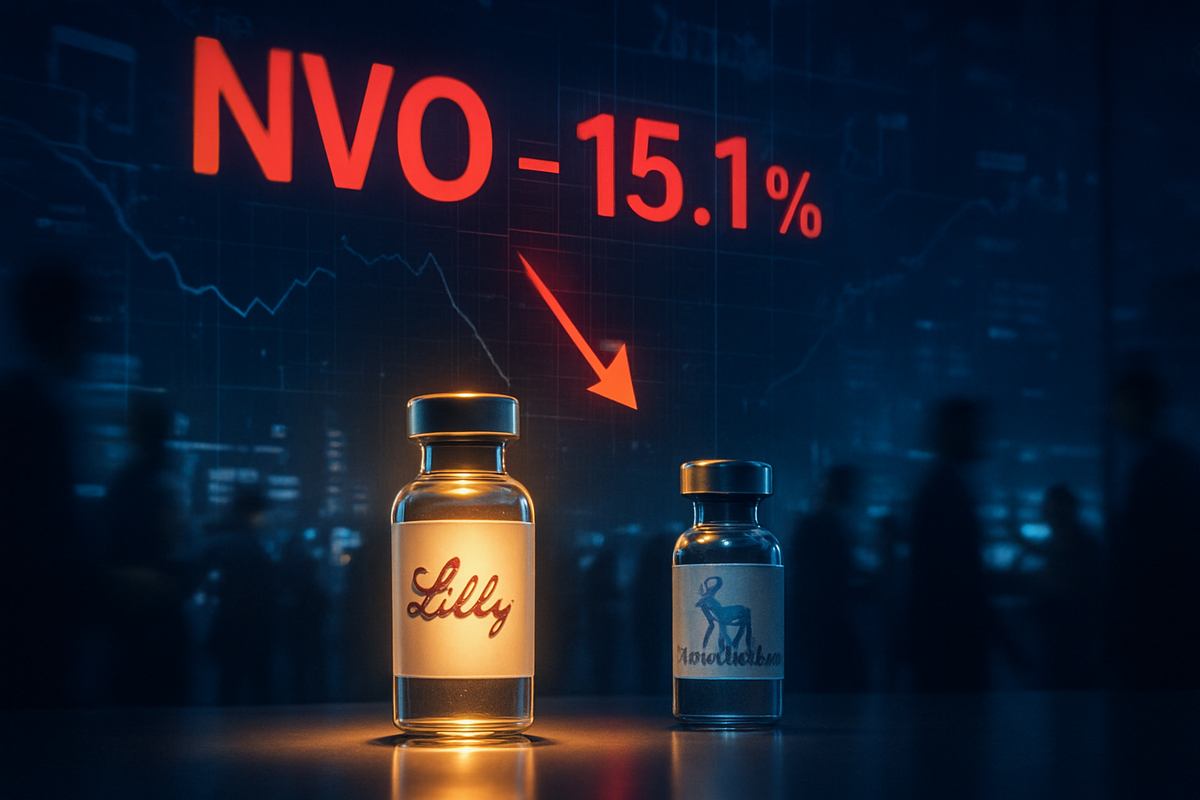
The undisputed reign of Novo Nordisk in the weight-loss drug sector faced its most severe challenge to date on February 23, 2026, as the company’s US-traded shares (NYSE: NVO) plummeted 15.1% in a single session. The massive sell-off, which erased approximately $100 billion in market capitalization, was triggered by the release of the highly anticipated REDEFINE 4 Phase 3 clinical trial results. The data revealed that Novo’s next-generation treatment, CagriSema, failed to surpass—or even match—the weight-loss efficacy of its primary rival, Eli Lilly’s Zepbound.
This market correction marks a pivotal shift in the "duopoly" of the obesity market. For years, investors had banked on CagriSema—a combination of semaglutide and the amylin analogue cagrilintide—to reclaim the crown of most effective weight-loss medication. Instead, the trial results showed a significant 2.5% efficacy gap in favor of Eli Lilly (NYSE: LLY), sending shockwaves through the healthcare sector and raising urgent questions about Novo Nordisk's long-term pipeline strategy.
The REDEFINE 4 trial was designed as a definitive head-to-head showdown between CagriSema and Eli Lilly's tirzepatide (marketed as Zepbound). Over an 84-week period, the study tracked the weight-loss progress of patients using both medications. While CagriSema achieved a respectable 23.0% weight loss when taken as directed, it was soundly defeated by Zepbound, which delivered a 25.5% reduction. Perhaps more concerning for Novo Nordisk was the "real-world" data, which showed CagriSema at 20.2% compared to Zepbound’s 23.6%, suggesting that Eli Lilly’s dual-agonist approach remains more potent and potentially more tolerable for patients outside of a strictly controlled clinical setting.
The timeline leading to this "CagriSema Crash" began in late 2025, when cracks first appeared in Novo's dominance. In June 2025, earlier Phase 3 data (REDEFINE 1) showed a 22.7% weight loss, which, while positive, missed Novo's internal targets of 25%. Sentiment soured further on February 4, 2026, when Novo Nordisk reported a cautious 2026 outlook, citing pricing pressures and a projected 5% to 13% decline in profit growth. The February 23rd results served as the "final straw" for many institutional investors who had held on in hopes that CagriSema would provide a definitive clinical advantage.
Key stakeholders, including major institutional holders and healthcare analysts, had largely priced in a "win" for Novo Nordisk. Analysts at Morgan Stanley and William Blair characterized the REDEFINE 4 results as a "worst-case scenario," noting that the failure to achieve non-inferiority—let alone superiority—leaves Novo without a clear "Lilly-killer" drug in its immediate arsenal. The immediate reaction from the floor of the New York Stock Exchange was one of rapid divestment, as the stock hit its lowest levels in over two years.
The clear winner in this pharmaceutical arms race is Eli Lilly & Co. (NYSE: LLY). Following the announcement, Lilly shares rose between 3% and 4%, pushing the stock to record highs above $1,100 per share. By maintaining its lead with Zepbound and already moving toward its next-generation "triple G" agonist, Retatrutide, Lilly has solidified its position as the market leader. With Retatrutide already showing nearly 29% weight loss in Phase 3 TRIUMPH-4 trials late last year, Lilly is positioning itself to own the premium "high-efficacy" segment of the market for the foreseeable future.
Conversely, Novo Nordisk finds itself in a precarious defensive position. The company must now rely heavily on its existing Ozempic and Wegovy franchises, which are facing increasing pressure from generic manufacturers and insurance formulary negotiations. Smaller players in the space, such as Viking Therapeutics (NASDAQ: VKTX) and Amgen (NASDAQ: AMGN), may also see an opening. As Novo Nordisk's pipeline loses its aura of invincibility, investors are increasingly looking toward these smaller biotech firms that are developing oral formulations and alternative pathways that might offer better convenience or fewer side effects than the current injectable staples.
For Novo Nordisk, the loss of market cap is only part of the problem; the company now faces a "reputation gap." For years, it was seen as the innovator that defined the GLP-1 category. With the failure of REDEFINE 4 to prove superiority, Novo may be forced into a period of aggressive mergers and acquisitions. Industry insiders suggest that Novo Nordisk will likely look to acquire mid-stage biotech companies with novel weight-loss mechanisms to replenish a pipeline that now appears "obsolete" relative to Lilly’s triple-agonist platform.
The implications of the REDEFINE 4 failure extend far beyond two companies. It signals a maturation of the obesity drug market where "good" results are no longer enough to satisfy investors or clinicians. The industry is rapidly moving from "Phase 1" (proving GLP-1s work) to "Phase 2" (optimizing efficacy and delivery). The 25% weight-loss threshold has now become the new baseline for premium therapeutics. This "arms race" for higher efficacy is putting immense pressure on R&D budgets across the entire pharmaceutical sector.
Furthermore, this event highlights the shifting regulatory and policy landscape. As competition heats up and efficacy gaps widen, payers (insurance companies and government health programs) will likely become more selective. If Zepbound consistently outperforms CagriSema in head-to-head trials, insurers may demand steeper discounts from Novo Nordisk to keep their products on preferred formularies. This "pricing war" could benefit the public by lowering the cost of these life-saving medications, but it will undoubtedly squeeze the profit margins that have driven the recent biotech boom.
Historically, this event draws comparisons to the "statin wars" of the 1990s and early 2000s. Just as Pfizer eventually dominated that market with Lipitor by proving superior efficacy over early movers, Eli Lilly appears to be executing a similar "leapfrog" strategy. The broader trend is clear: the obesity market is evolving into a high-stakes, data-driven arena where market share is won and lost on the decimal points of clinical trial outcomes.
In the short term, Novo Nordisk will likely initiate a strategic pivot focused on "differentiation over raw power." This may include emphasizing the cardiovascular benefits of its drugs or developing more patient-friendly oral versions of semaglutide. However, the shadow of Eli Lilly's Retatrutide looms large. With Lilly expected to launch its triple agonist by late 2026 or early 2027, Novo Nordisk has a very narrow window to convince the medical community that its amylin-combination approach offers unique benefits that weight loss alone cannot measure.
Strategic adaptations will also likely involve a shift toward combination therapies for co-morbidities. We may see Novo Nordisk focus more heavily on the "Ozempic-plus" strategy—combining its existing GLP-1 base with drugs targeting kidney disease, liver disease (MASH), and even Alzheimer’s. This diversification could provide a "moat" that protects the company from being judged solely on weight-loss percentages.
Market opportunities will emerge for contract manufacturing organizations and logistics providers as the volume of these drugs continues to scale, regardless of which company holds the top spot. However, the primary challenge for the next 12 to 18 months will be the "Retatrutide launch cycle." If Lilly’s triple-agonist hits the 30% weight-loss mark in real-world settings, the entire market hierarchy will be reset once again, potentially leaving any company without a triple-agonist or a highly potent oral alternative in the dust.
The 15.1% tumble in Novo Nordisk shares is a stark reminder of the volatility inherent in high-growth pharmaceutical sectors. The key takeaway from the REDEFINE 4 results is not that CagriSema is a "bad" drug—23% weight loss remains a medical marvel compared to treatments from a decade ago—but that in the hyper-competitive obesity market, being "second best" is a multi-billion dollar liability. The market has moved past the era of novelty; it is now in the era of peak performance.
Moving forward, the market will be characterized by intense price competition and a focus on "next-gen" delivery systems. Investors should watch for Novo Nordisk’s potential acquisition targets in the coming months, as the company seeks to buy its way back into a leadership position. Additionally, the upcoming regulatory filings for Eli Lilly's Retatrutide will be the next major catalyst for the sector.
For the public and for investors, the message is clear: the obesity drug gold rush is far from over, but the "easy money" phase has ended. The winners will be those who can consistently deliver superior clinical outcomes and adapt to a landscape where the bar for success is constantly being raised.
This content is intended for informational purposes only and is not financial advice.