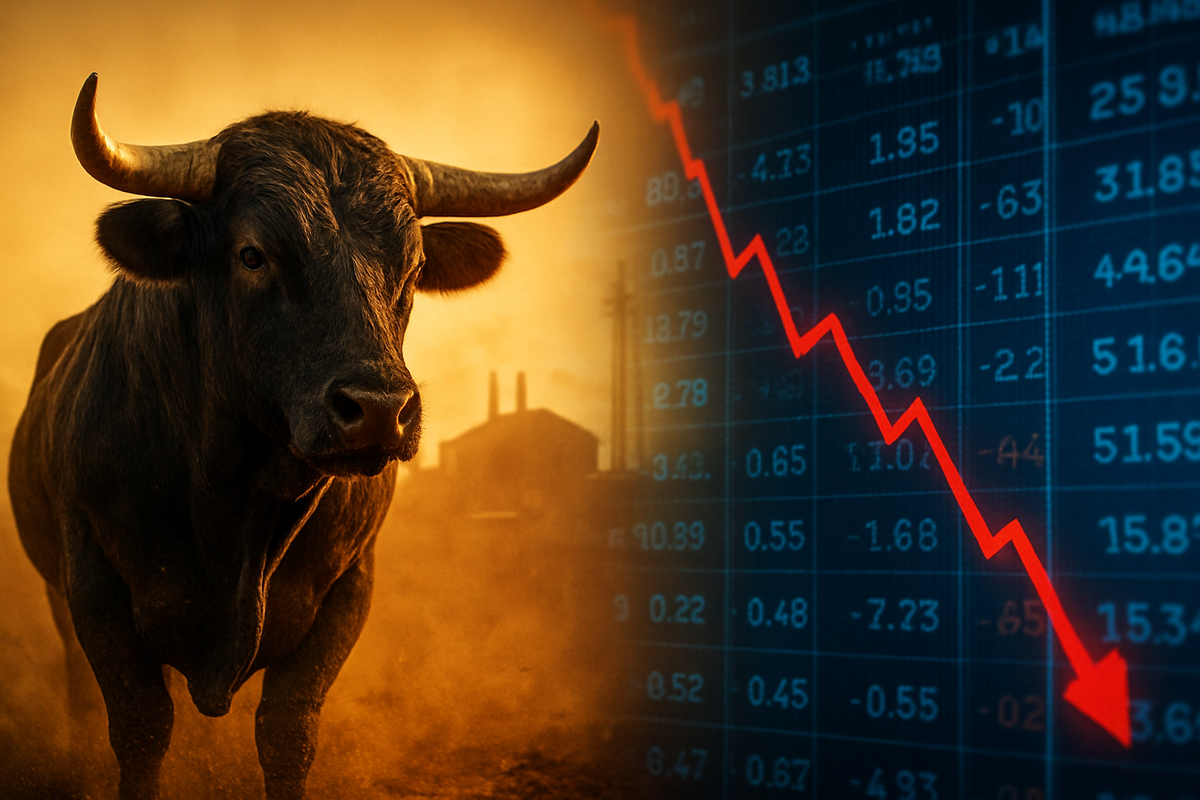
The United States cattle market has entered a period of unprecedented volatility, characterized by a staggering "Mexican standoff" between physical cash prices and paper futures. As of February 24, 2026, Northern dressed cattle have surged to a record-shattering $388 per hundredweight (cwt), signaling a desperate scramble for immediate supply. Conversely, the futures market has taken a sharp turn for the worse, with Live Cattle contracts retreating toward the $240 level as traders brace for a dual-pronged shock of labor unrest and geopolitical instability.
This divergence represents one of the most significant dislocations in the history of the protein complex. While the fundamental reality on the ground—driven by the smallest national cattle herd in over 75 years—screams for higher prices, the financial markets are pricing in a "risk-off" environment. A looming strike at one of the nation's largest processing plants and a 15-day diplomatic ultimatum involving Iran have created a vacuum of confidence, leaving producers and investors navigating a landscape where the cost of a steak is rising while the value of the animal is falling in the pits.
The Perfect Storm: Labor Strife and Middle East Tensions
The immediate catalyst for the futures retreat is the imminent threat of a total shutdown at the JBS S.A. (OTC: JBSAY) processing plant in Greeley, Colorado. On February 4, nearly 3,800 workers represented by UFCW Local 7 voted by a 99% margin to authorize a strike, protesting increased line speeds and demanding better safety protocols. As of this week, negotiations have reached a stalemate. With the Greeley plant processing approximately 10,000 head of cattle daily, a walkout would essentially sever a major artery of the U.S. beef supply chain, causing a backup of inventory that would depress cattle values in the short term.
Compounding this domestic anxiety is a sharp escalation in international tensions. The current administration has issued a 15-day deadline for Iran to re-negotiate nuclear terms, a move that has sent shockwaves through the commodities sector. While crude oil has spiked to six-month highs and gold has soared past $5,000 an ounce, the cattle market has reacted with a flight to liquidity. Speculative investors, wary of global trade disruptions and rising transportation costs, have liquidated "long" positions in cattle futures, contributing to the slide toward $240 even as the physical market remains historically tight.
Winners and Losers in a Fragmented Market
The primary victim of this divergence is JBS S.A. (OTC: JBSAY), which faces both a labor crisis and the soaring cost of procurement. If the Greeley strike proceeds, the company will lose significant market share to rivals while continuing to pay record-high prices for the cattle it can still process at other facilities. However, competitors such as Tyson Foods (NYSE: TSN) may find themselves in a complex position. While Tyson could benefit from a temporary reduction in JBS's market capacity, they are not immune to the $388/cwt cash price for Northern dressed cattle, which is severely compressing their margins across the board.
For the CME Group (NASDAQ: CME), the volatility has been a boon for trading volumes but a challenge for market stability. The massive "basis" (the difference between cash and futures) makes hedging nearly impossible for cattle feeders, potentially driving some smaller participants out of the market. Downstream, companies like Darden Restaurants, Inc. (NYSE: DRI), the owner of LongHorn Steakhouse, are facing a "worst-of-both-worlds" scenario: record-high raw material costs (cash) coupled with a volatile financial market that makes long-term price forecasting an exercise in futility.
A Structural Scarcity: Analyzing the USDA Data
The underlying supply metrics released in the USDA Cattle on Feed report on February 20, 2026, confirm that the record cash prices are not a fluke. The report showed that total cattle on feed as of February 1 stood at 11.5 million head, a 2% drop compared to last year. Even more concerning for long-term supply was the 5% year-over-year drop in January placements, indicating that the pipeline for new beef is drying up. Marketings were also down 13%, as packers moderated their slaughter pace to manage the exorbitant costs of live animals.
This structural scarcity is further exacerbated by a total suspension of live cattle imports from Mexico following a New World screwworm outbreak earlier this month. Historically, the U.S. has relied on these imports to buffer domestic shortages. Without that safety valve, and with the national herd at its lowest point since the 1940s, the physical supply of beef is at a breaking point. This event mirrors the supply chain shocks seen during the early 2020s but with the added weight of a much smaller breeding herd, suggesting that the "high price floor" for beef is likely here to stay for several years.
The Path Forward: Scenarios and Strategic Pivots
In the short term, the market's direction hinges entirely on the resolution of the JBS Greeley negotiations and the outcome of the 15-day Iran ultimatum. If a strike is averted and geopolitical tensions cool, futures are expected to "catch up" to the cash market in a violent rally. However, if the strike proceeds, the futures market could test even lower supports, further widening the gap with cash prices until the supply bottleneck is resolved.
For producers, the current strategy is one of "wait and see." Many are holding onto cattle in hopes of even higher cash prices, though the risk of a market collapse due to a processing halt is significant. For investors, the opportunity lies in the eventual narrowing of the basis. Whether through a futures surge or a cash correction, the current $148 gap between $388 dressed (approx. $245 live equivalent) and $237 futures is unsustainable. Market participants will likely need to adopt more sophisticated hedging strategies to navigate what is becoming the most volatile era for protein in modern history.
Market Outlook and Final Assessment
The striking divergence in the US cattle market is a case study in how "outside" macro shocks can temporarily override fundamental supply-and-demand realities. While the USDA data proves that the U.S. is facing a multi-year beef deficit, the immediate fears of labor strikes and global conflict have created a technical bear market in the midst of a physical bull run. The $388 record for Northern dressed cattle is a loud signal that the market is running out of animals, regardless of what the futures boards say.
Moving forward, investors should keep a close watch on the March 1st deadline for the Iran ultimatum and the daily updates from the UFCW Local 7 negotiations. These two factors will dictate whether the futures market finds its footing or continues its retreat. In the long run, the 2% drop in Cattle on Feed inventory suggests that consumers should prepare for "steak inflation" to remain a permanent fixture of the economy. For the cattle industry, the 2026 divergence is not just a market glitch; it is a preview of the high-stakes, low-supply future of American agriculture.
This content is intended for informational purposes only and is not financial advice