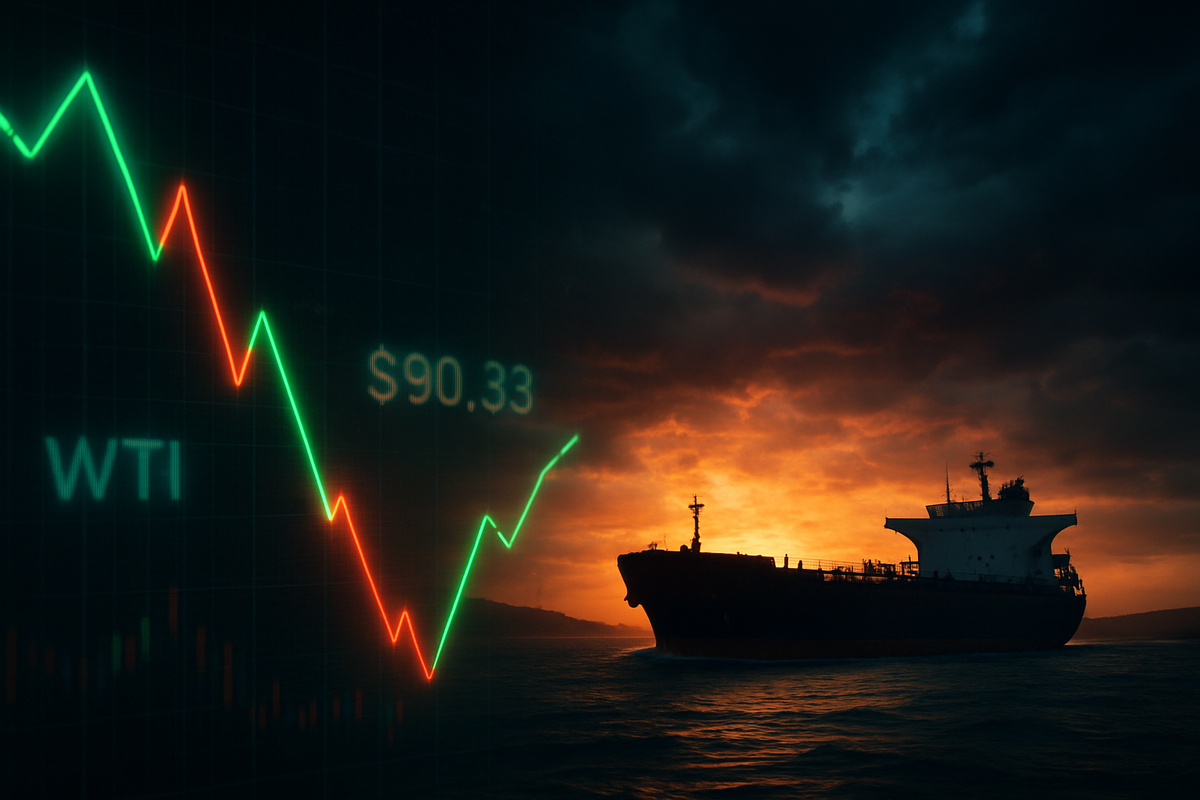
The global energy market endured a gut-wrenching 48 hours as West Texas Intermediate (WTI) crude oil futures surged nearly 2% to trade at $90.33 per barrel on Tuesday, March 24, 2026. This rebound follows a devastating 11% collapse during Monday’s session—the largest single-day percentage drop in nearly six years—which saw prices briefly plunge from the high $90s into the mid-$80s on the back of unsubstantiated ceasefire rumors.
The sudden reversal, often referred to by traders as a "dead cat bounce" or a "re-pricing of risk," occurred as Iranian officials categorically dismissed reports of a brokered peace deal in the Middle East. With the "war premium" quickly flooding back into the market, investors are once again grappling with the very real possibility of a prolonged closure of the Strait of Hormuz, a critical chokepoint through which approximately 20% of the world’s petroleum liquids transit daily.
A Tale of Two Sessions: From Panic Selling to Geopolitical Reality
The volatility began on Monday, March 23, when a series of unverified social media reports and a vaguely worded statement from a high-ranking U.S. State Department official suggested that a "framework for de-escalation" had been reached between Washington and Tehran. The news triggered a massive "flush" of long positions. Algorithmic trading bots, programmed to react to keywords like "ceasefire" and "normalization," liquidated billions of dollars in futures contracts, sending WTI tumbling over 10% in a matter of hours. By Monday's close, the market appeared to be pricing in a total resolution of the months-long maritime conflict.
However, the optimism was short-lived. Overnight, a spokesperson for the Iranian Ministry of Foreign Affairs characterized the U.S. claims as "psychological warfare" intended to manipulate global markets. By Tuesday morning, reports surfaced of fresh Iranian Revolutionary Guard Corps (IRGC) naval exercises near the Strait of Hormuz, effectively signaling that the threat to commercial shipping remained active. The conflicting narratives between the U.S. and Iran have left the market in a state of paralysis, with Brent and WTI reclaiming a significant portion of their Monday losses as the geopolitical risk discount was erased.
Key players in this drama extend beyond the diplomats. The market reaction was intensified by the involvement of major commodity trading houses and "macro" hedge funds that have been betting on a "higher-for-longer" energy price environment. For these stakeholders, the Monday crash was a liquidity event that tested the limits of margin calls, while Tuesday's rebound offered a reprieve, albeit a volatile one.
Winners and Losers: Energy Giants vs. The Transport Sector
The extreme swings in crude prices have created a stark divide among publicly traded companies. Integrated oil majors like Exxon Mobil Corp. (NYSE: XOM) and Chevron Corp. (NYSE: CVX) saw their stock prices mirror the volatility of the underlying commodity. While these companies benefit from the $90+ price floor established by the geopolitical tension, the uncertainty of a 10% daily swing makes capital expenditure planning and dividend forecasting a nightmare for management teams.
On the other side of the ledger, the transportation sector continues to suffer. For airline giants like United Airlines Holdings Inc. (NASDAQ: UAL) and Delta Air Lines Inc. (NYSE: DAL), the brief relief of Monday’s crash was quickly extinguished by Tuesday’s rebound. Jet fuel costs remain the largest variable expense for these firms, and the return to $90 crude threatens to squeeze profit margins just as the peak summer travel season approaches. Similarly, shipping firms and logistics companies like FedEx Corp. (NYSE: FDX) are facing increased operational costs that will likely be passed on to consumers in the form of "fuel surcharges," further fueling inflationary concerns.
A notable "winner" in this environment of heightened maritime risk is the tanker industry. Companies like Frontline PLC (NYSE: FRO) have seen their spot rates fluctuate wildly but generally trend higher as insurance premiums for transiting the Persian Gulf skyrocket. If the Strait of Hormuz remains under threat, the demand for longer, alternative shipping routes will likely drive tanker day-rates to multi-year highs, benefiting those with the most modern and flexible fleets.
The Strait of Hormuz and the Shadow of 1991
The current situation bears a striking resemblance to the "Resolution Crash" of January 1991, during the onset of Operation Desert Storm. In that instance, oil prices plummeted by over 30% in a single day as the market realized that Saudi oil fields would remain secure. However, 2026 presents a different set of challenges. Unlike 1991, the current conflict involves "asymmetric threats," such as drone swarms and naval mines, which are harder to neutralize through traditional military superiority.
The broader significance of this week's whiplash lies in the fragile state of global energy security. The market’s hyper-sensitivity to ceasefire rumors highlights just how much "war premium" is currently baked into the price of gas. Analysts suggest that without the threat of a Hormuz closure, WTI would likely be trading in the $65 to $75 range based purely on supply-and-demand fundamentals. This $20-per-barrel discrepancy represents a "geopolitical tax" that is currently being paid by every corner of the global economy.
Furthermore, the conflicting reports from the U.S. and Iran indicate a breakdown in credible communication. In a world of "deepfakes" and high-frequency trading, the ability of a single tweet or a retracted statement to wipe out 11% of the market's value raises serious questions for regulators at the Commodity Futures Trading Commission (CFTC). We may soon see calls for tighter "circuit breaker" rules on energy futures to prevent the kind of flash-crash witnessed on Monday.
Looking Ahead: The Fragile Path to $100
In the short term, the market is expected to remain in a "news-driven" holding pattern. If Iran continues to dismiss ceasefire rumors and maintains a military presence in the Strait, a push toward $100 per barrel seems inevitable. However, any verifiable sign of a diplomatic breakthrough could just as easily trigger another 10% leg down. For energy companies, the strategic pivot now involves "hedging the un-hedgeable"—trying to protect against extreme tail risks in a market where the baseline reality changes every twelve hours.
Long-term, this volatility may accelerate the shift toward domestic energy production and alternative fuels. If the Middle East remains a source of perpetual price shocks, companies like Occidental Petroleum Corp. (NYSE: OXY), which has a massive footprint in the Permian Basin, may become even more attractive to investors seeking "safe haven" energy assets far removed from the Strait of Hormuz. We are likely entering a period of "energy balkanization," where the security of the supply chain becomes just as important as the price of the commodity itself.
Market Wrap-Up and Investor Outlook
The "Oil Market Whiplash" of March 2026 serves as a stark reminder that in the world of commodities, sentiment can be as powerful as physical supply. The rebound to $90.33 confirms that the market is not yet ready to believe in a peaceful resolution. For investors, the key takeaways are clear: volatility is the new normal, and geopolitical risk is currently the primary driver of the energy sector's valuation.
Moving forward, the market will be hyper-focused on satellite imagery of the Persian Gulf and official communiqués from both Washington and Tehran. Investors should watch for any changes in the "contango" or "backwardation" of the oil futures curve, as these technical indicators will signal whether the current price spike is a temporary reaction or the beginning of a sustained upward trend. For now, the "war premium" is back, and the road to $100 crude is wider than it was yesterday.
This content is intended for informational purposes only and is not financial advice.