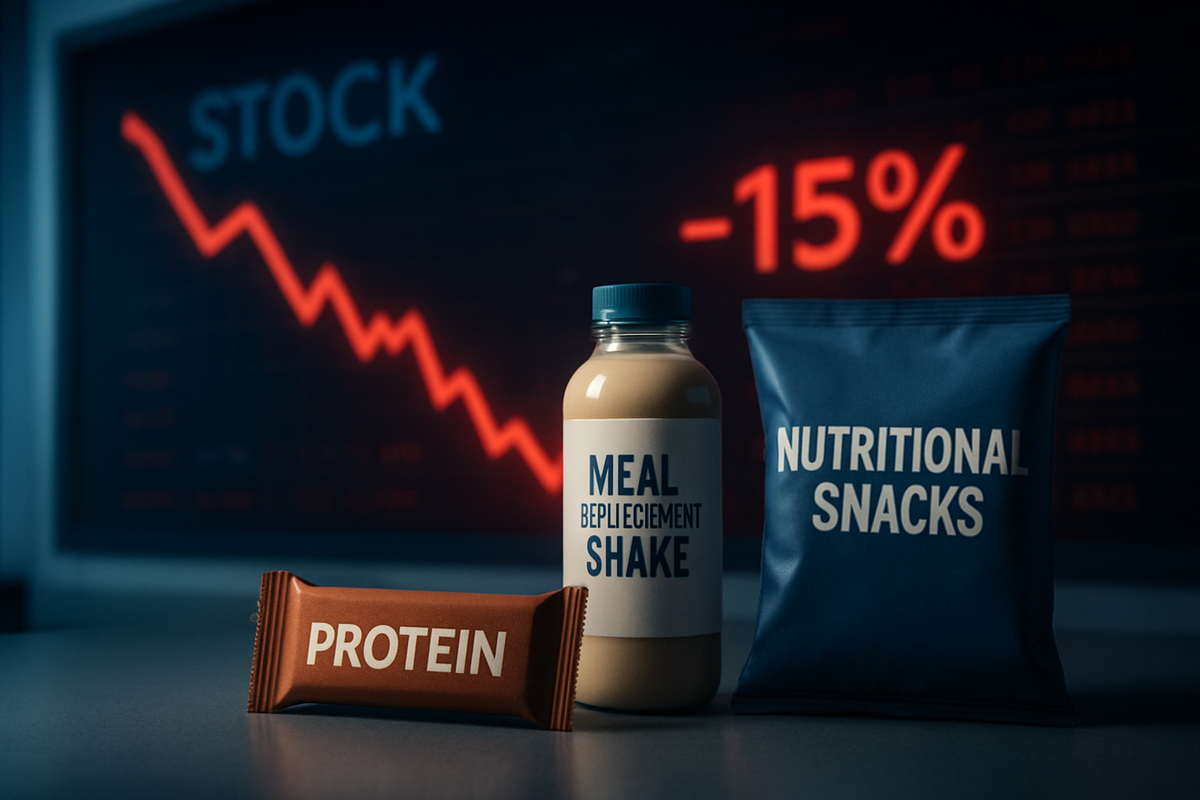
In a brutal day for the nutritional snacking sector, shares of The Simply Good Foods Company (Nasdaq: SMPL) plummeted more than 15% on Thursday after the company reported a sharper-than-expected revenue drop and a massive quarterly loss. The sell-off was triggered by a fiscal second-quarter earnings report that revealed deep structural challenges within the company’s legacy Atkins brand and execution missteps in its newly acquired OWYN line, prompting a blunt admission of failure from leadership.
The market reaction was swift and unforgiving. By mid-day trading on April 9, 2026, SMPL stock had touched a 52-week low, wiping out hundreds of millions in market capitalization. Investors were particularly rattled by the company's slashed full-year guidance and the revelation that the rise of GLP-1 weight-loss medications—once thought to be a tailwind for protein-rich snacks—is creating a more complex and competitive landscape than the company was prepared to navigate.
A "Quarter of Reckoning": Sales Slump and Impairment Charges
The financial results for the thirteen weeks ended February 28, 2026, painted a stark picture of a company in transition. Net sales for the quarter fell 9.4% year-over-year to $326 million, significantly trailing Wall Street’s expectations of $345 million. More alarming was the bottom line: Simply Good Foods swung to a staggering net loss of $159.7 million, a sharp reversal from the $36.7 million profit recorded in the same period a year ago.
A primary driver of this loss was a $249 million non-cash impairment charge. This accounting write-down effectively admitted that the brand values of Atkins ($62 million) and OWYN ($187 million) are worth far less than previously recorded, following lowered expectations for future cash flows. CEO Joe Scalzo, who returned to the helm just 12 weeks ago to orchestrate a turnaround, did not mince words during the earnings call.
"I want to make it quite clear that we are not satisfied with our current performance," Scalzo told analysts. "Our recent results have not met our expectations, and we have taken immediate and fundamental actions to turn around both our financial and in-market performance." Scalzo specifically pointed to "unsatisfactory" execution in the marketplace, noting that the Atkins brand saw a 23.4% decline in retail consumption as retailers pulled the low-carb pioneer off shelves to make room for trendier competitors.
Winners and Losers in the Protein Arms Race
The carnage at Simply Good Foods highlights a widening gap in the "active nutrition" space. While SMPL struggles with its legacy portfolio, rivals are moving aggressively to capture the shifting consumer. BellRing Brands (NYSE: BRBR), the maker of Premier Protein, appears to be a relative winner, as consumers increasingly pivot from solid protein bars to ready-to-drink (RTD) shakes—a format that is easier to consume for those on GLP-1 medications who experience suppressed appetites.
However, the threat landscape is diversifying. PepsiCo (Nasdaq: PEP) has recently entered the fray with "protein-fortified" versions of its mainstream snacks, directly challenging the dominance of SMPL’s Quest brand in the savory category. Meanwhile, Mondelez International (Nasdaq: MDLZ) continues to leverage its massive distribution network to push Clif Bar and Grenade into convenience stores, a channel where Simply Good Foods has struggled to gain traction this quarter.
On the losing side, legacy weight-loss brands that rely on traditional "dieting" tropes are being decimated. Alongside Atkins, brands owned by Glanbia (OTC: GLAPF), such as SlimFast, have faced similar headwinds as the market moves toward "muscle preservation" and "functional wellness" rather than simple calorie counting.
The GLP-1 Shift and the Savory Evolution
The broader industry is currently being reshaped by the "GLP-1 economy." By early 2026, the mainstream adoption of weight-loss drugs like Ozempic and Wegovy has fundamentally changed how Americans snack. While protein remains a high-demand ingredient, the format of that protein is changing. The "protein bar fatigue" that Scalzo noted in his remarks is a real phenomenon; consumers are moving away from dense, 60-gram bars in favor of "mini" formats and savory snacks like protein chips and pretzels.
Furthermore, the rise of GLP-1s has made "clean label" and "allergy-friendly" options more critical. This explains why the "unsatisfactory" performance of OWYN—a plant-based, allergen-free brand—was so disappointing to investors. SMPL acquired OWYN to be its growth engine for the GLP-1 era, but product quality issues (specifically taste and texture complaints in the Pro Elite line) and distribution hurdles have slowed its momentum at a critical juncture.
There is also a regulatory and macro shadow looming over the sector. Increased costs for key ingredients like cocoa and the implementation of new trade tariffs have compressed gross margins by 460 basis points to 31.6%. For a company already struggling with volume declines, these rising input costs create a "pincer effect" that leaves little room for error in pricing strategy.
The Road Ahead: Restructuring and Repositioning
In response to the crisis, Scalzo announced a comprehensive restructuring plan aimed at stripping $15 million in fixed costs out of the business. The company is also doubling down on "superior execution," which includes a massive push to regain shelf space for the Quest brand and a "retail baseline" stabilization plan for Atkins.
Short-term, the company must fix the quality issues plaguing the OWYN brand to capitalize on the plant-based trend. Long-term, the challenge is existential: can Atkins be rebranded for the GLP-1 generation? Scalzo hinted at a pivot that emphasizes fiber and muscle-preserving protein levels, moving away from the brand's 1990s-era "low carb" identity.
The market remains skeptical. Simply Good Foods lowered its full-year fiscal 2026 revenue guidance to a range of $1.31 billion to $1.35 billion, down from previous more optimistic targets. For the stock to recover, the company will need to prove that Quest can defend its "salty snack" moat against the likes of PepsiCo and that the OWYN integration was not an expensive mistake.
Conclusion: A High-Stakes Turnaround in Progress
The 15% plunge in SMPL shares is more than just a bad earnings day; it is a signal that the nutritional snacking category is entering a volatile new chapter. The key takeaways for investors are clear: brand legacy no longer guarantees shelf space, and the GLP-1 revolution is a double-edged sword that rewards liquid and savory formats while punishing traditional meal-replacement bars.
Moving forward, the market will be watching the "Scalzo Effect." Having led the company through successful periods in the past, the CEO's return is a high-stakes bet on his ability to navigate a much more crowded and medically-influenced marketplace. Investors should keep a close eye on retail distribution data over the next two quarters; if Atkins continues to lose shelf space to private labels and "permissible indulgence" brands from The Hershey Company (NYSE: HSY), the bottom may still be a long way off.
This content is intended for informational purposes only and is not financial advice.