Semiconductor testing company Teradyne (NASDAQ: TER) announced better-than-expected revenue in Q1 CY2026, with sales up 87% year on year to $1.28 billion. Guidance for next quarter’s revenue was optimistic at $1.2 billion at the midpoint, 2.4% above analysts’ estimates. Its non-GAAP profit of $2.56 per share was 21.1% above analysts’ consensus estimates.
Is now the time to buy Teradyne? Find out by accessing our full research report, it’s free.
Teradyne (TER) Q1 CY2026 Highlights:
- Revenue: $1.28 billion vs analyst estimates of $1.21 billion (87% year-on-year growth, 5.6% beat)
- Adjusted EPS: $2.56 vs analyst estimates of $2.11 (21.1% beat)
- Adjusted Operating Income: $494.9 million vs analyst estimates of $396.2 million (38.6% margin, 24.9% beat)
- Revenue Guidance for Q2 CY2026 is $1.2 billion at the midpoint, above analyst estimates of $1.17 billion
- Adjusted EPS guidance for Q2 CY2026 is $2.01 at the midpoint, above analyst estimates of $1.94
- "With approximately 70% of our revenue tied to AI-related demand, our results reflect the strength of our wafer to AI data center strategy"
- Operating Margin: 36.9%, up from 17.6% in the same quarter last year
- Free Cash Flow Margin: 15.6%, up from 14.2% in the same quarter last year
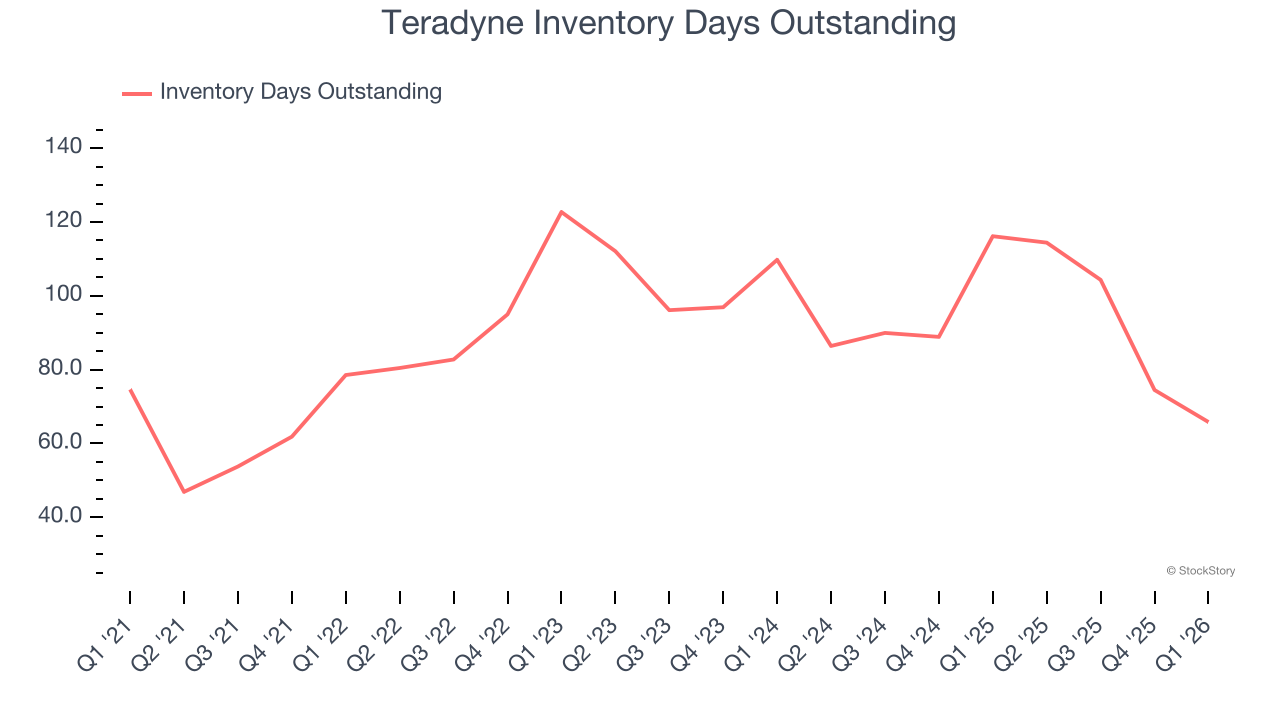
- Inventory Days Outstanding: 66, down from 74 in the previous quarter
- Market Capitalization: $62.94 billion
"Our Q1 results reached a new record high. With approximately 70% of our revenue tied to AI-related demand, our results reflect the strength of our wafer to AI data center strategy. All of our business groups - Semiconductor Test, Product Test, and Robotics - delivered strong year-over-year growth which we expect to continue with robust AI driven momentum as the catalyst,” said Teradyne CEO Greg Smith.
Company Overview
Sporting most major chip manufacturers as its customers, Teradyne (NASDAQ: TER) is a US-based supplier of automated test equipment for semiconductors as well as other technologies and devices.
Revenue Growth
A company’s long-term sales performance can indicate its overall quality. Any business can have short-term success, but a top-tier one grows for years. Unfortunately, Teradyne’s 3.4% annualized revenue growth over the last five years was mediocre. This was below our standard for the semiconductor sector and is a rough starting point for our analysis. Semiconductors are a cyclical industry, and long-term investors should be prepared for periods of high growth followed by periods of revenue contractions.
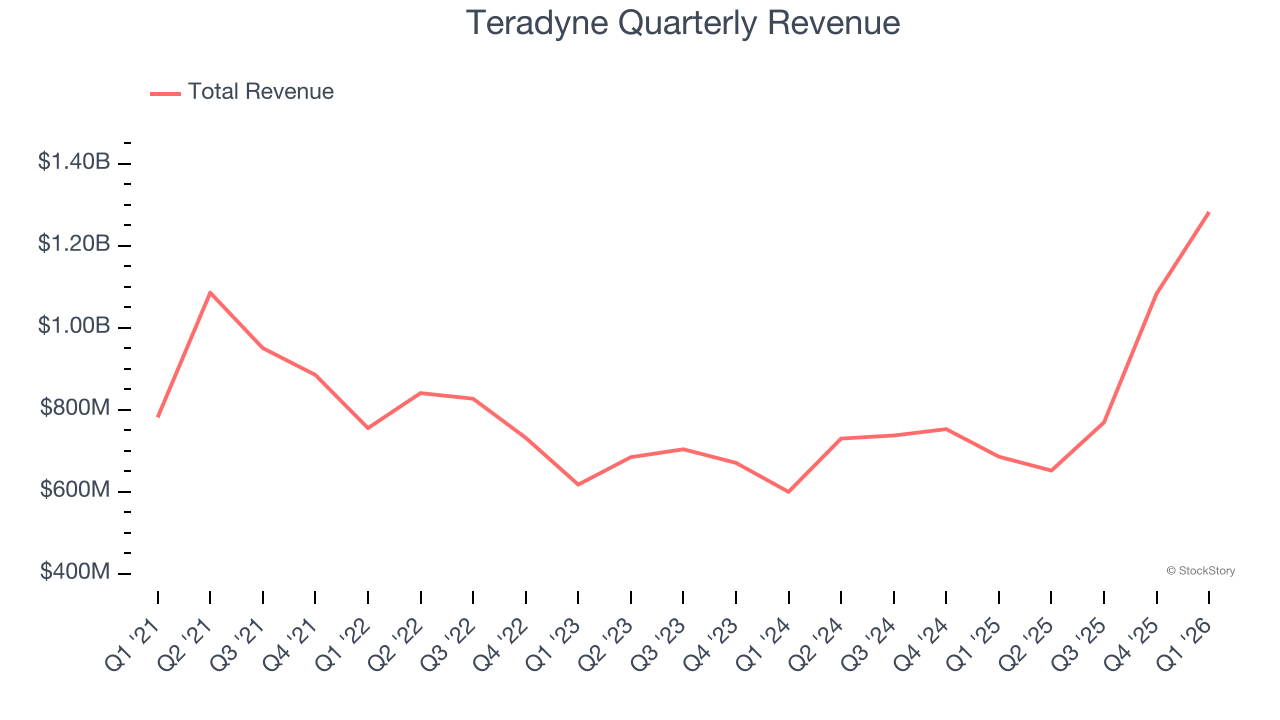
We at StockStory place the most emphasis on long-term growth, but within semiconductors, a half-decade historical view may miss new demand cycles or industry trends like AI. Teradyne’s annualized revenue growth of 19.3% over the last two years is above its five-year trend, suggesting its demand recently accelerated. 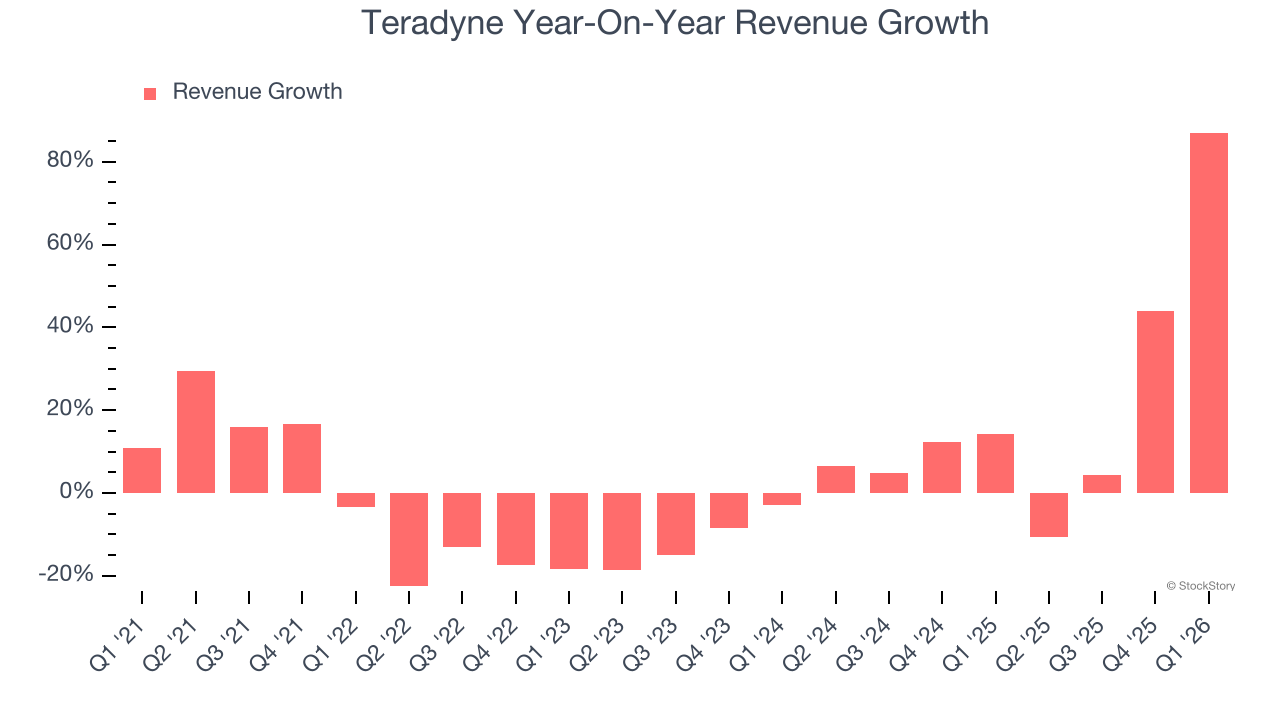
This quarter, Teradyne reported magnificent year-on-year revenue growth of 87%, and its $1.28 billion of revenue beat Wall Street’s estimates by 5.6%. Beyond the beat, we believe the company is still in the early days of an upcycle as this was the third consecutive quarter of growth - a typical upcycle tends to last 8-10 quarters. Company management is currently guiding for a 84.1% year-on-year increase in sales next quarter.
Looking further ahead, sell-side analysts expect revenue to grow 11.5% over the next 12 months, a deceleration versus the last two years. This projection is underwhelming and suggests its products and services will face some demand challenges.
WHILE YOU’RE HERE: The Next Palantir? One satellite company captures images of every point on Earth. Every single day. The Pentagon wants it. Hedge funds are using it to beat earnings. You’ve probably never heard of it.
This is what the early days of Palantir looked like before it became a $437 billion giant. Same playbook. Different technology. If you missed Palantir, you need to see this. Claim The Stock Ticker for Free HERE.
Product Demand & Outstanding Inventory
Days Inventory Outstanding (DIO) is an important metric for chipmakers, as it reflects a business’ capital intensity and the cyclical nature of semiconductor supply and demand. In a tight supply environment, inventories tend to be stable, allowing chipmakers to exert pricing power. Steadily increasing DIO can be a warning sign that demand is weak, and if inventories continue to rise, the company may have to downsize production.
This quarter, Teradyne’s DIO came in at 66, which is 23 days below its five-year average. At the moment, these numbers show no indication of an excessive inventory buildup.
Key Takeaways from Teradyne’s Q1 Results
We were impressed by Teradyne’s strong improvement in inventory levels. We were also glad its EPS outperformed Wall Street’s estimates. Zooming out, we think this was a solid print. Shares traded down 8.5% to $347.20 immediately after reporting, though, perhaps a reflection of follow-through on today's news that OpenAI missed internal targets for revenue and new uses. Teradyne mentioned in its release that "approximately 70% of our revenue tied to AI-related demand, our results reflect the strength of our wafer to AI data center strategy", showing how levered the company is to this trend.
Big picture, is Teradyne a buy here and now? If you’re making that decision, you should consider the bigger picture of valuation, business qualities, as well as the latest earnings. We cover that in our actionable full research report which you can read here (it’s free).